On the afternoon of Thursday, January 20, a cold, gray winter rain was changing to snow. I crossed the James River via the Huguenot Bridge headed toward the Woody Funeral Home in Chesterfield County. Seemed like the snow was falling harder south of the James.
Faye Bokkon, an outstanding Social Studies teacher, that I had worked with at Hermitage High School had lost her husband, Billy. A visitation for family and friends was taking place this afternoon. My schedule would not allow me to attend Billy’s funeral on Friday.
Billy was a good man. He was our insurance agent. He held our lives in paper policies.
Billy reminded me of my father who also sold insurance. They shared a common trait—honesty.
In our interactions with Billy, my wife and I found him to be honest, always thinking, always looking ahead, and we trusted his experience, his wisdom.
For the last few years, Billy’s health had been declining. On January 10, his body granted him the peace that he deserved.
At the visitation, I was able to speak with Faye for a few minutes. She was emotional. This was a tough loss. Her moist eyes and shaky voice affirmed her sadness.
But, I believe in Faye. She is a survivor. People like Faye, who dedicate their lives to classrooms with high school students packed in it, know how to work through life’s challenging moments.
Billy’s obituary cited his passions—family, the University of Virginia, and the village of Midlothian.
Billy was an avid sport fans. His love for the teams at the University of Virginia was unsurpassed.
Through a family connection Billy and Faye attended lots of football and basketball games, and the annual ACC mens basketball tournament.
When they attended the ACC tournament, I would ask Faye to pick up a copy of the tournament’s program for our son, Andrew. Andrew loved going through that packed magazine full of league history and lots of statistics.
Thanks to my brainwashing, Andrew and I cheered for the ACC team that wore the darker shade of blue. Billy knew this, and a couple of times he gave us his game tickets to watch Duke and Virginia play in Charlottesville. Andrew loved it.
In 2004, Faye and Billy attended the ACC tournament in Greensboro. Billy told me he would call if Virginia lost in the quarterfinals. A loss would mean there would be some extra tickets around from friends.
I think it was after midnight when he called saying he had two tickets for us to attend the semifinals and the finals.
Early on Saturday morning, Andrew and I drove to Greensboro. We met Billy in the lobby of the hotel, paid for the tickets, and worked our way to the Greensboro Coliseum. The seats were spectacular. We had a blast. Duke won their game, and they would be facing Maryland on Sunday in the finals.
The ride back to Richmond after the game on Sunday was long and painful—Duke lost to Maryland. But, in truth, there was a win in this. Thanks to Billy and Faye, we attended the best college basketball tournament in America.
A lot has changed in the world of college basketball in the eighteen years since we attended the tournament.
In 2019, Virginia won the mens college basketball championship. Their coach, Tony Bennett, is a class act. Virginia deserved to win the tournament that year. They were truly a united team, and the players never backed down in games when the outcome looked bleak.
I’m sure Billy enjoyed every minute of that championship season.
And I’m certain on Monday, February 7, 2022 from the comfort of courtside seats in heaven, Billy loved Virginia’s upset of seventh ranked Duke at Cameron Indoor Stadium.
Duke’s bluechip, one and done recruits were outplayed by a Virginia team who performed with a committed toughness and heart.
When I think about Billy, I keep coming back to his heart.
He had a heart for people.
Everything he did in life linked his good, kind, and generous heart to people.
I know our son, Andrew, will never forget Billy’s generous heart.
On that cold, snowy January afternoon, I will never forget Billy’s coffin draped in our American flag for his four years of service in the United States Air Force during the Vietnam War.
Nor will I forget the family and friends who filled the parlor space to pay their respects to Billy, Faye, and their daughter, Allison, and her family.
It was an opportunity for our hearts to give back to Billy for all that he meant to us.
Billy, up in the wild blue yonder, I know you are still smiling from that win over Duke.
Right now somewhere close by, or far, far away a person is crying.
Soft tears are rolling down a cheek. Hard tears are heaving up a chest. This is no fun.
No matter the type of tears, they are courtesy of a common human ailment—a broken heart.
I remember my first one—Alice Buffalo. I met her at a week long Methodist youth fellowship retreat at North Carolina Wesleyan College in Rocky Mount.
This relationship had no chance. Alice was from Rocky Mount. I lived in Burlington. But, we must have thought anything was possible because I remember writing letters. Of course, there were some faint hearted plans for Alice to come to Burlington for a weekend, but that never happened.
My father knew something about broken hearts. At some point during his World War II service in the Navy, his first marriage ended. Apparently, while he was away, my sweet, kindhearted father was dumped for an officer. I never talked with him about his broken heart. I sense my mother, his second wife, must have helped his heart to heal.
I don’t think we can be immune from a broken heart. To my knowledge scientists haven’t created a vaccine.
Poets, authors, screenwriters, and songwriters have written quite a bit about broken hearts.
Since November, I’ve been keeping track of friends whose hearts have been broken.
I think the worst type of broken heart is the blindside.
Ending a relationship by blindsiding the unsuspecting receiver is cruel.
With this news, the receiver’s heart and mind accelerate into a mad chaos.
The tears are horrid. Chest convulsions are like seismic shifts. Gasping lungs want to breathe. The heart is thrust into overdrive with an out of control propulsion of beats.
The blindside isn’t pretty. It deeply wounds a heart.
As a father, I know this blindsided heart.
We have a dear friend who survived a challenging divorce. I think our friend is a gentleman. No matter the difficulties created from the divorce, he has put his heart into maintaining his relationships with his daughters.
Despite his efforts, one daughter didn’t see it that way. She would not allow him to attend her wedding and give her away. Our friend’s heart is crushed. Mentally, he keeps questioning his heart, racking his brain asking himself over and over again—what did I do wrong?
There is never a good time for a broken heart, but Christmas is a bad choice.
Another friend was on his way to spend Christmas Day with his grown children, a former wife, and the wife’s family. Yes, I’m sure there would have been some awkward moments, but our friend’s children were really looking forward to seeing him.
As our friend was driving to this gathering, he received a phone call from his very distraught daughter. She was calling to tell him that he had been uninvited to this Christmas Day event. That phone call broke the heart of our friend and his two children.
Shortly after the start of the New Year, I received a call from a former elderly neighbor. I was hesitant to take the call, but my brainless heart talked me into it.
For a variety of reasons, our former neighbor is basically estranged from his children. That was the purpose of his call to complain about his children and everything related to his current living arrangements.
All I could do was listen. His mind, his stubborn heart would not budge on his assessment and opinions. Nothing I could say would persuade him that his brokenhearted children would be willing to talk with his unbending heart.
Warren Zevon was a very gifted songwriter, musician, and singer. You might remember his songs “Werewolves of London” and “Excitable Boy.” Additionally, Mr. Zevon’s songs were recorded by other singers most notably—Linda Ronstadt.
Sadly, Mr. Zevon died in 2003 from cancer. When diagnosed with cancer, he committed to recording a new album titled The Wind. The last song on the album “Keep Me In Your Heart” is a pretty, but sad tune about the end Mr. Zevon is facing.
He ask listeners to “keep me in your heart for a while.”
Amazon’s Alexa sits on the marble top of an old piece of furniture in our kitchen. If I were to shout out, “Alexa how do you repair a broken heart,” I wonder how she might respond?
Sometimes, I catch myself in a daydream going back to life’s bad moments when I know my words, my actions— hurt hearts. If I could only reclaim, retract that meanness.
Doesn’t matter whose heart has been broken, what that person needs to know from me and you comes from Mr. Zevon—“keep me in your heart for a while.”
Maybe that’s how broken hearts are repaired.
We keep those loved ones, those friends in our heart for a while, or for as long as they need us.
Graphic design created by a gifted artist, Elizabeth Loring Pike
In truth, I was dreading Wednesday, December 29, 2021. That was the day I would be driving my mother-in-law back to West Hartford, Connecticut. The dread wasn’t my mother-in-law. On this drive that I have made many times with her, she is a good co-pilot. The dread is the drive.
If you are lucky, the drive from Richmond to West Hartford is in the eight hour range. Of course, if you are unlucky, that ride becomes even more challenging.
Despite me botching up getting around/through our nation’s capital, we had a pretty good ride. Yes, we hit some pockets where we slowed down, and at times we questioned the sanity of our fellow drivers, but we made it.
When we arrived at Liz’s retirement community, we learned that the COVID-19 variant, Omicron, had temporarily closed the dining room. That meant after unloading the car, we would be going out for dinner.
Fortunately, West Hartford has many good restaurants. This evening, we would ride over to Effie’s Family Place. I’ve never had a bad meal at Effie’s, and tonight was no different— especially the warmed piece of blueberry pie with vanilla ice cream.
Best co-pilot and mother-in-law at Effie’s in West Hartford photo Bill Pike
After we returned from dinner, I organized my junk for an early morning departure. Liz prepped me a snack bag, and gave me a few pointers for breakfast.
Thursday morning, December 30 came quick. A little after six, I was walking with my stuff to the car.
I put my stuff in the back and transitioned to the driver’s seat. I put my foot on the brake pedal, touched the ignition button, and the car would not start. Very bad words spewed into the cold dark, dampness.
Grabbed my wallet, found my AAA card, and placed a call.
Within about twenty minutes, a nice young man arrived. I gave him some background, and let him know the battery was only six months old.
He saw no problems with the battery, and he hooked the car up for a jump. On his signal, I poked the ignition switch and the car started.
I thanked him, and I followed his instructions to let the car keep running.
In about 15 minutes, I decided to drive toward the interstate. I wasn’t going back down that east coast corridor of madness. This morning, I would take I-84 west to connect with I-81 south. Though this route is a tad bit longer, it seems less stressful.
It is a damp morning. No winter weather is in the forecast for the ride into New York and Pennsylvania. But, a collision of warm and cold air currents could create some pockets of fog.
Soon Connecticut is behind me. I crossed the Hudson River, and I’m clipping along not too far from the Pennsylvania line. Then I receive a message from my bladder—it needs some relief.
I pullover at the Wallkill rest stop. The state of New York is renovating the restrooms, so I’ll be using a port-a-john.
I make my bladder happy, get back in the car, foot on the brake pedal, push the ignition, and the car won’t start. Try again, no luck, no bad language, too angry.
A couple spaces down is a gentlemen in a pickup truck. I politely ask if he has jumper cables—sorry no is his reply.
Now, I’m back on the phone with AAA. They are trying to figure my location. Of course, I’m too much of a numbskull to walk back and see the sign for Wallkill.
Wallkill rest stop Photo Bill Pike
Finally, the dispatcher figures it out, and assigns a tow company to assist me.
I keep getting arrival time estimates, and then I receive a call from the tow company. I go through the whole location piece again, and I mention the port-a-johns out front. The driver says, “I know exactly where you are, but that’s not our territory.”
So, I’m calling AAA back explaining this new challenge. This dispatcher goes through the script again, and after several minutes he locates the correct rest stop.
The wait isn’t going to be horrible. Luckily, it is chilly, but not frigid temperatures.
I wait. I keep an eye on my phone for updates. Looking around the car, I realize I left the snack bag back in West Hartford.
I have the hood open on the car to help the AAA driver.
Patiently awaiting help Photo Bill Pike
An older model suburban pulls down several spaces from me.
A burly young man, with a massive beard, and a hoodie pulled tight over him gets my attention.
I open the door slightly, and he begins to tell me how he had trouble starting his car this morning too.
I’m not sure what he is holding in his hand with dangling wires. But, he tells me he used this contraption to start his car earlier today.
I give him permission to try, and I also tell him I don’t want you to get hurt. He assures me he will not.
So, he makes some connections to the battery. Once he is ready, he tells me to try to start the car. I do, nothing happens.
All I can imagine is this guy is going to end up frying himself like an inmate in The Green Mile, or he will be zapped while turning all shades of blue, white, and silver like a ghost in Ghostbusters.
He rattles his connection again, and I think one of his hands gets a little jolt. That’s when I tell him thanks, but I don’t want you to be hurt. He agrees and regroups to restart his drive back to Kentucky.
More long minutes pass, and then I receive a call. It is the tow truck driver. Now, I know the name of the rest stop, and I tell him Wallkill. He is only minutes away.
When he arrives, I am immediately relieved. This guy reminds me of Bill Murray.
I expect him to start talking to me like Carl Spackler, the greenskeeper in Caddyshack. I imagine Bill Murray’s next movie—The Tow Truck Guy.
But none of that happens, I explain the problem. He jump starts the car, but he advises me don’t turn the engine off when I make a stop.
He drives off. I work my way back on to I-84.
Back on the interstate, the car does some goofy things. Dashboard lights flash on/off. There is an unexplained jolt. So, I’m thinking as I cross the Pennsylvania line—something isn’t right. Instead of pushing ahead, I’m going to leave I-84 at Milford, Pennsylvania.
I stop at an Exxon for gas. As I’m pulling into a pump, the car feels like its lost the power steering. I leave the car running, I fill it up, and then park it out of the way.
I walk in to speak with the attendant. Turns out she is a pleasant young lady.
As I explain my dilemma, I’m looking at her carefully, and I see a face with a makeup covered black eye. I’m sure she tried her best to make the makeup work, but it didn’t.
My heart hurt for her as she guided me to Kost Tire and Auto Service. She told me Milford only has one stoplight, and I was to turn left at the light. It was a short drive to Kost after the turn. I thanked her and returned to my still running car.
I found Kost Tire and Auto. I parked and entered the service desk reception area.
A young man greeted me, and he patiently listened to my story. He told me to give him a few minutes. Today, Kost was busy.
I found a seat and waited.
After about a half hour, he asked me for the keys.
More wait time, and then, I was called back to the counter.
My non-mechanic brain had reasoned out that it couldn’t be the battery as the battery had been put in new in June. I was expecting to be told the car needed a new alternator. If it was an alternator, I’d been surprised if they had one in town. So, I’m preparing mentally to spend the night in Milford.
In talking with the service technician and the mechanic, I learned the computer’s electrical assessment of the car’s systems said I needed a new battery—the battery had a bad cell. Their analysis deduced the car had been running off of the alternator—too much car talk for my uneducated brain.
A new battery was installed. The mechanic wrapped the uncooperative battery in plastic for the ride back to Richmond. That way I could return it to my local mechanic.
And just to confirm that it is a small world, the mechanic has a daughter who lives in Mechanicsville, in Hanover County, Virginia. That is a twenty minute drive from our house in Henrico County.
I thanked them for letting me interrupt their day.
At some point after two, I was driving back through Milford toward I-84. And just so you know, Milford is a pretty little town, a town worth a stop for exploring.
With new confidence, I made the drive to Scranton, connected to I-81, and headed south.
The further south I drove into the mountains of Pennsylvania, another nemesis arrived—fog.
During the morning, that collision of air had not burned off. At times, the fog was so thick I could not make out the brake lights that were supposed to be in front of me. These conditions lingered for many, many miles, and of course, I reduced my speed for safety.
I don’t remember where, but gradually the fog dissipated. I was looking forward to crossing into Maryland followed quickly by West Virginia, and then Virginia. When I reached Virginia, I really wanted to exit the interstate and travel the backroads, but I opted to stay with the interstate.
Somehow during the drive, I stayed awake, and somehow much to my relief, I made it to our house before ten p.m. The normal eight hour drive had been stretched to sixteen. I would not wish that tension filled drive on my worst enemy.
But, I am thankful for one thing. I’m glad I was the driver, not my loving wife, the Commander Supreme.
When our kids attended Trinity preschool at our church, I loved attending programs and hearing the enthusiastic harmony of the voices of children singing out these words—“All night, all day, angels watching over me my Lord.”
I think Thursday, December 30 was an “angels watching over me” day.
Every person who rendered me assistance was patient, kind, an angel.
As I recall their faces, I will never forget the young lady at the service station with the makeup covered black eye.
I hope in her future that angels will be watching over her.
On Wednesday, December 15, we were going to hike up to Peacock Flats, a part of the Mokuleia Forest Reserve. For this hike, we followed an asphalt service road.
The beginning is a tease, straight and flat. But soon, your legs start to feel the rise in the grades with an ample supply of curves to keep you honest. There is an advantage to the upward push. As we climb, the views back to the coastline improve.
Both sides of the road are thick with greenery and splotches of color. Bike riders strain as they creep up the hills, but they come screaming down those same hills on the return loop.
Out on the trail Photo Bill Pike
Occasionally, we hear birds. In one section, a bird sounds like he/she is cackling in laughter at us as we trudge up another hill.
We do take some stops and look back at the blue sky with puffy clouds hanging above the Pacific. Once again, not a bad view.
A view looking back from the trail Photo Bill Pike
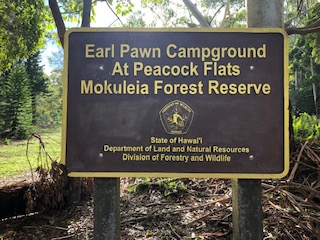
Then we recommit to keep pushing upward, and we do reach the Earl Pawn Campground at Peacock Flats.
Peacock Flats photo Bill Pike
The campground has a nice grass meadow surrounded by a variety of tall trees. Up here the asphalt trail disappears.
After a bit of exploring, we decide to start the walk back down.
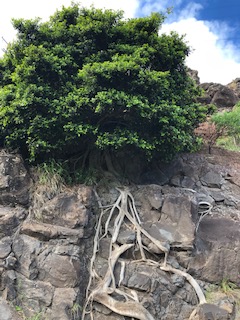
At one point, I take note of a shrub growing above a rock line with its exposed roots coming down the face of the rocks below. Somehow, this good sized shrub has figured out how to survive.
Roots of survival Photo Bill Pike
In the flatland of the valley we can see the runways for the Dillingham Airfield. I ask Art about gliders out here and almost instantly he notes a tow plane pulling a glider up into the sky.
I still have a kid’s fascination with airplanes. As we continue to watch the sky we received an unexpected treat.
In that clear blue, a glider that had been towed up and released earlier came gliding over us. Now that plane was hundreds of feet up in the sky. Yet, the quietness of our location allowed us to hear the wind wisping over its wings. Art commented—“For a glider pilot that is truly touching the face of God.”
Somewhere down below us is that flapjack flat surface where we started. Eventually we get there and follow this straight shot back to the car.
Art thought it would be a good idea to head into town to the food truck CrispyGrindz for an acai bowl.
In Haleiwa, there is a section in town where either side of the main road has two large parcels of land dedicated to food trucks. The acai bowl was as promised—delicious.
Thursday, December 16, 2021
This morning, Art drove us back in Honolulu. Our first stop is the Bishop Museum.
If in Honolulu, you must visit this museum. Even if you have a short window of time, you must make this stop.
Entrance Bishop Museum Photo Bill Pike
Yes, the meticulous displays seem endless. But, endless is to be expected for a museum that started in 1889. And the curators use these displays to tell the story of the people of Hawaii. Those stories are told with documents, photographs, and artifacts. Every aspect of life is captured.
Also, the museum incorporates the culture and history of other Pacific island cultures.
Beyond these traditional museum showcases, leaders at the Bishop bring in special exhibitions. On our visit, we took in Tatau: Marks of Polynesia. Also, the complex includes a state of the art planetarium that offers a variety of programming.
Again, if I’m lucky enough to return to Hawaii someday, I would like to spend more time exploring the Bishop Museum.
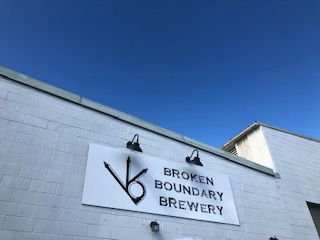
From the Bishop, we found our way to the Broken Boundary Brewery. This craft brewery also opened at the beginning of the pandemic, and somehow they have survived.
Simple signage at Broken Boundary Photo Bill Pike
The location for Broken Boundary is in a warehouse/industrial section of the city. But, the owners have taken this large interior space and given it a practical layout.
The brewery is in full view so visitors can watch as brewers attend to the various stages of brewing.
My bacon jam smash burger was delicious, and I enjoyed my Red Irish Ale named Ginger Ginger. Once back at the house, we regrouped and headed to the beach.
At some point, we took a nice leisurely walk heading west toward what Abby with great affection calls Parker’s beach. Just a few blocks away by car, Abby and Art’s son, Parker and his new bride reside in a condo.
On that walk, in the clear shallows next to the shoreline, we observe sea turtles. From time to time, the turtles will poke up their heads gulp some air and look around a bit.
I hope we can continue to protect these turtles and the environment they need to survive.
Friday, December 17, 2021
I knew this day would arrive, but I tried not to think about it.
Early that morning, we took the short drive over to the Haleiwa Harbor.
Haleiwa Harbor photo Bill Pike
That is where Art and Parker keep their boat. No fishing this morning, just a short cruise offshore. This is a good way to take a look at the land and the shoreline from a different angle.
The morning was postcard pretty. From the dock, we step on board as Art prepared the boat for departure. Other boats are in motion too, some going out, some heading in.
With a bright sun glistening off the Pacific, our views in every direction are pleasing. In fact, just about all of our views since November 30 are sure to stay with us for a long, long time. I’m not looking forward to the ride to the airport late this afternoon.
Just offshore Photo Bill Pike
While out on the boat, we have an unexpected treat. A few flying fish break the surface of the unsteady ocean and quickly skim by us. And then, just as quick, a singular spinner dolphin leaps and teases with its spin before disappearing again in the deep water.
Back in the harbor, Art tidy ups the boat, and Abby drives Betsy and I to Longs Drugs. Longs has a great selection of gifts for family and friends back home.
After Longs, we pick up Art, and head back to the house for the least favorite chore—packing up.
Amazingly, the packing goes well, so we head to the beach.
Later in the afternoon, we drive into Haleiwa for some food at Uncle Bo’s. I ordered Uncle Bo’s Kalua Pig Fried Rice with spinach. The dish was filling and tasty, just what I needed for the long redeye flight from Honolulu to Dallas/Ft. Worth.
We drove back to the house to make one more sweep for any potential stowaways who didn’t want to leave.
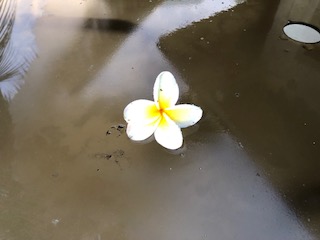
As we walked our luggage down the front steps, I took one last look at the pretty blooms of the plumeria tree. No blooms will greet us back in Richmond, and that’s ok. After all, the season of winter begins in four days on December 21.
With the bags loaded, we piled in the car, and Art started the drive back into Honolulu.
Goodbye Waialua, the Commander Supreme and I hope to return someday.
On the morning of Tuesday, December 14, our pace was a bit quicker. Abby had us booked at the Iolani Palace (the King’s Palace) for a tour.
We had to arrive at the Palace prior to our tour time in order to clear the COVID-19 protocols. The drive into Honolulu was uneventful. Parking around the Palace was a little tricky, but Art found a good spot just outside the entry gates.
Immediately, my eyes catch the building and the grounds. This is a special place.
Entering the grounds to the Iolani Palace photo by Bill Pike
We have no hiccups with the required health protocols at the check-in point. From there, we take the short walk to the entry area for the tour. Soon, we are given instructions based upon our time slot, and we are directed to chairs on a porch.
Within a few minutes, we are greeted and welcomed. All guests are provided slip coverings for their shoes, and we receive very specific instructions on how to use the hand held device that will provide the narration of the tour.
With that orientation, we enter the Palace. Clearly, the Palace is stunning in all directions. The historical information at each point on the tour is presented with clarity and detail. Guests learn not only about the building, but we learn about the leaders and their families.
No question, there is lots of history in terms of the development of the governing of the people of Hawaii, the construction of the palace with a focus on innovation, and Hawaii’s place in the world.
And then, there is America. Yes, America liked what it saw in Hawaii. And when America likes what it sees, sometimes there is a sad story. In this case, the Hawaiian monarchy was overthrown in 1893.
Since that turmoil, someone recognized the importance of this building. The Palace, its grounds have been nicely preserved. Additionally, the lower level of the building has a beautiful section of displays that continue to tell the Hawaiian story.
Gradually, we worked our way back to the car, and with an assist from technology, Art drove us to the Stewbum and Stonewall Brewing Company.
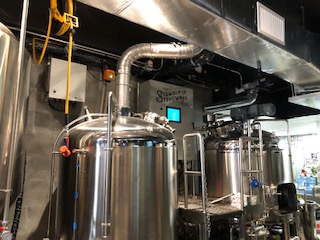
Located on the fringes of Honolulu’s Chinatown, this craft brewer has only been open for a couple of years. In fact, our waitress told us the brewery opened just as the pandemic hit. No new business owner wants to open in dire times, but Stewbum and Stonewall did.
Basically, the owners took a dilapidated store front, gutted the interior, installed a small brewing house, added a kitchen, created a tasty menu, and yes, they are more than competent in brewing beer. Their holiday beer named Low Elf Esteem was outstanding.
Part of the brewing system at Stewbum and Stonewall photo by Bill Pike
I do not visit craft breweries to become intoxicated. I go to see the uniqueness of their building, to learn the path of their story, to try one beer, and to support a local business.
It is a short walk back to the car. There we will regroup and find our way to the National Memorial Cemetery Of The Pacific, also known as the Punchbowl.
If you make the trip to Hawaii, I believe you should go to Pearl Harbor. If you go to Pearl Harbor, I insist that you go to the National Memorial Cemetery Of The Pacific.
Each place is unique. Each place will make you think. But, the location of the Punchbowl is priceless.
To get to the cemetery, you will drive through a residential neighborhood. A very nice visitor’s center preps guests for the short drive into the grounds. And it is the dignity of the grounds, the burial sites, and the historical displays that will catch your eyes.
A long, long time ago, a conflicted earth full of chaos and collisions formed this crater. Hot lava and the Koolau Mountain Range were a part of this creation. The Punchbowl was the site for a variety of uses before Congress and Hawaii agreed on securing the land and appropriating funding for construction that started in 1948.
We parked and walked.
The views are appealing.
From the crest of the hill in one direction, I see the Honolulu skyline and the Pacific.
Honolulu skyline Photo by Bill Pike
In another direction, I can peer down into green tree tops with a backdrop of homes and hills in the distance.
Personally, the Punchbowl is of interest to me for another reason. In the beautiful mosaic maps, the story of the war in the Pacific is carefully captured.
One of those maps shows the Coral Sea. On that map is the location of where the Navy destroyer the USS Simms went down after being attacked by Japanese planes. The Simms had been providing escort for the oiler, Neosho. My father’s oldest brother, Boyd, was on the Simms. Boyd died in that attack.
One of the mosaic maps Photo by Bill Pike
The focus at the Punchbowl is not reserved only for World War II. Both the Korean and Vietnam wars are a part of the displays and honoring the lives of the men and women lost in service to our country.
Perhaps the most stunning part of the grounds is the Courts of the Missing. The eight panels of names are overseen by a thirty foot statue of Lady Columbia, and tucked behind her is a beautiful chapel.
Lady Columbia photo by Bill Pike
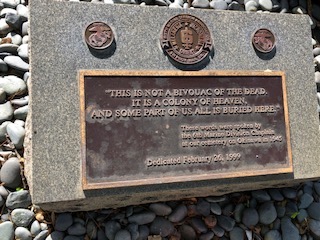
But, I also found the memorial walk to be moving. On either side of this path are ground ridden pieces of cut granite with bronze plaques attached to the top of the stone. These plaques contain a wide range of quotes and other information in tribute to the men and women that the Punchbowl honors.
One of the markers along the memorial path Photo by Bill Pike
If I’m lucky enough to return to Hawaii again, I hope to make another visit to the Punchbowl.
The word for punchbowl in the Hawaiian language is puowaina— which means “hill of sacrifice.”
Without question, this cemetery captures the loss of human life— the unwavering sacrifice that was in each of these lives.
Makes me wonder, why have we lost our ability to understand sacrifice for the good of all in our divided America?
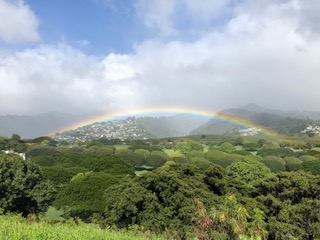
Maybe, we need to peer more deeply into the natural beauty and goodness of the rainbow that appeared during our visit to the Punchbowl.
Perhaps, I have forgotten the symbolism of hope found in a rainbow.
My hunch is the souls remembered at the Punchbowl never gave up on hope.
If this is true, then the question for me becomes— why should I?
I can’t give up on hope.
Because giving up on hope means I’m unwilling to work to find a middle ground in the divide that separates us.
Late on the afternoon of Saturday, December 11, Art and I drove Elizabeth into Honolulu. She was taking a redeye back to Raleigh.
As we made our way out of Waialua, the sun was starting to set behind us. By the time we transitioned to the interstate, we started to see more signs of Christmas lighting along the way.
I suspect Art could make this drive blindfolded to the Daniel K. Inouye International Airport. However, unless it is the dead of night, navigating into the departing and arrival terminals is always tricky.
We make it to the curbside for American Airlines. There is a scramble to help with the luggage, and one final inspection to make sure Elizabeth has the essentials for clearing the check-in and COVID protocol requirements. With hugs of thanks and love, she is off into that human airport chaos.
On the ride back to sleepy Waialua, Art and I solve all the world’s problems. At the very least, we had lots of recommendations.
Sunday, December 12 was quiet.
We took a brief neighborhood walk.
Then about mid-morning, we made the short drive to the Sugar Mill Shops.
At one time, harvesting sugar cane was part of the Hawaiian agriculture economy. These shops are framed into the remnant buildings from the Sugar Mill. A coffee maker, soap maker, surf shop, and in the main building a shop like a general store that is a good place to make purchases for the folks back home.
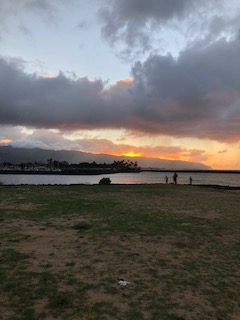
Of course, we had some beach time, and later in the afternoon we drove to the Beach House restaurant in Haleiwa for drinks and hors d’oeuvres. The Beach House sits across the street from Alii Beach giving guests good sight lines for Hawaiian sunsets.
Sunset from Alii Beach photo Bill Pike
Early on the morning of December 13, I went for a run on the bike path. This path is going to spoil me. First, it’s flat, no hills. Second, I’m running in a t-shirt and shorts.
When we return to Richmond, I’m fairly certain for my neighborhood runs, I will not be in a t-shirt and shorts. Those just about perfect Hawaiian mornings will be canceled out by cold north winds and a layer of frost.
After the run, Art was setting up a couple of surf rods on the beach.
At different times over the last couple of days, I had been casting a lure into the pretty Pacific water. But, I had no luck. In fact one day I had been unlucky. I lost one of Parker’s lures after getting hung up on a rock or an immoveable piece of coral.
This morning, Art set up two rods with pieces of octopus for bait. This set up was to be a new experience for me. Clipped to each rod was a small stainless steel bell.
Shaped like a cowbell, the intent here is that the bell will ring when a fish is on the line. This set up allows the fisherman to relax on shore waiting for a jingling bell to sound.
Two hopeful fishermen, note bell on rod behind my left shoulder Photo Betsy Pike
The octopus is a tough textured bait. No crab or fish is going to easily pull the octopus off of the hook. Art perfectly cast both lines well out into the surf. He set the rods into two sand spikes, and like all good fishermen we impatiently waited.
Once, we were teased. A gust of wind caused one of the bells to jingle. Just in case, Art reeled in the line and checked the bait—it was still snug on the hook. He recast the line, and though we were hopeful, neither bell jingled anymore that morning.
With those two baited lines still out in the calm surf, I continued to cast a lure.
Once as I reeled the lure into shore, I sliced through a school of small minnows. The quick moving lure must have startled them because their frightened leaps broke the surface of the water and they sparkled in the morning sunlight.
Later, a bigger, more curious minnow followed the lure into the clear shallows near the shoreline.
Who knows maybe someday, I’ll return to this beach front, and that same minnow will be here.
That now full size fish might look to the shoreline, and think—“I’ll be darned, it’s that old geezer from Virginia again. I think I’ll do a couple of big jumps and flips just to get his heart rate up.”
And that fish is right. My old eyes will catch the jumps and flips. I will silently chuckle at this teasing acrobatic show, a performance I’ve seen before on Cape Cod, the Eastern Shore of Virginia, the Outer Banks, Sanibel, and the Eastern Sierras.
But, it is a show my heart adores because in that spectacle is hope.
I hope to catch a fish. The fish hopes not to be caught.
And maybe, that is what the fish and I have learned about hope.
Hope gives us the capacity to hold on a little longer and endure.
And perhaps, that is why heavenly angels quietly construct rainbows—to give us hope and endurance.
Lord knows— we need it.
One of the many rainbows we saw during our visit. Photo Bill Pike
On Saturday, December 11, I was excited. We were going to take a hike out to Kaena Point. My enthusiasm was grounded in the possibility of seeing a magnificent bird—the albatross.
A long time ago, when I was the Title VII Remedial Reading teacher at Martinsville Jr. High School, the reading program our students worked with contained a short nonfiction piece about the albatross. For some reason, I have never forgotten the description of this graceful bird. Now with a little luck I might actually see one.
Abby, Art, Elizabeth, Betsy, and I piled into the car with water, hats, and sunscreen. It is a pretty ride out to entrance of Kaena Point.
Art parked the car. We organized ourselves, and at the start of the trail head, we were met by the friendly park ranger. She and a crew of volunteers were doing some grounds work just off the trail.
The park ranger asked where we were from, and she gave us a quick update about the trail and the albatross nesting area. She knew her facts and current data about the birds in the protected grounds. We could tell that she was committed to doing everything within her scope of power to help the future of the albatross.
So with her comments sinking into our brains, we started our first steps.
Now, before we get too far out on this trail, I have a confession to make. I probably have shared this in a previous post somewhere, but you need to know this sad fact—I have hiked more in other states than I have in my state of birth North Carolina, and my state of residency, Virginia. If I live long enough, and this old body holds up, I hope to improve that discrepancy.
We were not far into this hike when I realized no matter where I looked the landscape was dazzling. The views, the vistas kept coming at me. They were nonstop.
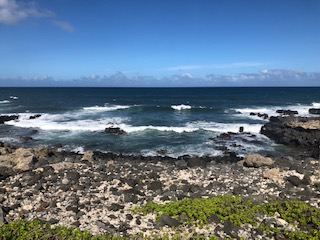
To the right was the shoreline with the Pacific in full engagement.
Ocean view Kaena Point Trail photo Bill Pike
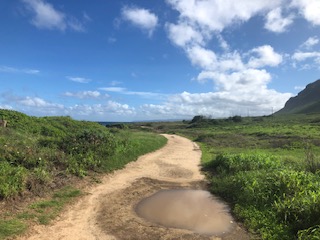
In front of me was a terrain with assorted earthly hues and vegetation. The trail was flat, up, down, with some twists, and complete with puddley, muddy remains from the big rain.
Part of the Kaena Point Trail photo Bill Pike
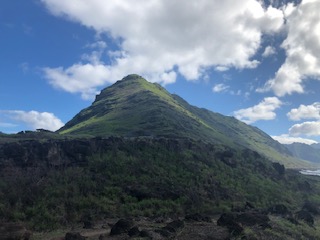
To my left were the hills majestic in their rise, yet solemnly silent as they peered down on us.
Quiet hills on the Kaena Trail photo Bill Pike
The trail has no tree canopy. We are in the open with unobstructed views in all directions.
It is a challenge to eye your steps while watching the Pacific roll a crest of waves into a rocky crag.
By contrast, at times, we peer down into restful tidal basins.
Tranquil tidal basin Kaena Point Trail Photo Bill Pike
At certain points, we see people on the beachfront, and a few times, a singular fisherman will appear casting his rig into the roiling sea.
Art keeps us moving. We chatter in intervals. The topics vary. Sometimes we straggle away from the group to snap a photograph. This means a quicker pace is needed to catch up.
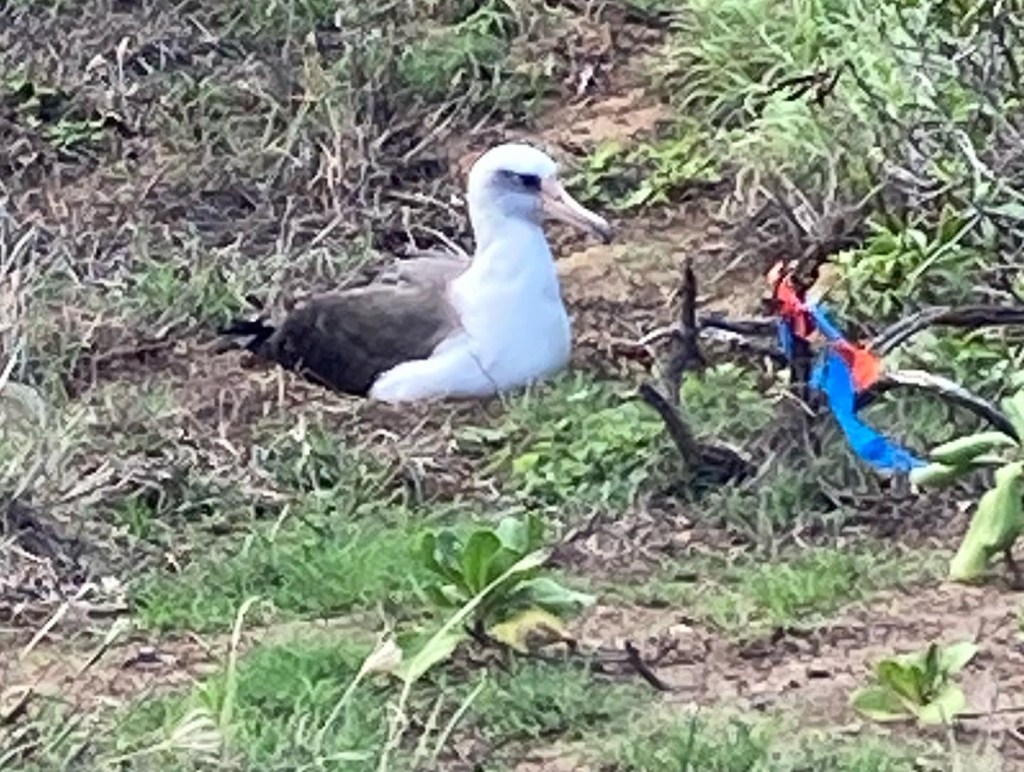
Before long, we come to a carefully constructed entry point for the albatross nesting area. True to the park ranger’s assessment, we slowly start to see a few albatross. They are quiet, but the birds eye us with a cautious curiosity.
An albatross in the Kaena Point nesting area Photo Betsy Pike
We keep walking with our eyes peeled for the albatross, and then it happens—a couple of the birds are airborne. These Laysan albatrosses are graceful in their gliding. With a wingspan over six feet, these birds make flying look uncomplicated. Art notes with laughter how one albatross skims just above the unknowing heads of Abby, Betsy, and Elizabeth.
We complete the loop of the nesting area and exit via the gate. On the walk back to the parking lot, the trail continues presenting pretty views in every direction.
Clearly, this hike will stay with me. I want to believe that a lousy day can be countered with a Kaena Point daydream gliding away from my troubles like a Laysan albatross.
A good daydreaming spot Kaena Point Trail photo Bill Pike
By Friday, December 10, the daily routine was a bit quieter. Only our youngest daughter, Elizabeth, remained with us.
At assorted points, the wedding travelers had packed up, scrunched into those big aluminum winged birds, and flown back to the mainland.
Elizabeth was scheduled to take a red eye out of Honolulu on Saturday evening. With her remaining time, she pursued a combination of stints on the beach and taking in more Hawaiian beauty.
At some point on Friday, Elizabeth, Betsy, and I made the drive back to the Waimea Valley Visitors Center. We wanted to take the walk to the falls and to explore the lush grounds along the way.
Quite simply, this is a beautiful walk. If you come this far to Hawaii, you must take this walk. Excuses are not acceptable.
No matter where our eyes are cast, our attention is captured by an unsurpassed loveliness. To put it another way, I can’t stop taking pictures. The vivid colors of floral blooms are remarkable.
Colorful blooms Photo by Bill Pike
The layout of the walkways is easy on old bones. Yes, there is a gradual incline to the falls, but the push upward is quite manageable. Sprinkled along the way are educational displays related to island life. Yes, these are nicely done, but the plant life steals the show.
At assorted points, we can see where the torrential rains from Monday created chaos with washouts and tree damage. The stream that meanders along with us is now running clear—an indication that nature’s filtering system is working.
Occasionally, birds chirp, an electric cart carrying visitors might whiz by, but overall it is quiet, serene, and calming as we work our way toward the falls.
And yet in all of this pretty tranquility, we encounter a meltdown.
At what I would describe as a concession/rest area off to our right, we hear a loud voice.
At first, we can’t determine if it is an employee in a confrontation with another employee or tourist. But, with a few more seconds of listening, we determine it is a tourist, a wife, a mother who has exploded at her husband and older daughter.
Apparently, there was some miscommunication. This lady had been waiting for the husband and daughter in this spot for a long, long time.
Her meltdown, spewed with hot volcanic words. For those intense minutes, ears burned. Respect for herself, her family, and innocent tourist with children was gone. That respect melted into a molten gush of harsh, profanity laced, yelling—a shameful embarrassment.
Upon reflection of this tirade, I thought it was too bad this aggravated lady had not been standing under a coconut tree. Perhaps, a timely drop of a coconut on to her volatile noggin might have brought her back to reality. But, who knows maybe what we heard was the reality of her life.
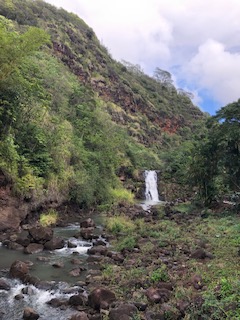
Despite this intrusion, the falls were as advertised. And yes, you can take a dip or swim in the pool below the falls. Water shoes and life vests can be rented if you want to take the plunge.
Waimea Falls Photo by Bill Pike
After admiring the falls, we turned around. The walk back to our starting point gave our eyes a new perspective as we saw the landscape from different angles. Yes, I took more pictures.
We drove back to Waialua even more appreciative of our world, and thankful that someone a long time ago made the decision to protect Waimea Falls.
Back at the house, we went down to the beach and took a long walk along the shoreline. Soon, in the distance, the sun would be setting behind the hazy, darkening hills. We were hoping for a colorful western sky as the sun slipped into the Pacific.
On the morning of Wednesday, December 8, 2021, there was a mad scramble to get organized for the ride to Kailua Beach. Somehow, we made the deadline, and three cars left Waialua loaded with enough beach gear to fill several cargo ships.
The ride over to Kailua Beach was long. Even the adults in our car asked the question reserved for children—“Are we there yet?”
That question was asked in good fun. But, the ride was full of a variety of scenery and that only enhanced the experience for us.
Gradually, we found our way to the public access parking lot for Kailua Beach. We unloaded, weighted ourselves down with the beach gear, and made the walk over the slight rise to meet the beach. Now, I understand why we made the long drive—Kailua Beach appears to be just about perfect.
Kailua Beach photo courtesy of Lauren Reinking
We found a good spot to set up our gear and plopped down. When we arrived the sun was out. The sun worshippers on the trip were excited. They finally could catch some rays. But that optimism changed quickly.
The sun teased peeking in and out of clouds, and as the morning minutes ticked by, the sun became hidden. Clouds came in, the wind picked up, and rain seemed likely. For quite a while, we stubbornly held our ground. Hopeful, that a smiling sun would return.
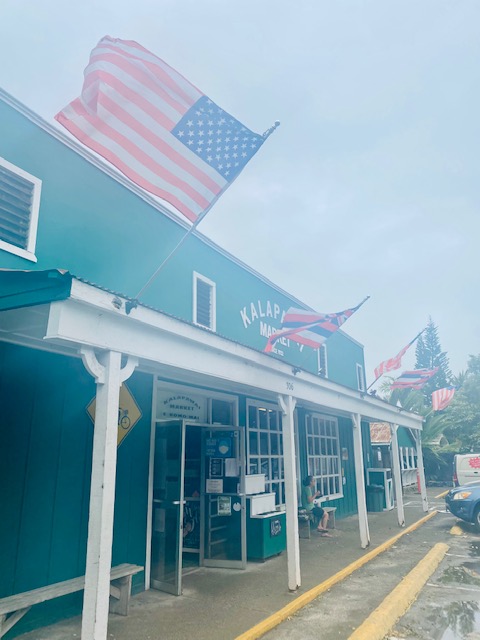
But, at some point, our hope faded. A decision was made to pack up. Arms loaded again, we trudged back to the cars. We agreed to make the short drive to the famous Kalapawai Market and order sandwiches from their deli.
Kalapawai Market photo courtesy of Elizabeth Pike
There are three additional locations of the market scattered around. This store was packed with all kinds of tempting items. Whoever does their purchasing and marketing knows what they are doing. And the BLTA 10 sandwich on sourdough bread that I shared with the Commander Supreme was delicious.
There was a small outside area where we could gather and enjoy our sandwiches. It didn’t take long for the local bird moochers to recognize that a bunch of tourist had arrived.
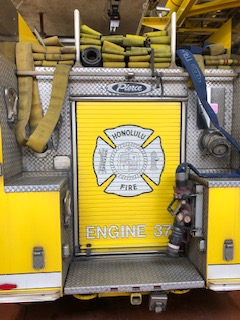
As the birdies searched for crumbs, we reloaded, and the caravan headed toward the Honolulu Fire Department station in Kahlulu home of Engine Company 37. This is where Betsy’s nephew, Parker, works as a firefighter.
Back of Engine #37 Photo by Bill Pike
All of the grandkids were excited, and I will admit, so was I.
For some reason, I have always loved fire trucks. I still remember the kindergarten visit to the fire station in Burlington, North Carolina where I grew up. The station at the time had a brass pole for the firefighters to descend from the second floor living quarters when an alarm was sounded.
I know the unique sound of a fire truck’s siren grabs our attention. But for my old ears, the unmistakeable sound of the truck’s engine is what I love to hear. Even without the wail of the siren, I know when a fire truck is on one of our neighborhood streets.
The building for Engine Company 37 is being readied for some renovations. Despite this work, Parker gave us the full tour, and the Captain provided the kids with a bag of treats about fire safety including some hands on crafts.
But, the highlight of the visit was when the Captain gave Parker permission to take the kids with their parents for a ride in the massive truck. Though the raindrop ride was short, all faces, minus one were smiling from this experience. Hudson liked the ride so much that he told his mother he wanted to go for another ride in the truck.
We thanked Parker and his teammates for the tour and headed back to Waialua.
On the morning of Thursday, December 9, I needed a run.
Earlier in the week, Abby and Art had taken us on a walk along the bike path to where it ends. But, they showed us how to extend the path by connecting to the quiet, narrow road named Crozier Lane.
Crozier Lane is a flat, straight shot with houses on the right side that look out on to the blue Pacific. On the left side of the road, the homes were on larger parcels of land.
Architecturally, the houses are a hodgepodge of styles. Some are original. Many have been renovated. And no matter where I look, my eyes are curious.
Occasionally, during the run, I hear the singular crow of a rooster, and once out in front of me some chickens scurried across the road.
Taking this loop allowed me to marvel at the rich green hills in the distance. Some of these large lots on the back side were gated, secluded in appearance. Others were open with lives on display.
Slowly, I made the correct turns to reconnect me with the bike path for the slog back to the house. A few times my attention is drawn to the darting appearance of the saffron finch, a small yellow feathered bird whose head and face are splashed in a faint sunburst orange.
I made it back to the house where I would need to hustle to be ready for a trip to the Dole Plantation.
The ride over to the Dole landmark featured more beautiful agricultural land. At certain points, coffee and banana trees filled in the landscape, and some of those plots appeared to be growing pineapples.
Once at Dole, we opted not to take the popular train ride, but we did fumble through what is billed as the world’s largest maze. Caroline and Hudson enjoyed this nicely designed puzzle of paths.
We did learn a bit while touring around Dole. Pineapples are still grown on the Dole land, but not in quantities large enough to supply the mainland. It takes 16 to 24 months for a pineapple to reach maturity.
Of course, the marketers at Dole have a very nice visitor’s center designed to tempt tourists to open their wallets in support of the Hawaii’s traveler driven economy.
So, if you go to Dole, you must treat yourself to a Dole Whip. This frozen pineapple concoction is a must. I had one, and I immediately wanted another one.
After the Dole Whip, we walked through the store, and yes, we did add to the support of the travel economy.
We crawled back into our assigned seats in the car. On the return ride to Waialua, Hudson requested Christmas music be played.
And while, his request seemed out of place, Bing Crosby’s “Mele Kalikimaka” never sounded so good.
A young pineapple at the Dole Plantation photo by Bill Pike
Our neighbors on the east side of our house have two sons. The oldest, Atticus, is a middle school student. When we are traveling, my wife asks Atticus to collect delivered packages and the daily newspaper.
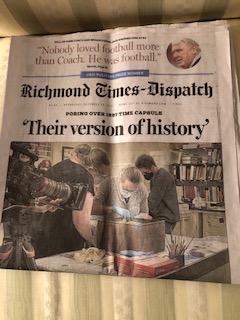
Back in October, my wife let Atticus know that he had lost one of his responsibilities. After a brief discussion, my wife and I decided to stop the daily home delivery of the print edition of the Richmond Times-Dispatch.
That was a difficult decision. For years, we loved holding the morning newspaper and skimming headlines.
But, it is no secret in the world of newspapers that a print subscription costs more than a digital edition. We made this decision to switch to digital despite the Times-Dispatch offering us a modest discount for continuing our print subscription during the last two years.
A daily newspaper has been a part of my life for many years.
Growing up in North Carolina, the Burlington Times News arrived every afternoon. On Sunday mornings, the Greensboro News and Record landed at the end of our gravel driveway. Sometimes, the carrier’s aim was off. The paper landed in a rain swollen ditch or puddle.
I loved sports, with either paper that was my first stop. During those years, I was never a prolific reader of the other pages that filled out the paper. Yet, unknown to me at the time, I was quietly developing my love for newspaper reading.
In college and graduate school, I remember spending library time researching assorted assignments. Some research required tracking down newspaper articles. I’ll never forget the sound of the spinning reel of the microfiche viewer as I skimmed through what seemed like miles of microfilm to find just the right article.
When I entered the teaching profession, I looked for opportunities within the curriculum to introduce students to journalism. Occasionally, editors of literature books wove historical reporting, essays, and opinion pieces from newspapers into textbooks.
During my assignment as principal at Lakeside Elementary, I cherished the point during the school year when the PTA provided funding for Newspapers In Education. Classroom sets of the Times-Dispatch were delivered to the school. Instructionally, our teachers were creative in how they taught students about the newspaper.
Earlier this fall, I listened with great interest to an interview with Art Cullen on the NPR show Fresh Air. Mr. Cullen is part of the ownership of the local newspaper in Storm Lake, Iowa. This newspaper is a family run business. Mr. Cullen, his wife, son, sister-in-law, and brother are the team that works to keep the paper alive.
Keeping a newspaper breathing is no easy task. Background for Mr. Cullen’s interview, cited one study that revealed 1,800 local newspapers have closed their doors or merged since 2004.
Despite the challenges in publishing The Storm Lake Times, in 2017, Mr. Cullen won a Pulitzer Prize for Editorial Writing. Those pieces had a significant impact in bringing about change in the Storm Lake community.
However, when local newspapers close, “so-called news deserts” emerge. This gap in local news coverage can in turn limit opportunities for less informed communities to embrace change.
Being a natural born worrier, I have added to my worry list the loss of newspapers. These closures, this loss of reporting news at the local level isn’t good.
Rightly or wrongly, I have friends who passionately dislike the Richmond Times-Dispatch. Their disfavor might be attributed to a single flaw or multiple agitations.
But, in truth, their dislike, disfavor, and agitation is at the heart of why we need responsible journalists, editors, and publishers.
Our communities need to be informed.
We need to know when work within local governments goes right and when it goes wrong.
We need to know the struggles of citizens to find employment, housing, and food.
We need to know when public leaders succeed and when they fail.
We need stories that make us laugh, cry, and most importantly— think.
And now more than ever, we do not need inaccurate misinformation. We need newspapers to fully vet diligent research and responsibly report the truth—no exceptions.
My wife has adjusted to the digital version of the Times-Dispatch better than me.
I’m attempting to be patient as I learn the digital format.
Next door, I suspect Atticus is quietly hoping that I will lose patience, implode, and resubscribe to the print edition.
Who knows, maybe out in Iowa, Art Cullen is rooting for the same reversal from me.

















 might be baloney