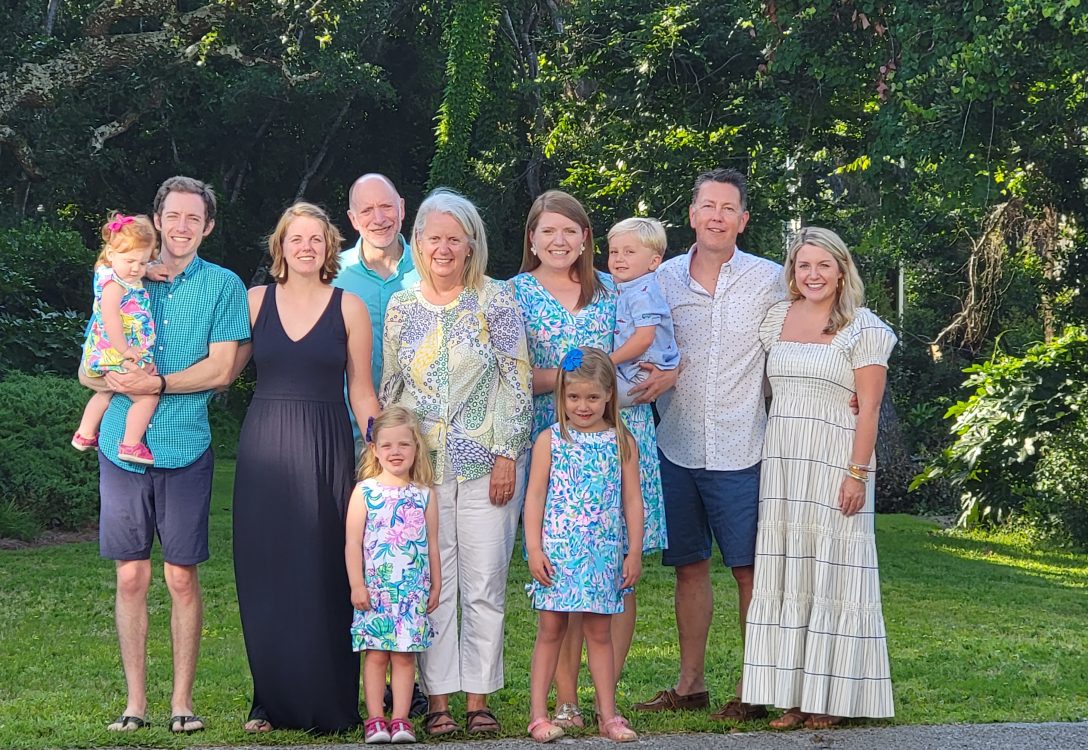
August 1976, I made my first visit to Cape Cod with my wife’s family. That was quite a transition for an old southern boy who grew up making family trips to the beaches along the North and South Carolina coastlines. But with each subsequent visit, Cape Cod continued to hook my heart.
After a seven year hiatus, thirty two family members returned to the Cape in late July. We descended upon Falmouth. Disappointment never intruded.
From our first glimpse of the rugged Bourne Bridge to the last spoonful of clam chowder at Pier 37 Boathouse, we made the most of our week.
Scrunched in three houses, our daily treks to the beach required the logistical precision of a military landing. But once there, we appreciated the well maintained beaches and the attentive lifeguards.
We loved our outing to watch a Cape Cod League baseball game as the Falmouth Commodores battled the Hyannis Harbor Hawks. It was clear from the attendance that your citizens appreciate what this league brings to each community.
No matter where we ventured, the merchants and local residents were polite and helpful.
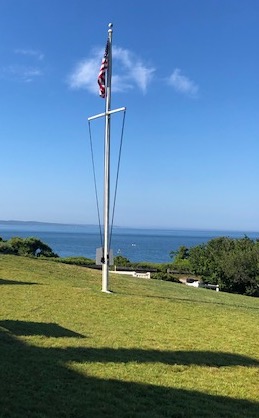
On our last morning, some of us took the short hike to The Knob. We were not disappointed with the spectacular water views.
And in all honesty, I think that is what I admire the most about the character of Cape Cod—the capacity to hold and preserve cherished land.
I pray your hearts never let go of that gritty grip.
Looking out at The Knob near Woods Hole on Cape Cod. Photo by Bill Pike
Author’s note: This post was submitted to the Cape Cod Times as a letter to the editor. I thought the editor/s might take a complimentary letter about the hospitality we experienced while vacationing there. Clearly, I thought wrong. Be safe, Bill
LETTER: Lack of public decency in civil discourse is unsettling
Editor:
West Virginia is a beautiful state. I know this from trips my wife and I have taken along Interstates 64 and 81.
We’ve enjoyed our stops at the New River Gorge National Park and Preserve and the famous Blenko glassware site in Milton. No matter if our stops were for hours or overnight, we always found the people of West Virginia courteous and friendly.
On Friday, July 21, we used I-81 to keep us off the heavily traveled I-95 on our way to Cape Cod for a family reunion.
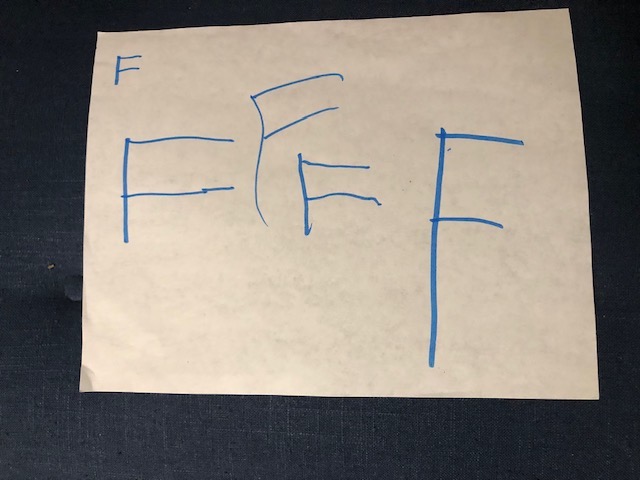
We stopped at the West Virginia Welcome Center for a quick break. As we reentered I-81, from the passenger’s side of the car, my wife saw an American flag flying upside down, and right beside it another flag. That flag featured the “F” word and, below this inappropriate slang, was the last name of President Joe Biden.
I could not believe my wife’s report. For the next several miles, I was in shock over this offensive public display.
In all honesty, I’m an imperfect human being who is no stranger to using unacceptable language. I believe in freedom of speech.
Yet, I struggle to understand why we choose to disregard the boundaries of decency and respect for this essential American value. Don’t we have other forums to vent our political frustrations without offensive flags flying along an interstate?
A few years ago, former U.S. Defense Secretary Robert Gates told an audience at the Richmond Forum: “The United States faces threats from extremists and unstable regimes around the world, but it’s the nation’s own political incivility that poses the gravest risk.”
I think Gates’ assessment is correct. But what is even more unsettling to me is our inability to see this.
Bill Pike Richmond, Virginia
Note from author: I’m honored to have my Letter To The Editor published in the Charleston Gazette-Mail today, Friday, August 4, 2023. If the words resonate with you please share. Love, Bill
American flag at Nobska Lighthouse Cape Cod (Photo by Bill Pike)
For too many years in my internal and external moments of anger, I have used the “f” word to curse at whatever was aggravating me at the time.
Late on the afternoon of Thursday, July 20, I used the “f” word more than former Duke basketball coach, Mike Krzyzewski, as he gently berated a referee over a foul call.
In packing our car for the vacation drive to Cape Cod, the Commander Supreme and I realized that the beach chairs were not going to fit in the car with all of the other required junk for a week at the beach.
For the next forty minutes, I wrestled with the rooftop carrier and the unfriendly design of the beach chairs. No matter the layering pattern I attempted with the chairs, the perfection I was pursuing for tight corners and interior snugness could not be found.
I “f’d” this and “f’d” that. Sweating profusely in the still hot and humid summer air, I slapped and “f’d” at blood thirsty mosquitoes who roared in laughter at me with each bite of my salty flesh.
Finally, by the grace of the trip packing gods, something worked. The chairs fit. The surrounding zipper for the soft case connected and closed. I secured the tie lines to the roof rails, and my use of the “f” word ceased, so much for being a Christian.
The logistics for this trip had been in planning for a year. Thirty two family members would be gathering in Falmouth, Massachusetts on Cape Cod. The airlines like this family gathering. People were flying into Boston from Great Britain, Hawaii, California, Texas, North Carolina, and Virginia. The local economy in Falmouth likes us too as we are renting three houses.
But back to the “f” word.
As we started our drive north on Friday morning, I started to reflect on my “f” rated tirade with the rooftop carrier. I thought back to Sunday morning, July 16.
We were in North Myrtle Beach, South Carolina. On Saturday morning, we had driven down from Richmond. My college roommate and his wife had rented a condo. They had invited the Commander and I and another college couple to join them for a few days.
Early that Sunday morning, I went for a run. The condo was located where Ocean Drive Beach and Cherry Grove Beach meet. I started my run heading north into Cherry Grove.
When I was growing up, my parents along with a couple of other families from our church in Burlington would make weekend trips to Cherry Grove in the late spring and early fall.
As I plod along the road that parallels the beach, I can’t believe how much Cherry Grove as changed. High rise condos dot the shoreline where soft sand dunes once held their ground.
My guess is homeowners across the street might have used the “f” word in defiance of the developers who built the high rises. These tall and often long buildings completely block out porch views of the ocean.
I made my way up to Forty Fifth Street and hooked a left. I followed this road back to the Sea Mountain Highway into the heart of Cherry Grove. This route gave me views of houses built along canals, and House Creek, where a few fishermen and crabbers were already casting.
Occasionally, cars and bicycle riders passed me. At one point, the quiet solitude of this already warm Sunday morning was broken.
A man and a woman were walking away from a house. I sensed they were starting a long walk. The woman shouted back at someone near the front entrance of the house—“ Aaron, you need to get a move on.” I didn’t hear what Aaron said back, but it must have been something with a sting too it, because the man walking with the woman shouted back “f you” Aaron.
Five days later, Friday, July 21, we made a rest stop at the West Virginia Welcome Center. We were on our way to Cape Cod. As we were re-entering Interstate 81, the Commander looked off to her right and saw the American flag flying upside down, and right beside it another flag was being flown with these words: “F Biden.”
For several minutes, all I could say or think was I can’t believe that someone would do such a thing. I was stunned.
We stopped for the night in Fishkill, New York.
On Saturday morning, we were up early. I went out to check the car, and on my way back to the elevator. I saw two men at the end of the hallway. One knocked on the door of a room. The man who knocked on the door said in a loud voice—“Open the “f” door, bitch, it’s me.”
Wanting to avoid Interstates 84 and 95 in Connecticut and Rhode Island, we opted to take the Taconic State Parkway to the Massachusetts Turnpike. At some point on the Turnpike or 495, we came upon two cars in a fender bender. I noted on the back window of one of the damaged cars the following sticker: “F Cancer.”
While I agree with the sentiment in that bumper sticker. I despise cancer. Yet, I wonder why we must push our free speech with inappropriate language in a public display? I guess “crush, combat, confront, cancel”— Cancer just doesn’t push far enough to capture a person’s attention.
In Adam Makos book Devotion, he writes about two Navy pilots who flew Corsairs, single engine propeller driven fighter planes, at the beginning of the Korean War. Makos focuses on Jesse Brown, an African American from Mississippi, and Tom Hudner from Massachusetts. The author takes us back into their early lives and captures pivotal confrontations that each man experienced growing up.
One afternoon, Jesse and his brothers had been spit upon and offended with racial slurs shouted at them from white students riding a school bus. That same evening, with his father reading the newspaper and listening, Jesse shares with his mother the displeasure he has experienced.
His mother shares this wisdom: “When someone calls you a ‘nigger’ then you feel sorry for him,” she said. “You have to pity him because his mind has such a sorry way of expressing itself.”(Devotion page 33)
Clearly, for too many years, when it comes to the “f” word, I have allowed my mind to develop a “sorry way of expressing itself.”
Over time, I have noticed in conversations that we have learned to substitute “freaking or frigging” for the “f” word. While not as offensive, the same meaning is conveyed.
Speaking for myself, and knowing that I’m not the brightest guy in the world, it seems quite obvious to me that we have lost what little self-respect we have left. From coaches fuming on the sidelines, to agitated travelers on passenger jets, uncivil politicians, and out of control students in school buildings, the use of inappropriate language has no boundaries.
Sadly, we seem as numb to our irresponsible choice of words in public settings as we are to our daily loss of American lives by pulling the trigger of a firearm.
What is even more disconcerting is what might have happened to me or another concerned citizen if I had said something to the “f” word offenders.
How would I have responded to a neighbor who happened to hear the “f” word flying out of my mouth as I wrestled with the beach chairs and rooftop carrier?
In the “Citizen’s Arrest” episode of the Andy Griffith Show, Wally’s Filling Station employee, Gomer Pyle, in an uncharacteristic fit of anger shouted: “You just go up an alley and holler fish” at Mayberry Deputy Barney Fife.
Deputy Fife had just issued Gomer a traffic ticket for making a questionable u-turn.
Regrettably, in America, we have pushed our foul language barrier a long way from “going up an alley and hollering fish.”
American singer and songwriter, Bob Dylan, has written over 500 songs. Earlier this year, I came upon a studio recording by The Steep Canyon Rangers of Dylan’s “Let Me Die In My Footsteps.”
I tracked down the lyrics, and the following verse caught my attention:
There’s always been people that have to cause fear. They’ve been talking of the war now for many long years. I have read all their statements and I’ve not said a word. But, now Lord God, let my poor voice be heard. Let me die in my footsteps, before I go down under the ground. “Let Me Die In My Footsteps” Written by Bob Dylan
In June, I turned seventy.
I don’t have many years left.
Yet, the words: “now Lord God, let my poor voice be heard” pinched my heart.
Pushing fear aside isn’t easy, but aren’t you, me, we, us overdue for our voices to be heard about how we disrespect ourselves and those around us with our public use of inappropriate words?
Have our minds in the words of Jesse Brown’s mother become that “sorry?”
I think we know the answer.
Graphic design by CHJE Productions (Photo by Bill Pike)
On June 13, I read discouraging news reports from California that confirmed the Anchor Brewing Company was stopping distribution of their beers outside of California, and ceasing the production of their legendary Christmas Ale.
Twenty nine days later on July 12, I received an email from my wife’s niece in San Francisco: “Looks like they are closing all together. Sorry, Bill.”
Attached to the email was a link to a report from the NBC news affiliate in San Francisco with this headline: Anchor Brewing Company in San Francisco to halt operations after 127 years.
Crushed again, I called our son. He quickly found several other similar headlines from other media outlets confirming the brewery’s closing.
Sam Singer spokesperson for the brewery cited numerous reasons for the closing, but mainly focused on declining sales in a beer market with lots of competition.
Accusatory fingers of blame will be pointed in many directions for the closing of Anchor Brewing. Most obvious will be the sale of the brewery in 2017 to Sapporo, a large brewer of beer from Japan.
I was shocked when I read about the sale of Anchor to Sapporo in 2017. I, who know nothing about the behind the scenes operation of a brewery, did not think this was a good fit.
I don’t think the Japanese culture has experienced the explosion of craft brewers like we have seen in America. I suspect Sapporo management didn’t properly understand that environment, or what had been carefully created at Anchor Brewing.
Years ago, in Richmond, Virginia, I witnessed a similar acquisition. Ukrops a very successful local, family run grocery store chain decided they were ready to sell. Apparently, they had lots of offers, but settled on Martins, a family run chain from Pennsylvania.
Martins also had ties to another large grocery store chain, Giant. In a few short years, Martins was gone. They could never match the quality and loyalty that was at the heart and soul of the Ukrops run stores. Likewise, I suspect that Sapporo never grasped the heart and soul of Anchor Brewing.
Sixty one Anchor Brewing employees lost their jobs with a “60 day notice and a separation package.” I hope those dedicated and loyal employees will quickly find comparable employment opportunities in the Bay Area without significant disruption to their lives.
I’d be curious to know who can claim and protect the beer recipes for all of the Anchor Brewing beers that have been brewed for so many years. I hope they are protected in such a way that would prohibit Sapporo from being able to cheaply mass brew the Anchor Brewing beers at the company’s large brewery in La Crosse, Wisconsin. A move like that would be shameful and disrespectful to the Anchor Brewing beers that are admired and respected by brewers and beer drinkers around the world.
Who knows, maybe there is another Fritz Maytag out there who is assessing this latest demise, and who at the last minute will make an offer that will rescue Anchor Brewing. That’s what Fritz Maytag did in 1965 when he purchased the struggling brewery. I would assume that Mr. Maytag who put his heart and soul into saving the brewery has lost some sleep over this disappointing announcement.
My wife’s brother-in-law sent me an article in the July 21 edition of the Washington Post by reporters Niha Masih and Praveena Somasundaram. Their article reported “that employees from the Anchor Brewery have submitted a proposal to Sapporo to purchase the brewery and run it as a co-op. Additionally, there are nearly two dozen bids with an interest in buying the historic brewery.”
Over the last few years, a handful of successful American craft breweries have been purchased by hefty foreign breweries. I wonder how the ledger sheets read for those acquisitions? Might there be other American craft breweries who are unstable economically and potentially facing closure?
Yes, I’m disappointed in this announcement.
But the closing of a beloved American brewery is nothing compared to other challenges in our world.
Thousands of miles from America, Ukraine continues to battle Russia and its heartless leader, Vladimir Putin.
In America, our political and economic divide continues to separate us from working together for the good of all.
Our physical and human infrastructure systems are worn and weary.
Our political system needs to be overhauled as we continue to wobble in a selfish instability.
We have become numb to the trigger pulling that is seen as the quickest and surest way to solve any problem with another American.
From sea to shining sea, we continue to experience the erosion of our dignity, patience, common sense, kindness, loyalty, and love.
And yet, I hold out hope that the current owner of Anchor Brewing, Sapporo Holdings, Ltd., will strongly consider the merit of the bid submitted by forty employees from Anchor to purchase the brewery.
And one more hope, as an imperfect human being and American, I will hold out hope that America will come to its senses and correct its challenges before America like Anchor Brewing is facing its closure.
As a parent, grandparent, and retired public school educator my heart hurts for the shooting tragedy that occurred after the Huguenot High School graduation. In a blink, lives are changed forever.
Honestly, I’m not surprised that we are processing another mass shooting.
Consider, these findings about gun violence, firearm ownership, single parent families, and the shrinking of religion.
The Johns Hopkins Center For Gun Violence Solutions has released its annual report.
The Center reported this grim data: In 2021, for the second straight year, gun deaths reached the highest number ever recorded. Nearly 49,000 people died from gun violence in the U.S. Each day, an average of 134 people died from gun violence—one death every 11 minutes.
A June 2021 survey of 10,606 American adults conducted by Pew Research Center found four-in-ten adults live in a household with a gun, including 30% who personally own one.
In August 2022, the Annie E. Casey Foundation reported nearly 24 million children live in single-parent families in the United States, or about one in every three kids across America.
Perhaps, you recently saw this headline: The Importance of Religion In The Lives of Americans Is Shrinking.
The Public Religion Research Institute collected data from 6,600 adults in all fifty states. The leading takeaway: “Just 16% of Americans surveyed said religion is the most important thing in their lives, that’s down from 20% a decade ago.”
Record setting deaths by gun violence, significant firearm ownership, millions of single parent families, and a country that every year slips further away from In God We Trust—forms quite a collision.
Yet, it seems perfectly clear to me that we are indifferent to the catastrophic collision revealed in this data. Additionally, we are numb to the repetitive reality found in headlines regarding another mass shooting.
If we think, we are insulated, immune, safe in our silos from being impacted by gun violence, firearm infatuation, fragile families, and crumbling churches, we are wrong.
Currently, we have a single frame of reference for solving a problem—take out a gun and shoot the problem.
In the movie, The Shawshank Redemption, actor Morgan Freeman, portrays Ellis Boyd Redding, a prisoner who has served forty years of a life sentence for committing murder.
In an appearance before the parole board, Mr. Redding is asked if he is sorry for what he did. Mr. Redding affirms that everyday he regrets his decision.
But, Mr. Redding also makes a revealing reflection about his act of violence. He states: “I look back on the way I was then— a young, stupid kid who committed that terrible crime. I want to talk to him. I want to try to talk some sense to him, tell him the way things are. But I can’t. That kid’s long gone, and this old man is all that’s left.”
No parent would turn down the opportunity to try and talk “some sense” into the raging mind of a loved one before the trigger is pulled. Regrettably, we keep missing the opportunity to talk.
As a retired educator, I know the planning that goes into a high school graduation ceremony. Years ago, safety was on the radar, but not like it is now.
After the Huguenot shooting, safety plans for graduation ceremonies are changed forever. School systems and municipalities must maintain interior security strategies that are working. But now, they will be required to design and implement a safety perimeter for the exterior of the building too.
Of course, no mass shooting is immune from comments by politicians.
Finger pointing and heated words are worthless. Instead of negligent posturing, why not commit to the hard work of building the relationships needed to solve our gun violence?
With regard to a solution, I believe these words from Anne Sullivan capture our situation: “We are afraid of ideas, of experimenting, of change. We shrink from thinking a problem through to a logical conclusion.”
This is an urgent matter.
We can no longer afford to be afraid of change. Nor can we continue to shrink from our responsibility to find logical and reasonable solutions.
Do we really want future reports from Johns Hopkins to document even more deaths per minute?
Do we want to continue to miss opportunities to “talk some sense into ourselves?”
We are overdue to set aside our differences and to commit to the hard work required to solve the mentality of pulling the trigger of a firearm as the way to fix a problem.
At this very moment, a troubled, frustrated, ready to snap human being is forming the next devastating headline.
Haven’t we had enough?
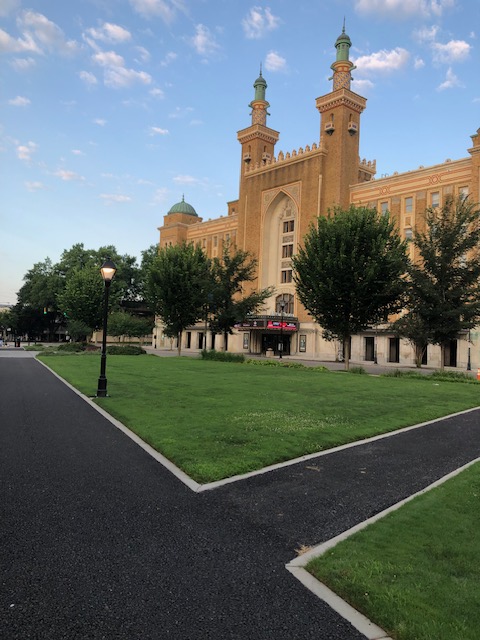
Monroe Park outside the Altria Theater where the Huguenot High School graduation shooting took place in June in Richmond, Virginia (Photo by Bill Pike)
Want to improve schools? Help families LETTERS TO THE EDITOR Richmond Times-Dispatch Saturday, July 8, 2023
The headline on a recent oped written by Virginia Del. Mike Cherry caught my attention: “Want to improve schools? Start by empowering parents,” June 30.
Del. Cherry used this opportunity to bash Democrats, noting their failure to support specific education legislation in the Virginia General Assembly.
Unfortunately, our politicians spend too much time criticizing each party while accomplishing little on behalf of students, teachers and parents.
Everyone has an opinion about public education and how to fi x our schools. Those opinions cover lots of topics complete with multiple recommendations, but rarely does anyone talk about a significant challenge to every classroom: the erosion of our families.
In August 2022, The Annie E. Casey Foundation reported that nearly 24 million children live in single-parent families in the United States, or about 1 in every 3 kids across America.
Del. Cherry referenced data from the Joint Legislative Audit and Review Commission related to disruptive student behaviors in our schools. From the teachers surveyed: “56% said behavior is a ‘very serious issue,’ while 24% called it a ‘serious’ problem.”
I wonder how many of Virginia’s disruptive students come from single-parent homes?
Republicans and Democrats can talk all they want about introducing legislation to “empower teachers with the support they need to allow them to better handle discipline in their classrooms.”
Yet, those same teachers who confirmed their concerns about disruptive student behaviors can unequivocally state there will be no empowering of classroom teachers until we address the challenges our families face every day.
This is because our teachers from kindergarten through 12th grade understand: For a student, it all starts at home.
Want to improve our schools?
Then embrace what our classroom teachers have known for many years: It all starts at home. Virginia, we are overdue to halt the erosion of our families.
Bill Pike Henrico
Author’s note: This letter to the editor was written in response to an Op-Ed piece that appeared in the Richmond Times-Dispatch on June 30, 2023. If you have a family member, relative, friends, and neighbors who teach in public schools, please consider sharing this letter with them. No pressure, thanks, Bill Pike
Tuesday, June 13, my wife emailed me this headline: Anchor Brewing Ceases National Distribution, Discontinues Beloved Christmas Ale.
For several minutes, I kept repeating to myself—I can’t believe this. Eight days later, I can’t still believe it.
I reached out to my wife’s sister and her family in Los Angeles and San Francisco for confirmation. Later that afternoon, I had article links verifying the announcement.
Subsequently, I have told the California family— in the future, don’t come east for a visit without Anchor Brewing’s beers in your suitcase.
I remember in college, Colorado’s Coors Beer wasn’t distributed east of the Mississippi River. People found subtle and not so subtle ways to bring Coors to the East Coast. Eventually, Coors expanded east, and a brewery was built near Harrisonburg, Virginia.
Who knows, maybe clever beer enthusiasts will find the means to distribute Anchor Brewing beers beyond the California borderlines.
My first tasting of Anchor Steam Beer came in the summer of 1980. My wife and I were on a trip to California to visit her sisters and their families. We’ve never forgotten our drive up the Pacific Coast Highway from Los Angeles to San Francisco.
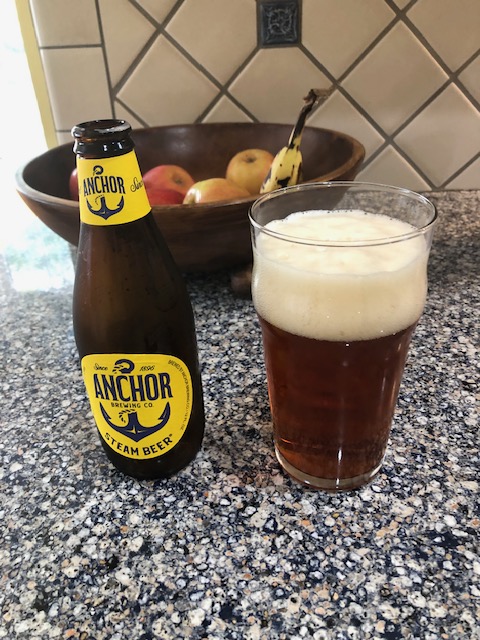
While in northern California, a cousin took us to Los Gatos for dinner at the Good Earth. That’s where I had my first Anchor Steam Beer. I admired the iconic label with the blue anchor, and the copper, amber color of the beer in the glass was a pretty sight.
Years later, when we visited our oldest daughter in Chicago, I always made a trip to Binny’s. Binny’s is a retailer who specializes in beer, liquor, and wine. Binny’s carried Anchor Brewing beers that would never make it to Virginia. One winter, Binny’s stocked a remarkable dark winter wheat beer from Anchor. That beer was one not to be forgotten.
But in 1965, Anchor Brewing was on the verge of being totally forgotten. The brewery was tilting toward bankruptcy, when Fritz Maytag, (yes, from the Maytag appliance manufacturer), rescued the struggling brewery.
With Mr. Maytag at the helm, the brewery regained its footing. Mr. Maytag learned about brewing from the ground up, and he corrected imperfections from the past.
He took the critical steps to improve the hygiene process in the brewing of their beers. Ensuring the integrity of the product and making required investments in new equipment were essential. Woven into those changes was a nudge toward the future. Mr. Maytag positioned the brewery to become an early innovator and leader in the craft brewing industry.
Over the years, the portfolio of beers created by the brew masters is impressive. The quality, handmade craftsmanship of their brewing did not go unnoticed. Other brewers and beer aficionados recognized that something special was taking place at Anchor Brewing.
That specialness was grounded in an appreciation for tradition, but also an untethered capacity to brew new beers beyond the traditional offerings. The brewery’s Zymaster series was an example of brewing beyond the established norms.
Since 1896, Anchor Brewing has continued to survive. Clearly, they have been a part of multiple transformations in America’s brewing history. But, I wonder if this latest decision could be the beginning of the brewery’s end?
In 2017, Anchor Brewing was purchased by Sapporo, a jumbo Japanese brewery. Sensing a potential instability, Anchor brewing employees unionized in 2019. This was followed in 2021 with a total redesigning of the brewery’s iconic labels and packaging.
When a large international brewer gobbles up a smaller brewery, at some point the purchaser is going to take a deeper look into the pennies needed to operate Anchor Brewing. The San Francisco Chronicle article quoted a company spokesman who stated that “seventy percent of the brewery’s sales come from California.”
Shipping beer from California to forty nine states isn’t inexpensive. For example, to reduce distribution costs, some West Coast brewers have built breweries on the East Coast.
Stopping the distribution of its beers outside of California is significant. However, ending the brewing of The Anchor Christmas Ale is an incompetent corporate decision direct from the Ebenezer Scrooge playbook. Not only was the beer a treat, but the label each year featured a different hand drawn tree by artist, Jim Stitt.
Writing to the San Francisco Chronicle about this decision, a former brewer at Anchor, Garrett Kelly said: “The loss of a beer as iconic as the Anchor Christmas Ale, the first American holiday beer post prohibition, is a loss for not only beer nerds like me, but anyone with an interest in preserving culture against the grinding pressure of corporate Darwinism.”
On the afternoon of June 13, I went to my local grocery store. The store had recently started to carry Anchor Steam Beer again. To counter this discouraging news, I decided to purchase a six pack.
When I reached into the cooler to grab the six pack of bottled beers, I nearly experienced a beer fatality.
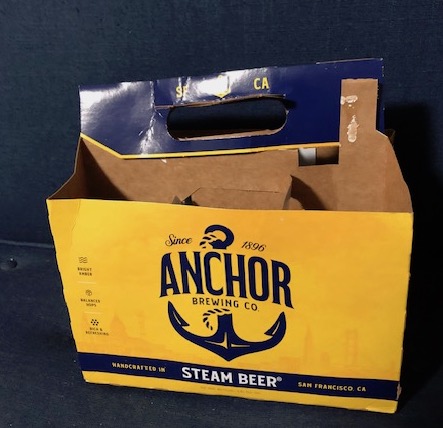
In the beer industry, the cardboard packaging that carries the beer bottles in called a sleeve. As I grabbed the sleeve’s built in handle, one of the glued seams failed and separated. I almost dropped a six pack of beer on to the hard surfaced terrazzo floor.
Luckily, despite my age, my reflexes were quick enough to catch and control the six pack before it crashed to the floor.
Not wanting another Anchor loyalist to have a similar scare, I let the store’s manager know my experience.
I came home, took out a pint glass, opened the bottle, and briskly poured the beer into the glass. In appearance, my old friend looked just as fresh and healthy from my first pour in Los Gatos 43 years ago.
Since Tuesday, I’ve thought a bit more about the failure of the glued seam on the six pack sleeve.
Was that the caused by a combination of temperature changes and humidity levels, or was this a Sapporo penny pitching decision—a less sturdy grade of cardboard and a watered down adhesive?
I’ll never know that answer.
If I was a lot younger, maybe I would organize a boycott or an interception of Sapporo beers in America.
Sometimes, James Thurber’s Walter Mitty, takes over my imagination.
I imagine that I’m the leader of a squadron of F-18 pilots from the United States Air Force, and I follow orders to intercept a commercial transport airliner loaded with Sapporo beers headed for America. The squadron escorts the plane back to Japan.
Or, I’m the commander of a team of Navy SEALS, and we seize a cargo ship loaded with Sapporo Beer that was headed for the port in San Francisco. That seized Sapporo beer is shipped to gardeners in America’s southeastern states where the beer will be used to kill slugs in flower gardens.
Luckily for Sapporo, my Walter Mitty intrusions are only harmless daydreams. But if my rock slinging pal from the Andy Griffith Show, Ernest T. Bass, gets riled up over the Anchor Brewing story, then all I can say is protect your windows.
I recently came across a few single cans of Sapporo’s Premium beer in the import section of a store that specializes in the selling of beer and wine. When I picked up this 22 ounce can of beer, I was surprised to read that the beer had been brewed in the Long An Province of Vietnam.
Upon further review, I learned that Sapporo uses the former G. Heileman Brewery in La Crosse, Wisconsin to brew its beers for American consumers. Perhaps that explains why the cost of one can of Sapporo Premium Lager was only $2.99.
Additionally, brewing their flagship beer in Wisconsin, makes me question Sapporo’s loyalty to it own brand and the legacy of their brewers in Japan.
From what I can tell, media coverage of the Anchor Steam distribution has been sparse compared to the coverage given to the decline of Anheuser-Busch’s Bud Light after the company pushed its best selling beer into “a social media promotion with a trans influencer in April 2023.”(NPR)
Ok, enough whining.
At this point, I will cling to the hope that family members in California will have empathy on an old geezer and smuggle Anchor Brewing six packs in their suitcases when they fly to Virginia.
Yes, I’m disappointed in this boneheaded Sapporo decision.
But, I’m hoping the loyalty and persistence of Anchor Brewing employees, and its now California only consumers will sustain the brewery beyond Sapporo’s mindless meddling.
Failed beer sleeve, upper right corner (Photo by Bill Pike)
By BILL PIKE Thursday, June 29, 2023 Roanoke Times
It’s OK, Roanoke, the Methodists have left the Berglund Center. The 241st Session of the Virginia Annual Conference of the United Methodist Church ended around midday June 17.
Mark Twain once stated: “The coldest winter I ever spent was a summer in San Fransisco.”
For me, the coldest first day of summer I ever spent was at the Berglund Center on June 21, 2019. I was attending the annual conference as a Richmond district delegate for Trinity United Methodist, my church in Henrico County.
A family sitting behind me was wrapped in fleece throws. They looked like diehard fans in a football stadium on a blustery, cold December day.
Maybe the coldness of the Berglund Center was requested by the conference leadership to keep attendees awake during debates and sermons.
I didn’t attend the annual conference this year. I took a break. I’m hoping the younger members in our church who attended will take up this torch now.
In case you haven’t noticed, churches in America have been struggling for several years.
Perhaps you recently picked up on this headline: “The importance of religion in the lives of Americans is shrinking.” That headline came from a recent survey by the Public Religion Research Institute.
The institute collected data from 6,600 adults in all 50 states. The leading takeaway: “Just 16% of Americans surveyed said religion is the most important thing in their lives, … down from 20% a decade ago.”
The CEO for PRRI, Melissa Deckman, stated: “Americans are becoming increasingly likely to become religiously unaffiliated.”
I’m a lifetime Methodist, and I agree with Ms. Deckman’s statement.
When I consider the current state of the so called “united” Methodist church, I believe chiggers in wild blackberry vines are more united as they attack an unsuspecting blackberry picker.
Declines in attendance, shrinking financial support, our political divide, human sexuality, interpretations of Scripture related to human sexuality, the aftermath of the pandemic, and disaffiliation have impacted our Methodist “unity.”
This session of the conference was led by our newly appointed bishop, Sue Haupert-Johnson, who has already made some difficult decisions.
Back on May 6, a Special Called Annual Conference session was held. Over matters of human sexuality, 64 Virginia United Methodist Churches were approved to disaffiliate from the United Methodist Church. By session vote, 90% approved and 10% disapproved.
More recently, on June 5, a joint resolution was reached involving a Virginia United Methodist pastor who had performed a same-gender wedding in the fall of 2019. That pastor was under complaint for more than 1,300 days. My guess is both parties feel a sense of relief that a resolution was found.
Annual conferences are fairly predictable — an agenda is followed, reports made, prayers, singing and sermons fill the Berglund Center, debates occur, new clergy ordained, aging clergy retire, appointments approved, and maybe by the end on Saturday attendees are renewed with hope.
With regard to hope, the PRRI research noted the following: “[F]or people who do still attend religious services, they say they’re optimistic about the future of their house of worship.”
In this year’s Book of Reports, I did find hope and optimism. For eight years, I served on the conference’s Board of Higher Education. From the work of our Wesley Foundation campus ministers at various universities in Virginia, I leaned a lot.
Bret Gresham is the Wesley Foundation campus minister at Virginia Tech. To his credit, Bret took a different approach in writing the annual report about his work with students at Virginia Tech. Bret’s tactic was to answer longstanding questions by conference leaders as to whether campus ministries are effective and worth the annual investment.
Bret started with: “Why is campus ministry important?” His response: “For many college students it is a matter of life and death.”
Consider this quote from a Virginia Tech student: “I was done with the Church prior to going to college, but if it weren’t for Wesley at VT, and the community within it, I would have ended my life due to events that transpired my first semester of college.” (Book of Reports, pages 69-70)
I wonder what the Virginia Annual Conference might learn about itself from this simple question and its heart-wrenching response?
If the Virginia Conference of the United Methodist Church expects to hang on and find stability, heartfelt questions combined with active listening might help the membership in regaining hope.
Anne Sullivan, the American educator best known for teaching Helen Keller, said: “We are afraid of ideas, of experimenting, of change. We shrink from thinking a problem through to a logical conclusion.”
The Virginia Annual Conference can no longer afford to fear change, nor can they shrink from thinking and working for the good of all.
Bill Pike is director of operations at Trinity United Methodist Church in Richmond.
Author’s note: I was honored to have this op-ed piece published in the Roanoke Times on Thursday, June 29, 2023. Thanks to the newspaper’s staff for the appropriate editing, and the willingness to run the piece.
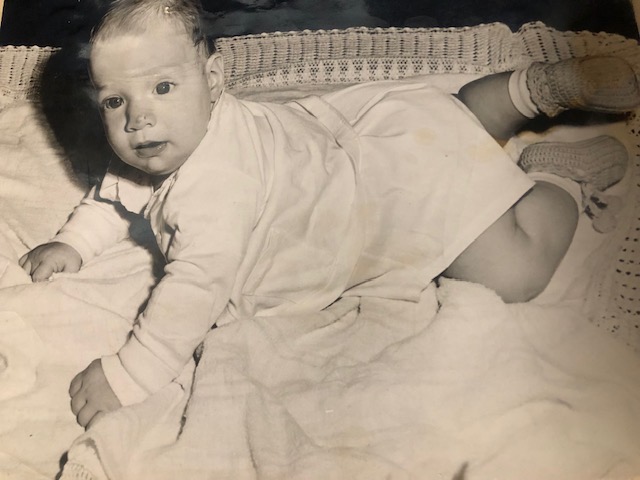
At three in the morning on Saturday, June 27, I came into this world.
My tattered baby book has eight pounds and seven and half ounces as my entry weight.
Knowing that June can be hot and humid in North Carolina, I feel certain my mother was happy when I arrived. And somewhere in a waiting room at Alamance County Hospital, my father was probably relieved too.
Today, I turn seventy.
Luckily, I’m not alone in reaching seventy, many of my friends will also celebrate hitting seventy this year.
At different times over the last seventy years, I’ve had thoughtful conversations with my childhood friends, John Huffman and Joe Vanderford. One thing we all agree on is how lucky we were to have our parents. Any success that we’ve had through the years came from the example they set with their hard work, sacrifice, care, and unyielding love.
I think love was the key for me as my parents continued to love me when I was not at my best, and I disappointed them.
Parenting is tough, tough work. Even in good circumstances, parenting is truly never easy, and the work of a parent is never done, even when your children are grown.
I appreciate the teachers who tolerated me. I’m forever grateful to my first grade teacher, Mrs. Hughes, who taught me the life skill of reading, Mrs. Wall who taught be how to type, and Mrs. Barnwell who in my senior year of high school challenged me to read Catcher In The Rye and the Invisible Man.
Mr. Wallace Pegram my cooperating teacher during my student teaching assignment stayed with me my whole career in public education with these words: “there’s a lot psychology in teaching.”
Throughout my life, I’ve been lucky to have the support of what I call families: my relatives, church family, education family, and neighbors. When I think back, no matter where I have been, I’ve been surrounded by good people.
My sister, Lisa, and her husband, Eric, are among those good people. They have always been patient and kind to our children. And, I deeply admire their compassion for the earth. Doesn’t matter if it is about farming, chickens, horses, or t-shirts, their passion and their ability to build community relationships is unsurpassed.
Another one of those good people, Don Gumm, guided my admission into Greensboro College, and my first teaching job at Martinsville Junior High School. Don had been the Youth Minister at Davis Street United Methodist Church.
I had no business being accepted into Greensboro College. But, Don believed in me, and despite my awful academic performance in high school, Don Gumm’s belief in me was good enough for the Admissions Director.
From that admission, I met my future wife, made five friends for life, and started my thirty one year career in public schools.
This November will mark forty eight years of marriage to the love of my life, Betsy. Despite my many aggravating faults, she has stayed by my side in all the ups and downs of my wobbling through this world.
And because of her, we have three slightly above average children, and four grandchildren that provide one of the most precious gifts of life—laughter.
To our children, you need to know that time is flying, and my prayer to you in the future is this: “ I pray that I will not become a burden to you as I zip into old age.” Who knows maybe I am already a burden to you. If I do become a burden, may the ghost of Dr. Kevorkian swoop down and take me.
For our grandchildren, I’m sorry our world is such a mess. Maybe, just maybe, you’ll be part of guiding the improvements that our world needs before it’s too late.
Even though that rotten cancer took your life, I still love you Pat Conroy. Your books always hit my heart.
To all the musicians and songwriters, I love it when your music moistens my eyes. There is nothing like a good cry from the beauty of a song. Speaking of musicians, Drew Willson, if you happen upon this reflection of baloney, I hope you record your third album before I croak.
Many thanks to all the curators who put together exhibits in art museums. I apologize to all of the security guards who have politely reminded me—“Sir, your leaning a bit too close to the painting.”
Hey God, I hope you didn’t expect me to skip over you in this pondering. Somedays, I wonder if you are still vertical, and then some tiny unexpected miracle will occur, and I think to myself, yes, God is still hanging around, we haven’t run him off yet.
However, God, I want to make it perfectly clear with you, no human being should battle cancer twice during a lifetime.
I forever cherish those days when a voice from deep inside my soul whispers to me “you need to go for a run.” There is nothing like an early morning run for me. I cherish the selfish, singularity of those moments. I’m thankful for the still sleepy beauty found in the first streaks of sunlight, the “good morning chatter” of birds, and the cycles of seasonal changes.
I love who ever invented the hot shower, oatmeal raisin cookies, the camera in a cell phone, eye glasses, fifty weight sunscreen, people with patience, the fishing rod, and the readers of my baloney.
I love Wayne Dementi and Nell Chesley in the development of our four books.
I apologize to all the people I have hurt, disappointed, or let down because of my multiple imperfections. In my seventy years, there have been too many. As my wife reminds me sometimes, “William, you are too hard on yourself.” But then again, aren’t we all?
It would be easy to ramble aimlessly for a few more paragraphs.
But, I’ll close with the Andy Griffith Show.
Despite the ways critics point out the show’s shortcomings, I believe the writers, actors, and actresses gently reminded us that: listening is important, patience is essential in an impatient world, common sense, telling the truth, believing in people in difficult times, and a kind heart are virtues that were as critical to our lives when the show first aired on October 3, 1960 as they are today. Sadly, those much needed life lessons are eroding like our coastal shorelines.
Thanks for letting me interrupt you, have a quiet day, I hope to see you at 80.
I never thought that a photograph in the Henrico Citizen would result in a reader reaching out to me. But, after the paper ran a photo of the Ivy Whackers clearing ivy from tree trunks at Trinity United Methodist Church that’s what happened. Back in March, I took a call from Marianne Rollings.
Since 2017, Mrs. Rollings has been the steady spirit for recovering and restoring The Sons and Daughters of Ham Cemetery. This historic African-American cemetery is compactly scrunched between the city of Richmond’s Bandy Field, the University of Richmond, and the beginning western edge of Henrico County.
Photo by Bill Pike
Mrs. Rollings knows every square inch of the cemetery’s history including the Revolutionary War, B.W. Green’s Huntley Plantation, Dahlgren’s Raid in the Civil War, and its founding in 1873.
After the Civil War and emancipation, members of the Bradford family, who had worked on the plantation, purchased property along Battalion Road which would later be renamed as Bandy Road. These land purchases led to the expansion of the formerly secret slave organization, the Sons of Ham. Some members of the organization built homes along Battalion Road. These land purchases also included a section designated as burial grounds for the family of Moses Bradford, Sr. and members of the Ham Council.
Seventeen years after the establishment of the Ham Council, Richmond’s Maggie Walker played a significant leadership role in helping to forge an agreement between the Independent Order of St. Luke and the Ham Council. This was seen as a consolidation of St. Luke with smaller independent societies.
For over fifty years, the Ham Council successfully oversaw the building of homes along Bandy Road, including properly maintaining the cemetery. Then in 1955, a significant intrusion occurred. The City of Richmond wanted the property to build a school. City officials imposed eminent domain. They forced the Bandy Road residents out, razed their homes, and also flattened most of the Civil War earthworks on the property.
Ironically, the school was never built, but the disrupted residents relocated to Bon Air, western Henrico, Northside, and an area around Westwood Baptist Church.
Eventually, that 1955 disruption had an impact on the cemetery. For the Ham Council families who had been forced to move, their ability to properly maintain the cemetery diminished.
That failed upkeep slowed Mrs. Rollings in her effort to locate the burial grounds. She stated, “I lived two blocks away from the cemetery, and the years of decomposing leaves and overgrown vegetation prevented me from finding the cemetery.”
In 1998, the city made an attempt to sell the property. On another front, the University of Richmond pushed an effort to acquire the Henrico County cemetery. Fortunately, efforts by the Friends of Bandy Field and members of the Bradford family prevented these potential purchases.
By 2019, Mrs. Rollings had successfully completed and filed the required paperwork so that the cemetery was incorporated as a nonprofit.
In 2021, Mrs. Rollings was filing more paperwork. This time, she was in pursuit of grant funding from the National Trust and the Virginia Outdoors Foundation. Once again, her historical knowledge of the site and her vision for what the grounds could become helped her to win grants from both organizations.
Much progress has been made in locating and cleaning up the site. But, this is on-going seasonal work that requires volunteers to maintain the property on four annual cleanup days. Friends of East End Cemetery, Henrico County employee volunteers, the University of Richmond, boy scouts, and a variety of non-profits and individuals have helped with the cleanup days.
One Boy Scout developed his Eagle Scout project to construct a much needed bridge. Also, Mrs. Rollings noted that significant interaction and help has occurred with Oliver Hill Scholars from the University of Richmond as well as the school’s archaeology department.
I asked Mrs. Rollings if there was a total for the number of grave sites on the property. Depending upon the source, she estimated that 50 to 100 souls are interred.
Yet, despite those estimates, only two grave markers remain. Sadly, from time to time vandalism has been a challenge. Yet, the two remaining markers are significant. One marker honors Private Moses Bradford, Jr., a Buffalo Soldier, and son of the founder of the Sons of the Ham Council. The other marker remembers Queenie Bradford Johnston, the granddaughter of that same founder. Queenie’s father had also toiled on the plantation.
With its founding in 1873, this year marks the sesquicentennial for the cemetery. For Mrs. Rollings, this 150 year birthday is the perfect time to recognize the history, the cleanups, the pathways, and signage improvements that have taken place since 2017.
From Mrs. Rollings’ vision there is much more to come in the future. She acknowledged the opportunity in working with an archaeologist to uncover more grave sites, the creation of a memorial garden on the site to help slow down the busyness of our lives, and an augmented reality program that will use a QR code to give visitors a deeper insight into the history of the Sons and Daughters of Ham.
When it comes to this piece of property, Marianne Rollings is a veritable history book. She has truly embraced one of her mantras in the restoration of this property: “every acre counts.”
If you or your organization would like to assist in making every acre count, you can contact Mrs. Rollings via this email: hamcemeteryrva@gmail.com
Author’s note: This piece was published in the Henrico Citizen as an At Home In Henrico column on Wednesday, June 21, 2023. A special thanks to publisher/editor, Tom Lappas, for taking the risk to run the piece in the paper.


 might be baloney