On the evening of Monday, April 8, the basketball season for the Purdue Boilermakers came to an end.
At some point that evening, in a quiet neighborhood in Summerfield, North Carolina, our son-in-law, a 1993 graduate of Purdue, realized that the basketball gods were not going to be kind to his team.
My introduction to basketball came in the fourth grade. I grew up in Burlington, North Carolina in the heart of the Atlantic Coast Conference. Sadly today, that conference, like the Big Ten bears no resemblance to their founding formation.
Unfortunately, money, lots of money has changed college basketball. That lure of money has altered the reasoning of players too.
Name, Image, and Likeness, the Transfer Portal, along with one and done players has eroded any concept of loyalty to the schools and teams where a player committed to play.
In his book, My Losing Season, Pat Conroy wrote: “There is no teacher more discriminating or transforming than loss. Loss invites reflection and reformulating and a change of strategies. Loss hurts and bleeds and aches.”
After being upset in the first round of the 2023 NCAA men’s basketball tournament, the Purdue Boilermakers could have chosen not to learn from that humiliating loss.
Yes, it would have been nice to win the national championship by defeating Connecticut on Monday night.
Yet, I believe the 2024 season was a triumph—a redemption, with valuable lessons learned for life about backbone, dedication, and resilience. “Boiler up!” Purdue.
(Photo by Bill Pike)
Author’s note: Back on April 9, 2024, the above letter was e-mailed to the editor of the Journal and Courier newspaper in Lafayette, Indiana. I was hopeful that the paper might run the letter, but as of today’s date, I’m reasonably sure the paper didn’t publish it. Truth be told, I wrote the letter with our son-in-law in mind as he is a 1993 graduate of Purdue. Thanks, Bill Pike
Back on March 18 and 19, 2024, Joe Vanderford and I taught a two-part class on Stevie Wonder for the Osher Lifelong Learning Institute at the University of Richmond.
On the evening of March 18, we screened the documentary the Summer of Soul.
Then on Tuesday morning, we offered a two-hour class with a focus on three of Stevie Wonder’s albums: Music Of My Mind, Talking Book, and Innervisions.
This was the seventh class that we have presented for Osher, and all of the classes have been linked to music.
Joe and I are lifelong friends. We grew up in Burlington, North Carolina, and quite a bit of our teenage years were spent listening to music, reading Rolling Stone, and occasionally attending a concert.
Our class format is to find a documentary that focuses on a band or an individual musician. We show the documentary the night before the class, and we use the film as the foundation for leading us into our presentation about the music created by the artist.
Clearly for Stevie Wonder, we had a deep catalog of options. But, we opted to target those three albums for a couple of reasons.
First, the transformation that was taking place with Stevie Wonder as a songwriter, multi-instrumentalist, and singer was significant. He was rapidly moving past his early billing as Little Stevie Wonder.
Second, these three albums were the beginning of a significant creative run for Mr. Wonder. From 1971-1976, he released six influential albums. Each was a progression that captured his emerging independence and maturity as an artist.
During this period, Mr. Wonder’s skills in the studio were enhanced by his collaborations with Robert Margouleff and Malcolm Cecil. Known as Tonto’s Expanding Headband, these musicians were leaders in utilizing synthesizers and other keyboards to capture new sounds in the recording process.
Just as the documentary the Summer of Soul captures what is taking place in America socially and musically in 1969, Stevie Wonder begins using his music as a means to capture how he is feeling about the challenges America is facing too.
Our presentations are grounded in multiple layers of research.
The core of the research is usually tied to a biography or autobiography. For Stevie Wonder, we relied upon Mark Ribowsky’s: Signed, Sealed, Delivered—The Soulful Journey of Stevie Wonder. We supplemented our research with a dive into available materials on the web related to newspapers, periodicals, and writing from rock music critics and historians.
From this research, we develop a detailed, but compressed script to guide our presentation.
A Power Point is created from the script. In the Power Point, we work to align photographic content to match Mr. Wonder’s career time-line, performance videos, insightful quotes, and interviews that add perspective.
With this presentation, we found an informative interview from the Merv Griffin Show, stellar live performances with Tom Jones, “Blame It On The Sun,” and Ray Charles, “Living For The City,” Mr. Wonder’s eloquent acceptance speech into the Rock and Roll Hall of Fame, and a humorous clip from Carpool Karaoke featuring Mr. Wonder and James Corden from the Late Late Show.
For both the screening and the class, we work to establish an easy, open atmosphere, welcoming insights and questions from students. The sharing of those insights and questions only serve to enhance the learning.
Joe describes the preparation for presenting an Osher class as “ dread, procrastination, and exhilaration.”
When we learn that our proposal for a class has been accepted, we experience a tinge of dread. This is because we know what we expect from each other to develop the best class we can offer.
But, before we work hard, we procrastinate. At some point, we jolt each other with phone calls and emails, and we acknowledge—the clock is ticking, we better get busy.
In that getting busy, we push each other, we debate, we question, we plunge deep into the research, we wrestle to find gentle compromise in culling content, and we practice the presentation.
As for the exhilaration, it humbly hits us when the class is over.
We are excited that despite the impact of dread and procrastination, we pulled off another class.
But from our perspective, the kindhearted applause and insightful feedback from the Osher members who took the class mean the world to Joe and me.
Joe heads back to Chapel Hill, and I return to Sweetbriar Road.
And at some point, we’ll wonder if we want to dread and procrastinate again.
I sense exhilaration might impact that decision.
It will take a few days, but eventually the Stevie Wonder songs that we featured in our class will stop playing in my old brain.
And while those songs will quietly drift away, I still think about the remarkable life of Stevie Wonder. His skills as a songwriter, singer, and multi-instrumentalist are well established. His recordings will stand the test of time. For Mr. Wonder’s songs capture life, they tug at our hearts, and they make us think.
In our research, we stumbled upon this Stevie Wonder quote: “Just because a man lacks the use of his eyes doesn’t mean he lacks vision.”
Mr. Wonder’s career showcases his vision—a vision that pushed boundaries in the recording studio, a vision to surround himself with very capable musicians in concert performances, and a vision to use his voice to address societal challenges.
Mr. Wonder’s unique vision parallels the vision of Bernard Osher who is responsible for the creation of the Osher Lifelong Learning Institute.
In 2000, Mr. Osher began to construct the template for the program.
By 2002, the foundation had issued its first two requests for proposals from the California State University and University of California systems. Now, across the United States, there are 125 Lifelong Learning Institutes with one in every state. (Bernard Osher Foundation)
The Lifelong Learning Institutes are established to provide: A diverse repertoire of intellectually stimulating, non-credit courses and educational activities, specifically designed for people who are 50 years of age or older. (Bernard Osher Foundation)
I’ll turn 71 in June.
As I continue to age, my internal voice tells me that I need to keep moving mentally and physically.
The Osher program at the University of Richmond does both for me.
Preparation to present a class is a rigorous mental journey. Joe and I are challenged to read and research a wide spectrum of materials. This stimulus guides us in assessing information and making decisions that lead us to the core development of our class.
The commitment to teach a class pushes me physically too.
At some point in the preparation, I make visits to the University of Richmond’s campus to seek technical assistance from students in the Learning Center.
These students are essential in ensuring that critical features for our Power Point meet the approval and whims of our unpredictable technology gods.
And yet, there is another physical part— the actual teaching of the class. This requires logistical coordination with the Osher staff. Learning the lecture hall where we present, understanding the dynamics of the room for lighting and sound, and then the most critical part—footwork. This helps a presenter to avoid podium lock by moving around the lecture hall during the presentation.
As you continue to age, you owe it to yourself to keep pushing your mental and physical capacities.
The Osher Institute of Lifelong Learning, can help you with that pursuit. If your community offers this program, I encourage you to do your homework and check it out.
Don’t dread making the inquiry.
Don’t procrastinate making a visit.
Because if you do, you are going to miss the exhilaration of finding a whole new world for yourself.
Bill Pike (left) and Joe Vanderford (right) at the University of Richmond (Photo Nell Smith)
On the morning of Saturday, April 6, the Commander Supreme and I drove to Tuckahoe Middle School.
At nine, our granddaughter, Josie, a kindergarten student, and her teammates were scheduled to play a soccer game.
This soccer program is coordinated with the Tuckahoe YMCA. The large soccer field that sits between Ridge Elementary School and Tuckahoe Middle School is converted into six playing fields for soccer.
When we arrived, the teams were warming up. We met our daughter-in-law’s parents as they were walking toward the designated playing field. Kathryn’s parents were bundled up like they were going to watch the Packers and Lions at Lambeau Field in Green Bay, Wisconsin.
Despite a clear blue sky with bright sunshine, it was cold. Too cold for an April spring morning, in fact, this could have been an October morning.
At game time the temperature was 47 degrees, wind chill was 41 degrees, and the wind was coming out of the northwest at 14 miles per hour with gusts up to 23. Several times during the game, the wind let us know— March hasn’t left Virginia.
A strong gust harmlessly toppled over a goal. Hats were blown off. Priceless artwork from either Josie, or her sister, Ellie was jostled from a bag.
The March like wind zoomed the paper over the awakening Bermuda turf. By the time an observant spectator caught up with the artwork, it was at the edge of another playing field.
That stiff northwest wind pierced my lined fleece, and I wondered out loud—shouldn’t the roar of March be over by now? But, clearly, March still wanted to showcase its wild bellow.
Kathryn’s father reminisced about a soccer game that she had played in years ago in a monsoon. In that drenching, everyone was relieved when a stubborn referee finally called the game in the second half.
There was no way this chilly game was going to be called, but I was hoping that the clock was moving fast.
A few years ago, I attended the Virginia Annual Conference for the United Methodist Church in Roanoke. Outside the civic center, the weather was June perfect—not hot, nor humid. However inside the main hall, the HVAC system felt like it was blowing out cold air from the Arctic.
People sitting near me were wrapped in blankets and throws like they were sitting outside at a college football game in November. I assume this was a ploy by the preachers in charge to keep people awake during the slow parts of the program.
And, it worked. I never nodded off during the conference.
Gradually, the game came to an end. We learned in talking with Kathryn that the season doesn’t conclude until the last days of May. This meant we would have more opportunities to whine about the game time weather conditions.
As I turn older, I have come to realize that my ability to whine is getting worse.
Instead of whining about an unseasonably cool April morning, shouldn’t I be thankful for a granddaughter who can run up and down a soccer field without a care in the world?
At this moment, I imagine carefree soccer games are not a daily occurrence for children in Ukraine and Gaza. I wonder how many years it will be before soccer can be enjoyed again by children in these war torn countries?
I wonder what spring looks like in Ukraine and Gaza neighborhoods where buildings have been blown apart by bombs and rockets, or in fields that are armed with life changing land mines?
Recently, I participated in a small group gathering at our church. A person talked about being out of town for Easter. That didn’t stop her family from attending an Easter service at a Methodist church in the town where they were staying.
This person made an interesting comment about attending church away from home. In reflecting about the out of town worship experience, she focused on how it felt— “to be somewhere new.”
Based upon her comments about the worship service, I sensed the new environment was refreshing. She noted the pastor’s take on the transition from Good Friday to Easter morning was from a different angle.
I’ve thought quite a bit about “to be somewhere new.”
I wonder how many of the challenges we face in our daily living are grounded to our reluctance to try something new.
Preachers have the difficult task of trying to make Easter new during every season of Lent.
Sometimes, when we try something new, or we place ourselves in a new environment, work and life can go horribly wrong.
That happened to the seven aid workers from World Central Kitchen who were killed as they were attempting to deliver food to Palestinians in Gaza.
War, no matter the circumstances, is complicated and horrible. This mistaken, misidentified air strike by the Israeli military only reinforces how hellishly horrific war is. And it appears to me that our inability to get along with each other seems to always drag us down this unforgiving and conflicted path.
With our conflicts, incivility, and war, we need “to be somewhere new.” Our previous preventative diplomacy attempts and military posturing are not bringing us untroubled peace and stability.
I gradually warmed up from the chill of the soccer game. But, it took mowing our yard, and vacuuming out our two cars to heat my blood back up.
While October is my favorite month, I do love the bright splashes of colorful blooms that April supplies.
An azalea in our backyard (Photo Bill Pike)
And I know that sooner or later, the leftover, cold, brisk winds from March will eventually settle down and leave April alone.
But for the winds of unrest that blow across our world, we are going to need help.
In Matthew Chapter 8, Jesus demonstrated his ability to calm the winds of a storm. If we expect to correct our current path, we need to find him again in these storms we are facing.
Which leads me to this question: Aren’t we overdue to find the means to work together to calm the storms that continue to plague us?
By 6:45 on the morning of Saturday, April 1, 2023, I was taking the short two block jog to the front drive of Trinity United Methodist Church in Richmond, Virginia.
A few years ago, the church mapped out a 5K course for a neighborhood run. This morning, I was going to follow that route to run the Give4GC5K, a fundraiser for the Greensboro College Athletic Department.
It was a balmy 65 degrees in Richmond, gray sky, a few raindrops, and a lingering March wind gusting up to 30 mph. My old sack of bones made it to the start line at Trinity. I checked my watch, hit the start button, and I was off like an Eastern box turtle.
This 5K course is a pretty one. It rolls through the neighborhoods of Rollingwood, College Hills, and Westham. The route is a mixture of flat stretches, gentle inclines, and a couple of steep hills for your heart.
Our home is in Rollingwood, and lots of the miles on my running shoes come from these quiet streets.
Along the way, I can see spring. Yellow pollen powder lays on the surface of rain puddles. Red buds, dogwoods, forsythia, and azaleas are at various stages of blooming. Their colors make a splash on the backdrop of this overcast morning. That gusty wind sways and whirls tree limbs.
I know that someday in the future, my body will tell me, “Hey, Bill, we can’t take you out for a run anymore. You’ve worn us down, we can no longer support your slug pace.”
That will be a sad day for me because going out for a run is an escape. My runs are an opportunity to take in the neighborhood and its seasonal changes, and I can also daydream and reflect.
Over the years, I’ve determined that I had no business being admitted into Greensboro College. I was a horrible high school student. Yet, somehow, Don Gumm, who was the youth director at Davis Street Methodist Church in Burlington, convinced the admission director to gamble on a worthless high school senior. Miraculously, I graduated in four years with the class of 1975. I’m sure the English Department: “Magical” Mary Ann Wimsatt, Ed “Charlestonian” Coleman, “Gentle Ben” Wilson, and John “Willie Shakespeare” Long praised the good Lord that I was gone when I received my diploma.
It was Greensboro College that prepared me for a thirty-one year career in public education in Virginia. I was a classroom teacher, a coach, an assistant principal, and principal during my tenure. Those experiences kept me tied to education after my retirement too.
Greensboro College has assisted me with something even better. This is where I met my wife of forty eight years, Betsy Cloud, and made lifetime friends: Steve Boone, Dan Callow, Steve Hodge, Doug Kinney, and Butch Sherrill. I would not trade anything for my wife and our cherished friends.
Since our graduation in 1975, at least once a year and sometimes twice, those friends, our spouses, significant others, and our children have gathered in our homes and assorted locations for fun, fellowship, and mental journeys back to Greensboro College.
I will never understand the gravity that pulled four tar heels, a Marylander, and a Floridian together for life, but I would not exchange our friendships for anything in this world.
In the Apple TV show Shrinking, Dr. Paul Rhodes, portrayed by Harrison Ford, said to a patient: “No one goes through life unscathed.” Those words hold true for the lives of my pals and me, but in those tough life moments, our hearts are always there for each other.
Back out on the 5K course, I’m about to cross Westham Parkway, and then I have a long flat section down Brookside. When I was a lot younger, I could have sprinted down Brookside to Baldwin, but not anymore—I’m the steady box turtle.
Right turn on Baldwin, left turn on Stuart Hall, cross the creek, and head up the hill to the finish line. I cross the imaginary line and hit the stop button on my watch. When I peer at the time, I cringe— 34:06. My 5K spring chicken days are done.
Good Lord willing maybe I’ll make it to next spring. And if Greensboro College offers the 5K again, I might just show up to run it in Greensboro, and who knows I might be able to persuade Steve, Dan, Steve, Doug, and Butch to show up too.
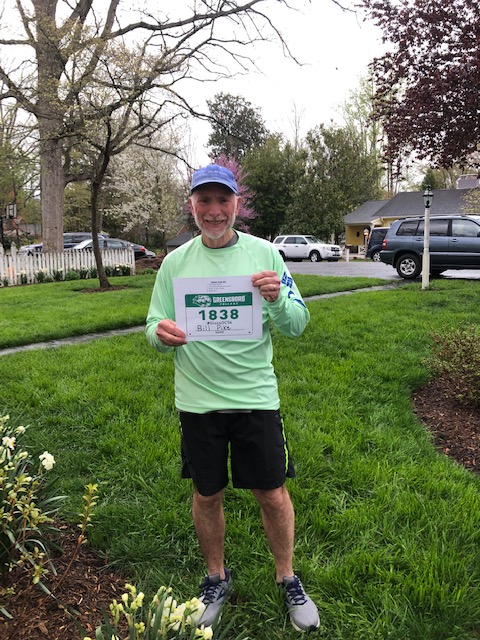
An old sack of bones April 1, 2023 (Photo Courtesy of Betsy C. Pike)
Author’s note: This baloney was sent to Greensboro College in April 2023. I’m told it was enthusiastically received. The plan was for the piece to be published in one of the school’s publications. To my knowledge, as of today’s date, Thursday, April 11, 2024, the reflection hasn’t been published. Due to personnel changes, it was lost, and forgotten. I was asked to resend it, and I did. If they decide to use the baloney, that’s fine, and if not, I’m ok. Please do not attempt to post the piece on any of the college’s social media. Thanks, Bill Pike
A few years ago, our youngest daughter, Elizabeth, gave us Amazon’s Alexa as a gift.
According to Wikipedia, Alexa is described as virtual assistant technology largely based on a Polish speech synthesizer.
I do not have the gray matter to comprehend the internal workings of this technology.
A precisely cut piece of marble sitting atop an antique storage cabinet is where Alexa sits in our eat-in kitchen.
I love being able to say to Alexa, play “When The Sun Sets On The Sage” by Commander Cody and the Lost Planet Airmen. And in a matter of seconds, the song is playing.
That’s how I stumbled upon a recording of a song by Alison Krauss and James Taylor—titled “How’s The World Treating You?”
The song was written in 1952 by Chet Atkins and Boudleaux ( pronounced Bood Low) Bryant.
The recording by Alison Krauss and James Taylor appeared on the 2003 tribute album— Livin’, Lovin’, Losin’: Songs of the Louvin Brothers.
The Louvin Brothers were an American duo who from the mid-fifties into the early sixties were known in country music for their tight harmonies. The brothers, Ira and Charlie, were very successful until Ira’s death in 1965.
In 2004, this tribute album won two Grammy awards, including Best Country Collaboration with Vocals for Alison Krauss and James Taylor.
The song is a classic country tear-jerker about the end of a broken romance.
Lyrically, the writer captures the brokenhearted feelings with lines like: “I’ve had nothing, but sorrow, there’s no hope for tomorrow, every sweet thing that mattered has been broken in two, how’s the world treating you?”
With the madness of March and the NCAA men’s and women’s basketball tournament, I imagine some fans feel “nothing, but sorrow, no hope for tomorrow, and have been left brokenhearted,” when their favorite team was beaten in the tournament.
Clearly, these discouraged fans probably feel like the world is not treating them too well. And yet, the song’s title, “How’s the world treating you?” is relevant for people who have been punched hard by life.
How is life treating the families of the construction workers who fell into the cold waters of the Patapsco River when the Key Bridge collapsed after being pummeled by a massive container ship?
How is life treating the families of a Texas school bus that was carrying Pre-K students when it was hit by a cement truck. The crash injured 51 and killed two. The students were returning from a field trip to a Texas zoo. Sadly, the driver’s confessed use of marijuana, cocaine, and lack of sleep contributed to the accident.
How is life treating the families of the loved ones who were killed and injured in the terrorist attack that took place at a concert in Moscow?
How is the world treating the family where Alzheimer’s disease has pushed a loved one into Hospice care?
How is the world treating the person who can’t find a ray of hope in any daylight as depression continues to wear this silent soul down?
Clearly, how the world treated my NCAA bracket is nothing in comparison to the brokenness that people experience any place in the world twenty four hours a day, seven days a week.
Proverbs Chapter 18, verse 14 reads: “The human spirit will endure sickness; but a broken spirit—who can bear?
I suppose I could ask Alexa who is responsible to help mend broken human spirits?
Maybe, Ed Sykes would be her answer.
For several weeks, I’ve been reading the book, The Patch and The Stream Where The American Fell.
This book was written by former United States Air Force Fighter Pilot, Ed Sykes. While flying a fighter jet during the Vietnam War, Lt. Sykes experienced the multiple challenges of wartime trauma. This included the loss of his roommate whose jet was shot down while completing a bombing mission.
Forty years later, and still haunted by the death of his friend, Lt. Sykes made a commitment to recover his roommate’s remains from the Laotian terrain where the jet crashed.
Sykes, with devotion and support from his roommate’s family, led the diplomatic and personal effort to recover Dave Dinan’s remains. He held firm to “Leave No Man Behind.”
Everyday, we encounter people who the world has left behind.
As best we can, with gentle, sincere kindness, we need to let these people know that while not experts in providing counseling or therapy, that you, me, we, us do care.
And maybe our caring includes hanging on to this wisdom from playwright, Eugene O’Neill: “Man is born broken. He lives by mending. The grace of God is glue.”
Alex on the corner of the marble top (Photo Bill Pike)
And if I’m not seen as much of a Christian because of my honesty about Easter, I understand.
My struggle is— I can’t figure out how a good man, in this case, Jesus, could be condemned and crucified on the cross for teaching people how to live a life grounded in love.
It is hard for me to consider celebrating the resurrection of Jesus when I don’t think he deserved to die.
Did he commit a murder?
Was he a thief?
Was he a liar?
Was he a fraud?
Was he evil?
No.
Seems to me that irrational, fear driven minds wanted Jesus condemned and crucified. The truth didn’t matter.
In James H. Cone’s book, The Cross And The Lynching Tree, he quotes Dr. Martin Luther King, and a comment he made after the assassination of John F. Kennedy. Dr. King told his wife: “This is what is going to happen to me also. I keep telling you this is such a sick society.”
Sadly, the sickness of our society has not gone away.
During March, the NCAA men’s and women’s basketball tournament generates lots of excitement across America. In the final seconds of an intense game, unexpected upsets can destroy a fan’s carefully constructed bracket. .
And unfortunately, for a team who earns a berth in the tournament, they can have their excitement disrupted by individuals who take pleasure in being disrespectful, hateful, and unkind.
On the evening of Thursday, March 21, as the University of Utah’s women’s basketball team was walking to dinner in Coeur d’Alene, Idaho “someone in a pickup truck displaying a confederate flag, yelled racial slurs, and revved the engine in a menacing way,” toward the team. (NBC, ABC, NPR, CNN)
Regrettably, this is another example of our “sick society.”
Bonnie Raitt is a gifted singer, songwriter, and guitarist. Perhaps, you have heard her Grammy winning song, “Just Like That.”
The song was inspired by a news story that Raitt had seen. A mother had donated the organs from her deceased child to help others. Because of this act of kindness, this courageous mother was able to meet the man who received her child’s heart.
Touched by the emotion of this meeting, Raitt wrote the beautiful song, “Just Like That.” I will admit, this is a song that makes tears well up in my old, weary eyes.
I am drawn to the song’s compelling lyrics, especially this line: “They say Jesus brings you peace and grace, well, he ain’t found me yet.”
In our “sick society,” we seemingly have many people who haven’t found Jesus, and his peace and grace. And truth be told, I have days when I wonder if I have his peace and grace.
As defeated as Jesus felt as he trudged toward his death on the cross, I can only imagine how he feels when he looks down on our “sick society.”
I have discouraging days too. Days, when I feel like giving up on scripture reading, pondering a devotional, and praying. On those days, I feel like the devil is a half step behind me.
And yet, something nudges me at the start of a new day to continue to read scripture, ponder a devotional, and pray.
My college roommate, H. D. Sherrill, Jr. is a graduate of Duke Divinity School. During his career, Reverend Sherrill had a variety of assignments in churches and local nonprofits. He is a very gifted storyteller.
Back in January, he shared a story, a conversation with one of his four grandsons. Reverend Sherrill wondered if this grandson might be interested in learning how to become an acolyte.
When he asked if the grandson had any interest, the grandson responded: “Pops, I’m not a churchy person.”
Reverend Sherrill accepted the honest answer.
A few weeks later, Reverend Sherrill noted that the not very churchy grandson was in the acolyte training class.
Curious, he asked his grandson why had he signed up for the class?
Reverend Sherrill received the best answer: “Pops, a person can change.”
Bonnie Raitt affirmed that in her song with this line: “And just like that your life can change.”
And even though as a so called Christian, I struggle with Easter, I will hold on to verse 21 of Romans 12: “Don’t be defeated by evil, but defeat evil with good.”
Happy Easter, love you all, Bill Pike
Pretty spring flowers courtesy of Trinity UMC Preschool students (Photo Bill Pike)
I have a hunch that no one looks forward to the preparation for a colonoscopy.
As I was working with my doctor’s office to finalize the appointment and confirm the prescription, I asked if the process for clearing my bowels had changed over the last nine years?
The scheduler who was working with me responded, “We can put a man on the moon, but the method for cleaning you out hasn’t changed.” I loved her humorous perspective.
When I went to the pharmacy to pickup my 1.5 liter jug of GoLytely, the clerk who checked me out, grinned at me and said, “have fun.”
On yes, I was looking to have lots of fun on Monday, February 26, and Tuesday, February 27.
With the help of my Commander Supreme, we read, and reread the dietary restrictions that I needed to follow prior to Monday. Then on Monday, my liquid diet began with bullion, jello, and the recommended beverages being slurped down at different times during the day.
I had already carefully mixed the intestinal clearing potion and added the lemon flavoring to the powdered mixture. Next, I stored this concoction in the refrigerator.
I wonder who sat around and figured out this whole miserable process?
My guess is these were deeply demented, mad medical researchers who worked for decades in a mysterious, subterranean lab in the catacombs of an unremarkable building out in the flatlands of America.
I wonder how they recruited the volunteers to test out these internal gutter clearing potions?
Wanted: Research project will pay for courageous, curious individuals who want to make a significant gastrointestinal contribution to mankind by testing the comfort level of toilet seats over a time frame of twelve hours.
Let me make this clear, there is nothing light about GoLytely once its activation started in my digestive tract. As my time on the toilet ticked along on Monday evening, I began to wonder if I would ever be able to go to sleep?
At some point close to midnight, the demons in my bowels said, “let’s shut this guy down for tonight, we’ll finish him up tomorrow, he is really overloaded with years of crap.”
In his book, The Patch and The Stream Where The American Fell, retired United States Air Force fighter pilot, Ed Sykes, describes an assortment of gauges that monitor the workings of the F-105 jet he flew during the Vietnam War.
Sykes discusses the exhaust gas temperature and the exhaust pressure ratio for the F-105 as these gases exited the engine. If those gauges had been part of monitoring my bowel clearing on Monday evening, the gauges would have broken. They would have become unreliable, inoperable.
Early on Tuesday morning, my intake of GoLytely continued and so did my toilet sitting. Yes, the cleansing continued. I had to finish the consumption of GoLytely by 10 a.m. Finally, my last fifteen minute interval arrived. I gulped down the last eight ounces of the this swill. Internally, I cheered.
At some point, my bowels said we’re done, I took a shower, and we made the short drive to St. Mary’s Hospital.
We parked in the deck. Made the quick walk to the main entrance to the hospital, and took an instant left into the registration area.
Once that was completed, a nice young lady walked us over to the waiting room for all who were enthusiastically anticipating their scoping procedure.
I don’t recall her words, but the receptionist used humor to try and calm us.
A lady sitting near us struck up a conversation with another patient. The lady who initiated the conversation with no hesitation started talking about recent legislation in Virginia related to medical marijuana. She was excited.
I overheard this chatter while my head was buried in Signed, Sealed, and Delivered The Soulful Journey of Stevie Wonder. My North Carolina, childhood friend, Joe Vanderford, and I are teaching a class on Stevie Wonder for the Osher Institute of Lifelong Learning at the University of Richmond in March.
At some point, the receptionist gave the Commander Supreme the scoop on how to read the monitors related to patient status, and then I heard my name called.
The Commander wished me luck, and I walked through the double doors with the nurse.
The first thing she asked me was my birth date. For some reason, I looked down at my wrist band. My birth date was incorrect on the wrist band.
Luckily, it did not take an act of our dysfunctional pals in Congress to have the required correction made.
I made one last trip to the restroom before changing into the hospital gown. Then, crawled on to the gurney that would be my home for the next couple of hours.
For several minutes, the nurse and I reviewed my medical history.
An IV was started on the top of my right hand.
Soon, the anesthesiologist introduced herself and walked me through how she was going to knock me out.
Just before I was wheeled into the invasion of the intestines room, the doctor, who looked to be about fifteen introduced himself and talked about the process.
As I was settled into my new location, more introductions from the people who would be taking care of me took place. Again, they verified that I was really me, and then I was out.
This brief period of snoozing was good, and at some point I started to wake up.
Nurses asked questions.
Gradually, a nurse gave me this startling update—the doctor removed five polyps from exploring my intestines. I was shocked at this news. This had never happened in previous invasions.
Eventually, I was awake enough to sip ginger ale and to get dressed. I received post-procedure orders, and then I was wheeled out to our car.
The commander confirmed her conversation with the doctor about the five polyps. Now, I had a two week wait for the lab analysis of those troubling tissues.
Back in 1992, when my mother died from throat cancer, I remember talking with our neighbor, Bennett Amick. I’ve never forgotten Mr. Amick’s words.
He said, “people ask me all the time—how are you doing? I tell them, I’m fine. But, the truth is—I really don’t know how my body is doing inside of me.”
Mr. Amick’s words resonated with me because I can seem to be fine, but I really don’t know what might be conspiring in the cells of my body for a collision.
And, I thought further about this purging, this temporary cleansing of my digestive tract.
Why can’t we cleanse ourselves of the evil that causes so many problems in our world today?
In our class for the Osher Institute, Joe and I will be taking a close look at three albums by Stevie Wonder. One of those albums Music of My Mind released in 1972 ends with a song titled “Evil.”
Lyricist Yvonne Wright ask a series of introspective questions about evil:
Evil, why have you engulfed so many hearts? Evil, why have you destroyed so many minds? Evil, why do you infest our purest thoughts with hatred? Evil, why have you stolen so much love? Evil, why have you taken over God’s children’s eyes? Evil, why have you destroyed?
Here we are fifty two years later, and I’m afraid the questions raised by Wright about evil are even more prevalent in our world today. Why is that?
Well, my mind tells me there are multiple reasons.
Perhaps a reasonable starting point might be our inability to solve vicious generational challenges related to mental/physical health, housing, nutrition, unemployment, safety, justice, education, and equity. This is despite spending piles of money in these areas.
As a nation, we are more likely to spend billions—billions exploring space from every possible angle while America struggles to solve its fiscal, physical, and human infrastructure challenges.
Toss in our political divide, our inability to find common ground to work together, our nation’s spiritual decline, and we have a mess. But, if we are honest with ourselves, despite our good moments, America has always been a mess.
At some point in the last few weeks, we finally sat down and watched the movie, A Man Called Otto.
Yes, I will admit, Otto and I are very similar. We both excel in our grumpiness.
Essentially, Otto has three hearts.
Otto’s body heart suffers from a medical condition hypertrophic cardiomyopathy. This condition causes the heart muscle to thicken making it hard for the heart to pump blood.
His second heart, is heartbroken over the death of his wife.
Otto’s third heart is a heart that lives in isolation. This heart refuses to let love come into his life.
As the movie progresses, Otto’s third heart begins to change. His neighbors impact the changes in his heart.
Otto comes to understand their needs. He begins to understand how his skills, experiences, and his own stubborn persistence can help his neighbors and the significant challenges they face.
But, it is through the collective determined hearts of Otto and his neighbors that they push back a bit of evil.
I’m not going to lie to you.
Just like I was dreading my colonoscopy on February 27, there is part of me that dreads skimming the news headlines every day. Quite often, these headlines are tainted with evil.
For years, we have been unable to find a lasting peace in the Middle East.
For years, no matter whether a Democrat or a Republican has been our President, we have never been able to develop and implement an immigration policy that works.
For years, Putin in Russia has been a perfect example of an evil dictator with no heart or conscience.The war with Ukraine and the death of his leading opponent, Alexei Navalny, are only two examples of his vicious villainous empty chest.
For years, America has been unwilling to solve our never-ending loss of life from the use of firearms.
For years, the world has been unable to solve the challenges in Haiti.
For years, Americans have been searching for the ultimate high and subsequently dying from drug overdoses.
For years, for years, for years, for years, our challenges have remained relentless in wearing America down and pushing us into a despicable, disrespectful divide that threatens the soul of our democracy.
Our hearts need immediate work.
I wonder if there is a GoLytely for hearts?
Our hearts need a purging, a cleansing.
Our hearts can’t continue to live like this.
And the truth of the matter is we know our hearts can’t continue down this path, and yet, we appear unwilling to change them.
Steve Jobs once said: “For the past 33 years, I have looked in the mirror every morning and asked myself: ‘If today were the last day of my life, would I want to do what I am about to do today?’ And whenever the answer has been ‘No’ for too many days in a row, I know I need to change something.”
In A Man Called Otto, screenwriter, David Magee, carries us deeper into Otto’s world at a graveside conversation that he has with his deceased wife, Sonya.
Otto is concerned that a local real estate company, Dye & Merika, wants to buy up the homes in his neighborhood and turn the land into condos.
In the conversation with his lost love, Otto states: “Dye & Merika—what idiot thought that was a good name for a real estate company? Sounds like ‘dying America’…It is, I suppose.
‘Dying America…’ it is, I suppose.’
Deep in my heart, I have sensed this feeling “dying America” for a long, long, long time.
Look, this will not be simple or easy, but our hearts can’t let our democracy die.
On Thursday, March 14, I was reading the daily devotional from the Upper Room. The suggested scripture reading was Hebrews Chapter 11.
Reading from the New Oxford Annotated Bible Revised Standard Version published in 1973, verse 16 immediately resonated with me: “But as it is, they desire a better country, that is, a heavenly one.”
As I have stated many, many times, I’m no Biblical scholar. I’m not the person to give you the historical angles for this chapter in Hebrews, nor its significance.Yet, “they desire a better country” hit me.
I wonder how those words hit you?
Deep in our conflicted, divided, stubborn hearts isn’t that what we all want “ a better country” for all?
If you, me, we, us want to truly reclaim “a better country” for all, maybe we need to ponder more deeply in our hearts this quote from Winston Churchill: “All it takes for evil to triumph is for good people to do nothing.”
On the morning of Friday, January 26, 2024, I decided to take my second run in the Waialua neighborhood where we were staying. I wanted to see if I could complete a run that I had taken the last time we visited in Hawaii.
It looked to be another pretty day with more sunshine and blue sky. I made my way out to the Waialua Beach Road, and started my run.
My quads were still a bit touchy from my run on January 24. As I eased my way back on to the narrow single lane road that will carry me deeper into the neighborhood, I felt pretty good.
This is a nice place for an old guy to run as the road on this trek is flat. The only hills I see are the Waianae Mountains that form an appealing backdrop.
It is quiet back here. Occasionally, I hear the crow of a rooster, or a slowly passing car. But that’s it.
I enjoy running in a different environment. If I was back in Richmond taking a run on January 26, unless there was a significant winter warm up, I would not be running in shorts and a t-shirt.
My pacing is good, and I decide to push further into the neighborhood so that I can complete the full circuit. When I make my final left turn, I pass by a retreat center, Camp Homeland, that is run by the local Salvation Army. This center still appears to be in good shape since our visit to Hawaii in December 2021.
I work my way out of the neighborhood and end up on the asphalt trail. Gradually, I come to the street that takes me back to the house. I check the traffic and trot across the street. My run time clocks out at 38:15.
After breakfast, we figure out a plan for washing clothes, talk about our departure time for the port on Saturday morning, and coordinate our ride back into Haleiwa for some shopping and lunch.
Loaded in the van, we made the short drive into Haleiwa. We took advantage of the parking lots behind the shops.
We revisited some of the same shops, and made a few new stops too.
A unique shop is the Kokua General Store. The General Store is a part of the Kokua Hawaii Foundation. In 2003, the foundation was started by musician, Jack Johnson, and his wife, Kim.
Kokua General Store (Photo Bill Pike)
A friendly staff and an array of unique products await visitors. The store prides itself as a “bulk, refill, and low-waste lifestyle product store.This space provides the community the tools needed to reduce waste in their lives.”(From website)
In close proximity to the Kokua General Store is the Waialua Courthouse. The courthouse opened in1913. The building became a part of the Hawaii Register of Historic Places in 1979. By 1989, the building was closed, and it fell into disrepair.
Waialua Courthouse (Photo Bill Pike)
Thankfully, the Haleiwa Main Street Program helped to lead the renovation. By 1997, the restoration was completed. Now, the building is used for community meetings and native Hawaiian cultural activities. (Historical Marker)
Our shopping came to an end, and we walked to one of the parking areas where food trucks are located.
Betsy and I headed to the Crispy Grindz. Here, we ordered two Acai bowls loaded with fruit toppings.
After lunch, we drove back to the house. The washing of clothes continued, and more talk about Saturday took place.
Dan, Betsy, and I decided to take a walk down to the beach with the goal of taking a swim. Once on the beach, we walked in a westerly direction.
The water was exceptionally clear, and along the way we began to spot numerous turtles. In fact, there was a turtle up on the sandy shoreline.
And of course, neither Betsy, Dan, or I brought a camera or phone with us. So, we missed multiple opportunities for turtle photos.
We found a calm, pool of water between the reef breaking waves and the shallow shoreline. The Pacific’s water seems less salty than the Atlantic, but the clarity was unbelievable.
Refreshed from the swim, we reluctantly made the walk back to the house. The remainder of the afternoon passed quickly.
I did a bit of organizing for packing, and before we knew it, we were driving over to meet Brandy and Parker for dinner at the Haleiwa Beach House Restaurant.
Again, we had a delicious meal and enjoyable conversations. One of the nice things about this restaurant is its location.
The front of the restaurant runs parallel to the Kamehameha Highway, and just across this thoroughfare is the Haleiwa Harbor. With a little luck, diners are treated to some very pretty sunsets.
Our dining fun gradually came to an end. We said our goodbyes and thanks to Brandy and Parker for all of their hospitality during our visit.
Back at the house, the last of the laundry was being done, and the pace of the packing started to pickup.
My old body was asking for sleep.
Our last morning in Waialua would be here before I knew it.
And before dozing off, my mind wondered back to the short walk on the beach and the quick swim in the Pacific. I’m still amazed at the clarity of the water.
I imagine that clear water is critical for the survival of the turtles.
It would be my hope that we can continue to find ways to keep the water clean not only for the turtles, but all sea life, and ourselves too.
Sunset colors across from the Haleiwa Beach House Restaurant (Photo Bill Pike)
This week, the men’s Atlantic Coast Conference(ACC) basketball tournament has tipped off in Washington, D.C. at the Capital One Arena. Thus, the streets around the Greensboro Coliseum will be less hectic.
What was once the premier college basketball tournament in America has been diminished by illogical thinking and the lure of money.
When the conference was founded in 1953, there were eight teams. Six of those schools remain. Soon, the conference will expand to seventeen teams.
I wonder what ACC leaders might learn from this Marc Andreessen quote: “There is the opportunity to do more and better if you’re smaller and more nimble.”
So, ACC Commissioner Jim Phillips, remember, if the expansion isn’t the right fit for the new teams, the conference can invite Guilford College and Hampden-Sydney. Both will be playing in the NCAA Division 3 final four this week, and geographically, they fit.
Bill Pike Richmond, VA
The writer grew up in Burlington.
This letter was published in the Wednesday, March 13, 2024 edition of the Greensboro News and Record.
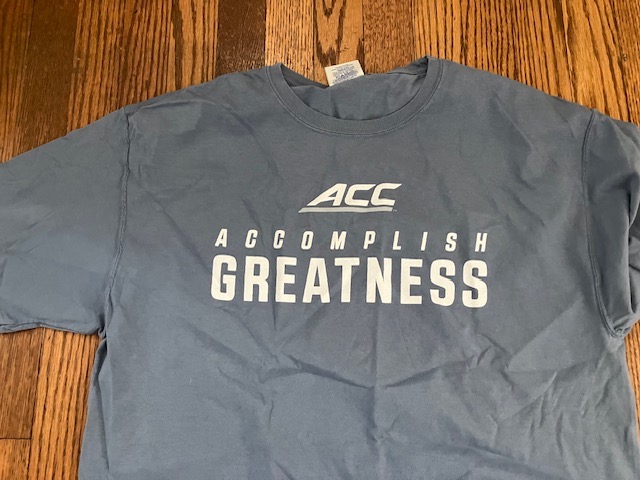
T-shirt courtesy of Joe Vanderford (Photo Bill Pike)
On Monday, November 20, 2023, Barbara Osborne passed away. My friend, Bruce Bowen, called to tell me.
Bruce and I, like many others, had the privilege to work with Barbara at Hermitage High School. At Hermitage, Barbara was one of our essential and critical employees. She did the behind the scenes work to keep the school running.
Another Hermitage High School colleague, David Howe, reminded me that at one time, Barbara was the study hall czar. She organized and kept tabs on the students who were assigned to a study hall during the course of a school day. That was one tough job.
I also seem to recall that Barbara had something to do with the attendance office. Another nightmare of a job that required perfect record keeping and lots of interaction with parents and their students. At some point, Barbara found what I believe was her permanent home in the school’s Guidance Department. Again, she was a keeper of records, this time those academic records for each student.
These records have traveled with a student from kindergarten to his/her current grade level. In working with these documents, Barbara had to know school system policies, state board of education protocols, and federal guidelines related to privacy.
She was the pivot point as the registrar for preparing and providing transcript requests made by students for college applications, employment, and military enlistments
One thing is very clear, no matter where Barbara Osborne served at Hermitage High School, she served with distinction, and grace, and dignity.
On the evening of Friday, February 23, I had the privilege of attending Barbara’s visitation at North Run Baptist Church. I viewed with interest tables holding photographs of Barbara, her late, beloved husband of sixty eight years, Bob, and their family. Those photographs captured the stories of their lives.
Those cherished photographs present happy faces. The photographs don’t captured the ups and downs, the sacrifices, and the hard, hard work it takes to sustain a family, but Barbara and Bob persevered. No matter what life tossed at them, they survived for this family.
During the visitation on Friday evening, I was able to interact with friends, family members, and two of Barbara’s three children. I wanted them to know that Barbara was one of the best human beings that God ever made. And I meant what I said—best human beings that God ever made.
In April of 1972, singer/songwriter, Neil Young, scored a hit record with a song he wrote titled “Heart of Gold.” In the song, Young writes about searching for a heart of gold.
Well, if Mr. Young had ever met Barbara Osborne, his search for a heart of gold would have come to an end.
I’m convinced that is why Barbara Osborne was such a special human being—she possessed a heart of gold.
In all of my years of working with her, I never heard a complaint, or an unkind word. If something went wrong(which it rarely did), Barbara took responsibility and learned.
Barbara was a people person.
No matter the setting, she knew the importance of attentive listening, and undoubtedly, she understood the significance for building relationships. A heart of gold allows a person to listen and build relationships.
In looking at those family photographs, it is also clear to me that everything Barbara and Bob did for each other, their families, and friends in the community was grounded in love.
And to be honest, I know Barbara wasn’t perfect. I’m sure she had some meltdowns. She’s human and not immune from imperfections, but I never saw those moments.
Scattered throughout the Bible are numerous verses of scripture related to love and prayer. My hunch is “you shall love your neighbor as yourself” and “rejoice in hope; be patient in affliction; persevere in prayer” formed the core of her daily walk through life.
Our missing of Barbara Osborne started on November 20, and hey God, that is why we need you to make us another Barbara Osborne.
But the truth be told God, we need you to make more than one of Barbara. The world would become a kinder and gentler place if we could share her with this conflicted world.
And at this very moment, this old world sure could use Barbara’s heart of gold.
Barbara Osborne (Photo Bill Pike from 1989 Hermitage High School yearbook)









 might be baloney