As a lifelong Methodist, I feel an obligation to let you know that the Virginia Conference of the United Methodist Church will hold its annual gathering at the Hampton Roads Convention Center starting June 20.
We are a fairly tame group. Occasionally, we get riled up. If I were you, I wouldn’t fret too much. Navigating a large religious organization is like attempting to turn a battleship in the Norfolk harbor—slug pace.
Since attendance and interest in churches is down across America, you might have missed an overdue tsunami shift in the United Methodist Church. At the church’s General Conference held in May in Charlotte, North Carolina, delegates finally voted to repeal its ban on LGBTQ clergy and now allows clergy to perform same-sex weddings.
In my opinion, this new policy was long overdue. The fifty years of skirmishes within the denomination over this matter significantly divided Methodists causing some to disaffiliate from the church.
As pleased as I am with this decision, and as good as it feels to those who fought the battle, we Methodist still have lots of work to do to turn our battleship.
An article in Christian Century by longtime Methodist leader, Will Willimon, should be required reading for Methodists. In this article, Willimon acknowledges “some good steps” were taken in Charlotte. However, he also states: “but we are too afraid to name certain truths.”
Willimon doesn’t hold back in naming those truths. His points are grounded in how the church loss members related to its LGBTQ stance, the challenges church leaders face in managing this oversized, wobbly body, grim financial realities, massive church attendance decline, and the graying of the denomination.
Despite our efforts, I sense Willimon’s points at my Methodist church where I am a member and an employee.
This year, I will not be attending the conference in Hampton. But I hope that our Virginia Bishop, Sue Haupert-Johnson, her team, and delegates will move us beyond treading water.
While we tread to keep from sinking, I have the following questions:
How is the consolidation of districts in the Virginia conference working? Has this budget shaving move helped?
How many churches in the conference are hanging by their financial fingernails?
If financial instability leads to more church closings, how might these buildings or land holdings be converted into affordable housing across Virginia?
How can the Bishop and her team help local pastors and their congregations address our aging and lack of diversity?
Can Methodist churches in our communities provide leadership to help us address our division and political polarization? Can these church leaders help us to become better listeners and neighbors?
Prior to my church work, I spent 31 years in Virginia’s public schools. Those experiences make me wonder if congregations might benefit from a thorough “self-study/accreditation” process.
This would be similar to the format utilized by the Southern Association of Colleges and Schools. I sense congregations who are willing to ask tough internal questions about finances, programming, data, outreach, human resources, and facilities will be shocked at what they learn about their church operations.
Personally, I believe Methodist churches in Virginia have an opportunity in front of them. At this critical point in forming the church’s future, I hope conference leaders and congregations keep this quote from Thomas Edison pasted to their foreheads: “Opportunity is missed by most people because it is dressed in overalls and looks like work.”
During their three days in Hampton, it is my hope that Methodist leaders and delegates will not fear the work ahead of us and miss an opportunity.
In his article, Will Willimon reminds Methodists that “hope is not a strategy.” He is correct.
To turn our worn Methodist battleship, we will need to work together, with a sense of urgency.
The denomination can’t withstand another fifty years of treading water.
On the afternoon of Tuesday, May 14, our office administrator, Paula Cadden, handed off a phone call to our associate pastor, Daniel Guenther.
The mother on the phone was calling in desperation. She was behind $2,400 in rent. Her landlord had a court date set for Thursday, May 16. Anxiety, stress, and tears rang in Daniel’s ears as he listened intently to the urgency of the mother’s pre-eviction pleadings.
Daniel made one promise. He would have an answer for the mother by midday on Wednesday.
After Pub Theology on Tuesday evening, Daniel and I talked a bit further about the mother’s situation. Interestingly, our guest at Pub Theology, Richmond radio personality, Mike King, made a point about countering the predictable “no” that we often use as a response to a question with an unexpected “yes.”
On my way home, I stopped by Trinity to secure the building. Before leaving, I sent an email to our church treasurer asking how we might fund the mother’s request. I also emailed two members who have expertise in law and housing.
On Wednesday morning, Daniel, our senior pastor, Brian Siegle, and our kids director, Jen Williams, dove deeper into the mother’s needs. In looking at documentation provided by the mother and the landlord, we had a number of questions. So, we reached back out to the landlord for some clarity. While his answers helped us, we continued to wrestle with our own internal debates.
We talked, thought more, considered our options, and gradually formulated a plan. The plan positioned the church to cover a portion of the debt. We also included a referral to a local nonprofit, ACTS, where the mother would receive counseling on how to more carefully manage her income. Perhaps, more importantly, the landlord approved of our plan, and canceled the court date.
Daniel followed up with the mother, and while she was temporarily relieved, the tough work of making this plan work was still in front of her.
I think our staff felt good about the potential of this plan to make a difference for the mother. And while I believe we learned from the situation, maybe the most important question is— what did we learn to help us prepare for the next person who makes a similar request?
This week, one of the devotion writers from the Upper Room cited this scripture from John 16:33: “I have told you these things, so that in me you may have peace. In this world you will have trouble. But take heart! I have overcome the world.”
Sometimes, I think the greatest challenges we face in this world is overcoming ourselves.
As I was driving out to Pub Theology on Tuesday afternoon, I heard a story on National Public Radio about the primary in Maryland for a seat in the U. S. Senate. David Trone, a Maryland Congressman, and founder of Total Wine and More, has spent $40 million of his own money to attempt to win the nomination for the senate seat.
On that same Tuesday evening, Trone lost the primary election—$40 million dollars gone.
I thought about our mother who was behind in her rent. I wondered—how many mothers in arrears across America could Congressman David Trone helped with the $40 million he spent on a failed bid for a Senate seat?
Anyone with an ounce of common sense knows that our hearts are going to experience trouble in our walk through life.
But how much of that trouble comes from our inability to overcome ourselves?
What does it say about a society where we spend billions on our political campaigns, but continue to be unable to solve our longstanding problems related to mental and physical health, housing, safety, food instability, unemployment, and equity?
Out on Battleground Avenue North in Greensboro, North Carolina, the words “God Can” appear on the outside wall of the sanctuary at Charity Baptist Church.
When we visit our oldest daughter and her family in nearby Summerfield, those words always catch my attention as I drive by while running an errand.
Honestly, there are days in my life when I wonder if “God Can” anymore?
Have we given up on him?
Has God given up on us?
And then a day like Tuesday, May 14 will arrive.
Days like that are an opportunity for a staff to be guided and nudged by God. God’s nudging led a staff to counter the troubles the mother was facing. Essentially, God led us to respond with the unexpected “yes.”
For those few hours of teamwork, I learned that God Can help us to overcome ourselves.
Just under the center window “God Can” (Photo from the internet)
I can’t believe it has been one year since the passing of my wife’s mother.
Early on the morning of June 1, 2023 in West Hartford, Connecticut, Liz checked out.
She told that demon cancer where to go.
Liz had too much dignity and grace to really give that evil intruder a good cussing out.
Her family knew this day was coming.
The last few days before June 1 had been tough.
Knowing that you are losing a loved one wears a family down. Her living children experienced this as did the grandchildren who were able to make final visits.
In that year, much has happened.
This old world has become more troubled.
Despite the restless world, in July, thirty plus family members gathered in Falmouth on Cape Cod in Massachusetts to celebrate Liz and her husband, Ken.
Liz and Ken were responsible for introducing us to the Cape. I don’t think the memories created there will ever leave us.
On a beautiful Cape morning, we gathered in Patuisset on a favorite beach to share our love of Liz. Some of her ashes were scattered into the tranquil brine with Bassetts Island as a backdrop.
Then in September, the family had a beautiful celebration of Liz’s life at St. James Episcopal Church in West Hartford, Connecticut.
And as dismal as the world can be some days, there was a special arrival in February. Another great grandchild arrived in San Fransisco. Liz would have loved Ashley and Rob’s new daughter, Bridgette.
I can see Liz carefully studying Bridgette’s beauty. I can hear her sharing Bridgette’s arrival with her friends. I’m sure Liz did this humble bragging in the wild blue yonder with her angel friends too.
With patient perseverance, Betsy, Abby, and Ken have worked to meet the requirements of Connecticut laws, bankers, and lawyers to officially close out the paperwork of Liz’s life.
Earlier in May, Abby flew from California to Richmond for the purpose to sort out framed pictures, photographs, and other family artifacts. One morning, Abby, Betsy, and Ken gathered at our kitchen table sorting through stacks of the snapshots of life.
We’ve continued to live out our lives.
We keep in touch, and I suspect, we all have our Liz moments.
We’ve missed her elegant touch, family stories, and her robust, contagious laugh that always turned to tears at the dinner table for Thanksgiving, Christmas, and Easter.
On a desk in our kitchen is a digital picture frame.
Some days, Liz will appear in the magic of that technology.
Her smiling face is present. She is surrounded by the family who loved and respected her.
I stumbled upon this quote from James Gates Percival: “There are moments in life that we never forget, which brighten and brighten as time steals away.”
Elizabeth Crosby Cloud was more than a moment in our lives. But our memories of her will only continue to ‘brighten and brighten as time steals away.’
I never met my father’s oldest brother, Boyd Pike. But, I think of Boyd every Memorial Day.
Boyd was a Fireman Third Class aboard the USS Sims, a United States Navy destroyer. In early May 1942, my grandparents received the notification from the Navy that no parents want—Boyd was missing in action.
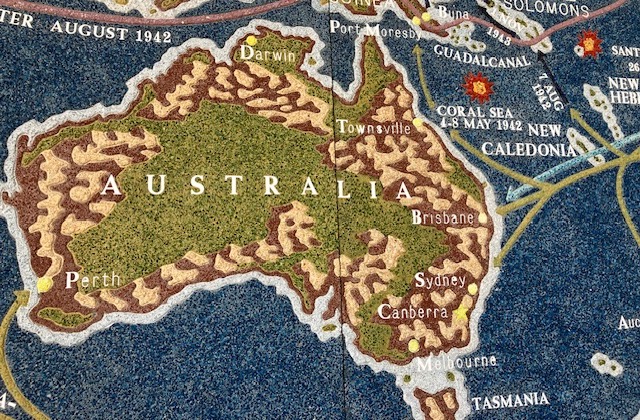
In the Coral Sea, the Sims had been escorting an oiler, the Neosho, when both ships were attacked by Japanese fighter planes. Unfortunately, the Sims could not withstand the fierce attack. The ship sunk. Thirteen survived. Boyd was not one of them.
A year later, the family received official notification from the Navy declaring Boyd dead. Boyd’s parents and nine siblings are now deceased. Yet, the nieces and nephews in the family make a point of not forgetting Boyd’s sacrifice.
In an United States military cemetery in the Philippines, there is a grave marker for Boyd. In the cemetery, at the family’s home church, Mt. Pleasant United Methodist in Guilford County, North Carolina, a gravestone honors Boyd.
I don’t expect in my life time to make an excursion to the Coral Sea or the cemetery in the Philippines to honor Boyd. Yet, I hold in deep respect Boyd and the United States military personnel who gave their lives to preserve our freedoms.
In January 2024, with friends from college, my wife and I had the privilege of making our second trip to Hawaii. During this visit, we made a point of taking our friends to the Pearl Harbor National Memorial and to the National Memorial Cemetery of the Pacific.
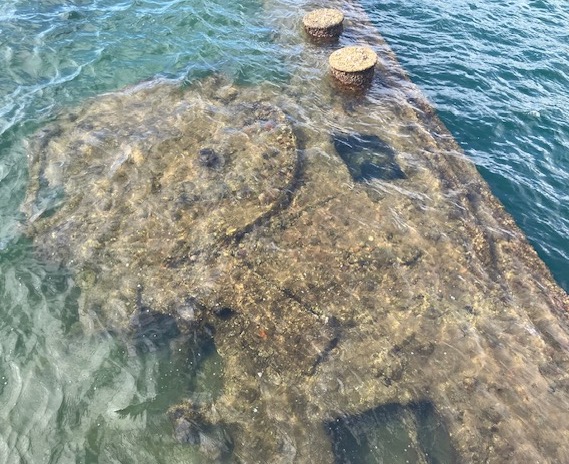
Each memorial is distinct in their offerings to the public. At Pearl Harbor, the displays capture what took place on the morning of the attack. But for me, the most moving part of Pearl Harbor is the boat ride to the USS Arizona Memorial.
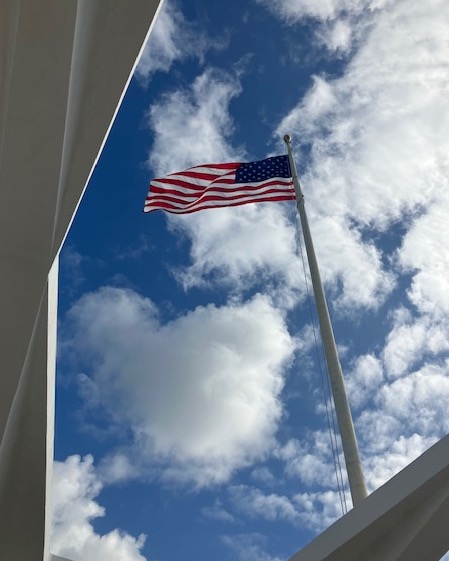
Before boarding the boat, an atmosphere of quiet reverence hushes all visitors. That restraint is maintained throughout the visit. At the Arizona’s memorial, the stillness is broken by the American flag flapping in the breeze, and the solemn voice of a docent carefully recanting what the crew of the Arizona experienced on the fateful morning.
A section of the rusting Arizona (Photo Bill Pike)
At the National Memorial Cemetery of the Pacific, a quiet reverence is also present. Here, the setting is in the crater of an extinct volcano. The cemetery is nicknamed the “punchbowl.”
The meticulously maintained grounds frame out the grand stairs with their majestic panels. These panels form eight courts. Inscribed on the panels are the 18,095 names of the missing from the battles in the Pacific during World War II.
Looking down the grand stairs (Photo Bill Pike)
At the top of the stairs, visitors will find another area of displays capturing the battles in the Pacific. Rendered in mosaic tiles, I found the Coral Sea with the posted days that the attacks took place in May 1942.
Tile mosaic note the Coral Sea (Photo Bill Pike)
The walk to the area of the overlook is worth it. At this point, visitors look down over Honolulu with the blue Pacific Ocean forming a sun sparkled backdrop.
When my wife and I returned from our Hawaiian trip, we started to work on our plans for a visit to New Orleans. My main purpose for making this journey was to visit The National World War II Museum.
On Thursday, May 9, we spent our entire day at this museum. The museum’s location in New Orleans is tied to the Higgins boats. These landing craft were built in the city. They were used to transport our troops to the beaches of Normandy on D-Day.
A Higgins boat (Photo Bill Pike)
The museum is massive. Curators missed no details in capturing World War II from its beginning until the final victory. To take in the museum in a day, we had to hustle.
Yet, our quick, but focused pace allowed us to appreciate the hearts and souls, and sacrifices of all Americans during the war. Their determination is well documented.
No question that films, short videos, and photographic displays add much to the telling of the World War II story. However, my wife and I were touched by multiple recorded interviews with our military personnel who gave firsthand accounts about their experiences during the war.
I wonder what my Uncle Boyd’s story would have been if he had survived?
As an imperfect American, one thing is very clear to me— we can’t allow ourselves to forget the stories from World War II.
At various points around the museum are quotes from famous leaders. Inscribed in stone, I’ve been thinking quite a bit about this quote from George C. Marshall: “The soldier’s heart, the soldier’s spirit, the soldier’s soul are everything.”
This Memorial Day, and those in my future, I hope I never fail to understand that my existence is forever linked to the heart, spirit, and soul of those soldiers and their sacrifice.
American flag at the Arizona Memorial (Photo Bill Pike)
Author’s note: On Monday, May 13, 2024, this letter was sent to the editors of the Washington Post. On Thursday, May 16, I was notified by an editor that the letter was under consideration for publication. I had to answer a few questions, and then review an edited copy of the letter. On Friday, May 17, I received a final draft of the letter to review and approve. That final draft was published in the Saturday, May 18 edition of the Washington Post. The final edited version appears after the original letter I sent.
As a retired Virginia public schools’ educator, I was disappointed to read that the school board for Shenandoah County Public Schools has voted to reinstate Confederates’ names to two of its schools.
This is another example of how the fear of losing touch with the past pushed this school board to reverse a logical decision made by a previous Shenandoah County school board in 2020.
But of course, fear can prevent a school board from thinking logically. Only one member of the school board, Kyle Gutshall, thought logically and voted against reinstating the Confederates’ names.
I wonder how many of the conservative influencers in the county who orchestrated this change actually have students in the school system?
The school board stated the cost to install new signage will be covered by private donations. Will these same private donors step forward when the school system has a budget crisis with a dead HVAC system in a school?
School systems in Virginia are struggling to find and retain skilled teachers. After this decision, why would any prospective teacher consider applying to Shenandoah County Public Schools?
I’m sure the teachers in the Shenandoah system are deeply appreciative of the extra level of pressure that has been placed upon them with this regressive decision.
Since this school board is so intent to preserve the past, perhaps they would benefit from a group reading of Isabel Wilkerson’s The Warmth Of Other Suns. Yet, I’m uncertain the harsh truths documented in this book could even jolt their insensitive stubbornness.
I appreciate this quote from American writer, E. B. White: ‘The only sense that is common in the long run, is the sense of change and we all instinctively avoid it.”
Public school systems that instinctively avoid needed changes will continue to find difficult challenges in the future.
One of the most difficult of those challenges will be dealing with the morale of every student, parent, and teacher who put their trust in the school board to make a reasonable decision for the good of all, not just those who fear losing the past.
The edited letter as it appeared in the Washington Post on May 18, 2024.
As a retired Virginia public schools educator, I was disappointed to read that the school board for Shenandoah County has voted to reinstate Confederate names to two of its schools. The decision itself is foolish, reversing a logical decision made by a previous school board. And it made me wonder how many of the conservative influencers in the county who orchestrated this change actually have students in the school system?
The school board stated the cost to install new signage bearing the schools’ reinstated names will be covered by private donations. Will these same private donors step forward when the school system has a budget crisis, or a dead HVAC system in a school leaves students learning in freezing or sweltering conditions?
School systems in Virginia are struggling to find and retain skilled teachers. After this decision, why would any prospective teacher consider applying to Shenandoah County Public Schools if this is what the school board prioritizes? And how must teachers in the Shenandoah system feel about the extra level of pressure that has been placed upon them with this regressive decision?
E. B. White once wrote: ‘The only sense that is common in the long run, is the sense of change and we all instinctively avoid it.” Public school systems that instinctively avoid needed changes will continue to find difficult challenges in the future.
Among the challenges the Shenandoah County School Board has created for itself is how to earn back the trust of every student, parent and teacher who looks to the school board to make reasonable decisions for the good of all, not just those who fear losing one version of the past.
As a lifelong member of the United Methodist Church, I’m relieved with the news from Charlotte, North Carolina.
On May 1, multiple news outlets reported that members attending the General Conference of the United Methodist Church “by a 692-51 vote, passed several rules without debate, including overturning both its ban on gay clergy and the penalties for holding same-sex marriages.”
From my perspective, it’s about time for the church to initiate this change.
This emotional issue has resulted in many Methodist churches in America leaving the denomination through a disaffiliation process. Methodists aren’t the only mainline denomination to be walloped with challenges related to human sexuality.
For many years, data has a revealed a steady decline in church attendance across America. While it is true that the pandemic added to the woes of churches, churches were struggling before COVID-19 hit. Declining attendance, shrinking budgets, and deteriorating facilities are among the challenges experienced by churches that resulted in closures.
In Virginia, I had the privilege of attending three annual conferences. At each annual conference a handful of churches were closed because of challenges related to attendance and finances.
Even if the reorganization plan gives relief to the church’s stance on human sexuality, challenges related to attendance, finance, and facilities are not going away.
With a decline in church attendance and religion in America, the release of a January 2024 report from the Pew Research Center has an interesting finding.
The Pew report found that the “religious ‘Nones’ are now the largest religiously unaffiliated cohort in America at 28%. The ‘Nones’ are larger than Catholics 23% and evangelical Protestants 24%.”
I wonder how many of the ‘Nones’ are from the LGBTQ community, or individuals who didn’t grow up in the church, or who had an unpleasant church experience? Also, I wonder if the Methodist church or any other mainline denomination can find ways to bring the ‘Nones’ back to church?
For the last twelve years, I’ve had the privilege of working at the Methodist church where my family and I are members. With this work, and in my previous career in public education, I’ve come to realize that churches like schools are interesting places as they both center upon working with people.
I find church leaders and their congregations to be good people who care deeply about their church. However, these good people are often reluctant or incapable of making needed changes. This inability to change has hurt churches more than they realize.
Whether related to human sexuality, declining attendance, drops in revenue, and deteriorating facilities, I don’t think we’ve seen the end of church closings. And there is part of me that wonders if churches would benefit from undergoing an accreditation process. Schools, fire/police departments, non-profits, and some professions are familiar with this practice.
I’m curious to learn if the challenges that churches are experiencing could have been avoided or corrected with a rigorous “self-study.” This diligent internal examination would require churches to carefully assess their programming, personnel, finances, facilities, outreach, and communication. Even if an accreditation process was available to church leaders and their congregations, I’m not certain they would pursue taking a hard look at themselves. It is easier to develop a strategic plan that collects dust rather than asking difficult internal questions about your operations.
However, if churches have any desire to slow their downward spiral, leaders and their congregations must work quickly to assess their fiscal, mental, physical, and spiritual health status.
Our current church times are in sharp contrast to the boom of the 50s and 60s. Then the mentality was if we build a church—they will come.
Within easy driving distance to our church are five other Methodist churches. Today, any of those congregations could be nervously thinking— ok, we’ve built this church, but do we have capacity to sustain it?
In her book, Factory Man, author, Beth Macy, wrote about John Bassett III, and the challenges he faced in America’s furniture industry. I love this advice from Mr. Bassett— “be willing to change and improve repeatedly.”
If the United Methodist Church has any hope of being around for fifty more years, church leaders and congregations must “be willing to change and improve repeatedly.”
Failure to change beyond the Charlotte vote guarantees two things: the ‘Nones’ will continue to grow, and more Methodist churches will close.
Yes, I’m encouraged by the Charlotte vote.
But now, the real work must start.
An impatient world will be watching to see if Methodists can truly become more inclusive. I hope we can.
Post Conference Reflections
I am a lifelong Methodist.
But, I did not attend the General Conference of the United Methodist Church that was held in Charlotte, North Carolina from April 23 – May 3, 2024.
Nor did I carefully follow any pre-Conference wrangling, or any daily news reports about what was taking place at the conference.
Personally, I wasn’t optimistic that we Methodist could agree to settle our differences found in the Book of Discipline related to ordaining gay clergy and clergy having permission to perform same-sex marriages.
On May 1, multiple news outlets reported that members attending the General Conference of the United Methodist Church “by a 692-51 vote, passed several rules without debate, including overturning both its ban on gay clergy and the penalties for holding same-sex marriages.”
From my perspective, it’s about time for the church to initiate this change. And, I can’t believe that making this change took over fifty years.
Now, the tough work must begin.
No one can deny that the COVID-19 pandemic walloped churches. But the truth is that churches were in trouble prior to the pandemic. Attendance was down, financial giving slipping, and facilities were feeling the impact of neglect. Add to this to the struggle to understand a changing world related to LGBTQ communities, and churches were in trouble.
For Methodist, even with this historic vote, we have lots of work to do to attempt to slow the multiple challenges that church leaders and congregations face. Personally, I don’t sense we are done with churches closing.
In her book, Factory Man, author, Beth Macy, wrote about John Bassett III, and the challenges he faced in America’s furniture industry. I love this advice from Mr. Bassett— “be willing to change and improve repeatedly.”
If the United Methodist Church has any hopeof being around for fifty more years, church leaders and congregations must “be willing to change and improve repeatedly.”
I’m not sure if Methodist leaders and their congregations realize how much the church has been hurt by the paralyzing inability to change.
In David Halberstam’s book The Teammates, he writes about a 1997 decision made by the management of the Boston Red Sox to let go a long time coach and team legend, Johnny Pesky. This wasn’t a popular decision in Boston.
Five years later, the Red Sox were sold. One of the first things the new owner did was to bring back Johnny Pesky.
Halberstam wrote the following when he reflected about the general manager of the team who had dismissed Johnny Pesky: “It was almost as if his strategy was designed to separate himself from the team’s rich history and lore, as if the past was more of a burden than an enhancement, and that in order to build for the future, he had to destroy the past.”
As the Methodist church looks to its future, it must not bury its past. Rather the church must understand its past to learn how to shape the future.
We Methodist are at a critical point. If we continue to mire ourselves in “that’s the way we have always done it mentality,” we’ll miss an opportunity to connect with people who are searching for a community.
I’m not a big believer in banners that adorn the front lawns of many churches. I think a banner is a blur to a driver zipping by a church.
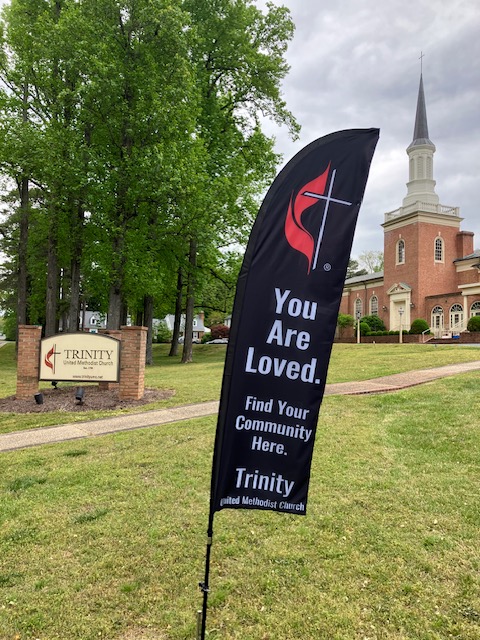
Yet, out on the lawn of Trinity, is a banner that reads: You Are Loved. Find Your Community Here.
Methodist— you, me, we, us are overdue to love all in our community.
The third verse of Psalm 23 states: “He restores my soul.”
Isn’t this an opportunity through love to “restore our souls”?
Isn’t this an opportunity that we can’t afford to miss?
I don’t believe either of us had trouble sleeping on our first night on the ship.
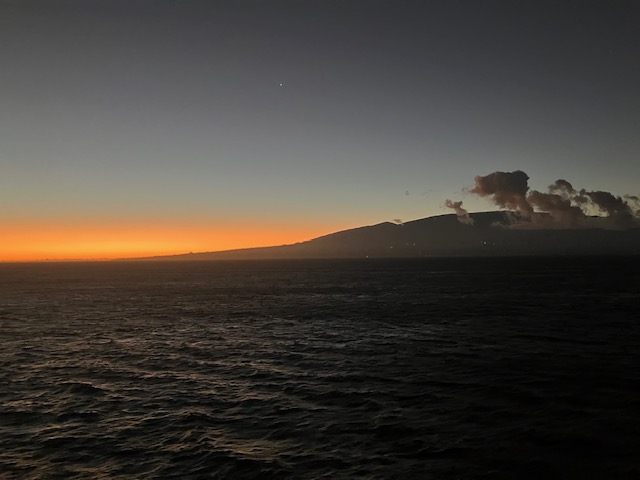
Early riser that I am, I found my way around the tiny cabin without stumping a toe or noisily clunking into something. I was working my way toward the sliding door where our small balcony was starting to show the first signs of light over the Pacific.
This first light was the color of the flesh of a fully ripe summer cantaloupe. A few clouds were near the brightening light, and hills were etched out like an artist had used pen and ink to trace their smooth edges.
(Photo Bill Pike)
The time on the phone noted 6:30 a.m. By 8:30, we were to boarding for an excursion to the Haleakala Crater.
I continued to watch the movement of the ship as we came into this commercial port for docking.
In the cabin next door were our friends the Sherrills, and at some point our early morning curiosity had connected us on our respective balconies for a good morning and comments about the sights.
Soon, we were ready to find our way to breakfast. Without any wrong turns, we found a big dining hall. The room was loaded with multiple food options and tourists just like us trying to figure what to eat and where to sit. We managed, and this was followed by hustling back to the room to make sure we were ready for our excursion departure.
We cleared the security check, and proceeded to the waiting area for our bus and driver. Following instructions from Norwegian personnel, we were soon in a line and boarding the bus.
Our tour guide was named Dino. He was an all in one package—the driver and the guy with the knowledge about our trip. During the course of the week, we found that all of the guides had a story about how they had arrived on Hawaii. Dino was soft spoken and low key, but he was knowledgeable about the area as he drove us toward the crater.
Agriculture was an early topic, and we learned how the sugar cane economy is gone. Pineapples are still around, but we saw groves of avocado and citrus trees.
The landscape began a gradual transition as we started the climb toward Haleakala National Park.
Dino shared with us that real early risers can make a reservation through the National Park Service to see what must be spectacular views of the sunrise.
One thing Dino cautioned us about was the change in temperature that we would experience. He was correct. For the area we were in, one source recorded the high temperature for January 28 as 52 degrees and the low was 39 degrees.
We made an initial stop at the park’s headquarters and visitor center. The elevation here was 7,000 feet, and as soon as I stepped off the bus, I could feel the change in temperature with a bit of wind in the bright sunshine.
All around us were pretty views and interesting plant life. We noted the Haleakala silverswords.
(Photo Bill Pike)
We re-boarded the bus, and drove toward the visitor’s center for Haleakala Crater.
The elevation at our next stop was 9,000 feet. The difference here was the wind. It was intense.
We had all dressed in layers, but the wind was a cutting wind. The layers weren’t much help. But the cold air and biting wind didn’t matter, the remarkable scenery captured us.
I don’t know that I ever viewed such a landscape. It rolled and dipped, rose and fell. Rock and hills of all shapes and contortions were all around us. The puffy tops of clouds formed a layer covering a valley beyond the hilltops.
(Photo Bill Pike)
The tough terrain was painted in varying shades of gray, onyx, rust, coffee, faded khaki, and those tones were cast in every direction.
(Photo Bill Pike)
We countered the wind with the exterior design of the visitors center, and marveled more at the madness found in nature’s sculptured topography.
And at the agreed upon time, Dino rounded us up. With everyone present, we started making our way back down via a winding road.
Dino continued his obligatory chatter as he retraced his turns to bring us safely back to the ship.
Before re-entering the ship, we had to again clear security. We had no hiccups, and our group agreed on meeting at the Cadillac Diner for lunch. The temptation was their milkshakes. While we patiently persevered the less than adequate service, the milkshakes were a hit.
Napping, more exploring the ship took up the remainder of the afternoon.
It is amazing to me that geologist have figured out how a volcano formed out in the middle of the Pacific Ocean.
The eruption of hotspots in the Pacific Plate is the pivotal first step. Over time, these volcanoes are moved away from the hotspot to the Aleutian Trench. At that point, the plate sinks into our planet, Earth.
I’m not smart enough to fully understand these important discoveries, but I sense that if we continue to be careless and reckless with our planet, we will eventually destroy it, and all of Earth’s unique beauty.
If we are clever enough to build this massive ship to tote people out into the middle of an ocean to see these beautiful and fragile Hawaiian Islands, then we need to be even smarter and more determined than ever to protect them.
A plot of land about the size of a postcard on the north side of our church’s grounds has become a home for the unwanted, the castaways.
Growing in this plot are towering Loblolly pines, delicate dogwoods, a couple of magnolias, a Bradford pear, one crepe myrtle, and a random assortment of other plantings.
It is my rapidly aging, sympathetic heart that has let this plot become a home for the unwanted, the castaways.
Over the years, clumps of flowers and singular shrubs have found a home in this landscape. These relocations occur when gardeners in the neighborhood change their landscape plan.
They dig up the flowers or shrubs that no longer fit. Often, I happen to be in the wrong place at the wrong time to claim the unwanted.
Once I transport the plants to church, I work to find these outcasts a good spot in the tract. A part of the planting includes a good soaking from a deep bucket of water.
At Easter, the altar in the Sanctuary of our church is adorned with real, live potted lilium longiflorum, better known as the Easter Lily.
After the Easter services, the lilies are offered to the congregation. Most are taken, but a few always remain.
My conscience will not allow me to even think about tossing an Easter lily. Last year, I started transplanting the lilies that no one claimed.
Trinity member, Dianne Moore, encouraged me to give this a try.
Weeks after Easter, I began my work. I’m not sure how many I planted, but in the end, I had one lily that looked frail and puny. I was certain this lily was dead.
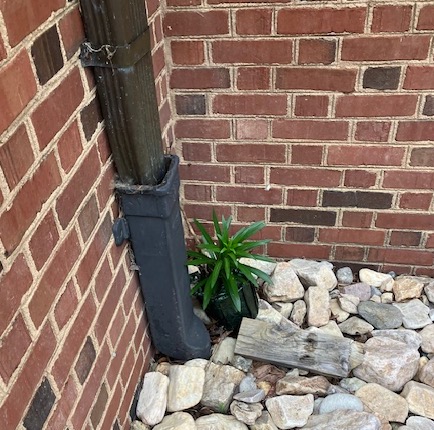
For some reason, I left the dried up flower in its pot, and I tucked it away in an outside corner of our building.
The lily was out of my sight lines, somewhat concealed by a downspout and two electrical transformer boxes.
Through the summer, fall, and into the winter, I completely forgot about the lily.
And, I don’t know why, but this year, a few days after Easter, something nudged me to look into the corner.
When I did, my eyes stared in disbelief. The discarded and forgotten lily was peering out by the downspout where it had been placed.
Several inches high, with healthy green leaves sprouting from its stem, the lily looked just like a lily should.
On the morning of April 11, Dianne was at church for a United Women In Faith meeting. When there was a break, I asked Dianne to walk outside with me.
I led her to the lily’s spot and showed her the green miracle. This viewing also included my admission that I had been completely negligent in providing any care.
Perhaps, you are familiar with the scripture from Matthew Chapter 6 verses 28-29: “And why do you worry about clothing? Consider the lilies of the field, how they grow; they neither toil nor spin, 29 yet I tell you, even Solomon in all his glory was not clothed like one of these.”
I guess I shouldn’t have worried about whether the scrawny lily was going to survive.
Seems to me that the uncared-for Lily wasn’t worried about surviving. The lily was better in trusting God than I am when worry consumes my life.
After sharing the lily’s story with Dianne, I transplanted it along with a couple of other shrubs that had straggled into my life.
Maybe, the real question for me is how do I respond to the people who straggle into my life who appear to be discarded, tossed aside, and forgotten?
Do I pay attention to their needs, their struggles, or do I toss them into a corner?
I knew Saturday, January 27, 2024 would arrive quickly. This was our final morning at the house before packing up and driving to the harbor in Honolulu.
Another pretty morning greeted us in Waialua. On Friday, we had been diligent about washing clothes, packing, and going over our checklists. We knew our targeted departure time, and I was really trying to enjoy my last views around the house.
On the backside of the house, on the Dole property, we were treated to an early morning baseball game. A small, but boisterous crowd was on hand to cheer the youngsters for both teams. We could hear the ebb and flow of the game based upon the sounds of the spectators.
The baseball field behind us (Photo Bill Pike)
From either porch, the views were bright and sunny. I will miss staring into the dark green hills of the Waianae Range that can be shrouded with cumulus clouds and highlighted with a perfect blue sky backdrop.
Waianae Range in background (Photo Bill Pike)
From the end of the other porch, there is the constant snapshot of an ever changing Pacific Ocean. Its water hues are always transforming as waves cleanse its palette.
But, I think I will miss the porch on the ocean side the most. Shaded, open, comfortable, so comfortable that I’m not sure I want to board the cruise ship.
The porch (Photo Bill Pike)
By mid-morning, we are loaded. The drive into Honolulu is uneventful. We are dropped off at the ship terminal. Butch and Dan make the short drive back to the airport to return the rental van.
Our luggage was swooped away on a large flatbed cart. Betsy, Judy, Marian, and I find a bench. For several minutes we take in the mass of humanity that is before us. It is a study in amateur people watching. Some people are hustling. Others have a slower pace. Some are intense in their communication. A few have come decked out in their swimming attire. They are ready to be the first at the pool.
Butch and Dan return with no problems in the dropping the van off. Now, we are ready to wind our way through the check in process. We clear the security checks, and once we are fully on board, our first stop is our assigned safety station and our designated lifeboat.
With this behind us, we start our navigation of the ship to a dining room for lunch. We do a good job in following the layout of the ship, and within minutes we are seated with a slightly grumpy waitress working our table.
After lunch, we explore the ship some more, work our way to our rooms, make sure our luggage has arrived, and then we regroup by the pool.
Butch, Dan, and I navigate a stop at one the poolside bars. I’m wearing my old, well-worn, East Carolina University hat.
No sooner have we placed our order, and a guy on the other side of the bar becomes quite animated when he spots my hat. He too is wearing an East Carolina University hat. He wonders when I graduated. I have to explain to him that our youngest daughter earned her degree from East Carolina.
He continues to probe by asking where I’m from. When I tell him Richmond,Virginia, he immediately hopes that I had nothing to do with the removal of the Civil War statues on Monument Avenue. I make a comment to sidestep his inquiry because I’m not about to tangle verbally with a guy who already appears to be wound tight about Civil War statues.
In truth, I’m a bit nervous about shoving off at 7 p.m. I’ve never been out on the ocean in a huge ship. I’m hoping the ship and my body will encounter smooth sailing. I don’t want a barf bag to become my new best friend.
Speaking of new best friends, at some point during the afternoon, we met via the ship’s p.a. system our tour director for the cruise. Her name is Anne Marie, whenever she came on the p.a. she bellowed out a big “ A Lo Ha!” Her boisterous announcements were a nerve plucking for me.
Later in the afternoon, we figured out the timing of our dinner plans. We make it back to a dining room, and place our orders. As we were finishing up dinner, we could feel the first signs that the Norwegian Cruise Line ship the Pride of America was starting to move away from its berth.
Leaving the restaurant, we walked around on one of the decks. There we could clearly see a team of tugboats positioned at points along the ship to help get it underway.
One of the tugboats guiding the ship (Photo Bill Pike)
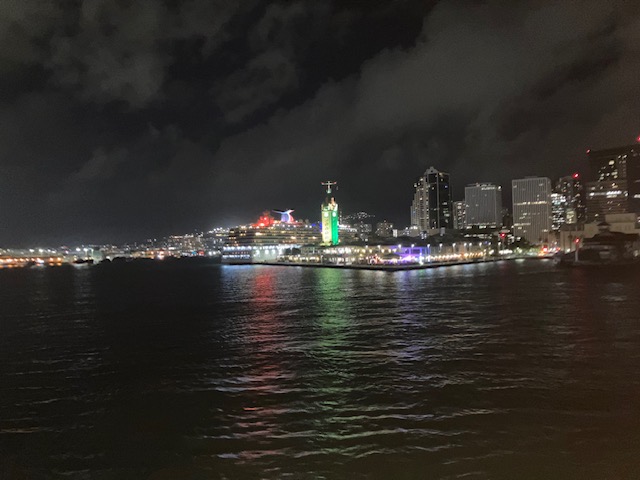
The Honolulu Harbor was pretty with an assortment of lights reflecting off the dark water. I don’t know the timing of when we cleared the harbor.
Honolulu Harbor at night (Photo Bill Pike)
I was excited about the exploring that awaited us, and so far, my tummy and equilibrium were cooperating. However, I knew that could change quickly out on the open Pacific.
I was ready for sleep knowing that Kahului on Maui would be waiting for us when we docked on Sunday morning at 8.
From April 23 – May 3, a lot of church people will be meeting in Charlotte, North Carolina.
These are United Methodist from around the world who are attending their General Conference of the United Methodist Church.
Perhaps, you know this conference is being held to attempt to sort out human sexuality as it pertains to gay clergy, same sex weddings, and how the church is positioned to work with LGBTQ communities.
I am a lifelong Methodist, and since 1972 our Book of Discipline has not allowed the ordination of gay ministers, nor for Methodist ministers to perform same sex marriages.
At the conference, I suspect the following will be in play: emotions will run high, Robert’s Rules of Order will be put to the test, and the Methodist motto: “open hearts, open minds, and open doors” might continue to be closed for people who are different.
For the last twelve years, I’ve had the privilege of working at the church where my family and I are members. In this work, and in my previous career in public education, I’ve come to realize that churches like schools are interesting places as they both center on working with people.
Maybe, you are aware that across America mainline denominations and their churches have seen a decline in attendance for several years. Clearly, the pandemic really punched churches, but in truth, churches were in trouble prior to the pandemic.
A January 2024 study by the Pew Research Center captured a portion of this decline. Their findings noted that the “religious ‘Nones’ are now the largest religiously unaffiliated cohort in America at 28%. The ‘Nones’ are larger than Catholics 23% and evangelical Protestants 24%.” I wonder how many of the ‘Nones’ are from the LGBTQ community, or individuals who didn’t grow up in the church, or who had an unpleasant church experience.
Before this issue of human sexuality smacked the United Methodist Church, Methodist churches across America were closing every year related to declining attendance shrinking budgets, and deteriorating buildings. Moving forward, I don’t think closings tied to these undeniable challenges are finished.
It is the potential closing of more church buildings that makes me pose this question—might churches benefit from participating in an accreditation process?
Schools, fire and police departments, other public agencies, non-profits, and some professions go through an accreditation process. I ask myself how many of the current challenges that church leaders and their congregations face could have been avoided or corrected with an accreditation process?
For example, a review related to programming, personnel, finances, facilities, outreach, and communication might form a basic core for assessing how a church and its congregation are performing. Church leaders and their congregations might be surprised at what they learn about their fiscal, physical, and spiritual, health in this process.
Personally, I believe fear and resistance to change have a significant impact on the thinking of church leaders and congregations.
If a church can’t let go of ineffective programs, fear can paralyze a congregation reducing any chance of making a needed change. Sadly, the inability to courageously make a change only ensures more church closings.
My college roommate, H. D. Sherrill, Jr. is a graduate of Duke Divinity School. During his career, Reverend Sherrill served with distinction at assignments in churches and local nonprofits. He is a very gifted storyteller.
Back in January, Reverend Sherrill shared a conversation he had with one of his grandsons. He wondered, if this grandson might be interested in learning how to become an acolyte.
When Reverend Sherrill asked his grandson if he had any interest, the grandson responded: “Pops, I’m not a churchy person.”
Reverend Sherrill accepted the honest answer.
A few weeks later, Reverend Sherrill noted that the not churchy grandson had completed an orientation for becoming an acolyte.
Curious, he asked his grandson why had participated in the acolyte orientation.
Reverend Sherrill received the best answer: “Pops, a person can change.”
When I consider the task at the General Conference related to human sexuality and the survival of churches who are hanging on by their fingernails, I think any chance of salvaging the future of the church depends upon our capacity to embrace change.
In her book, Factory Man, author, Beth Macy, wrote about John Bassett III and the challenges he faced in America’s furniture industry. I love this advice from Mr. Bassett related to change— “be willing to change and improve repeatedly.”
If the United Methodist Church has any hope in slowing their downward spiral, the church must be willing to change.
Failure to change guarantees two things: the ‘Nones’/not churchy people will grow, and more Methodist churches close.
In Charlotte, I’m hoping the hearts, minds, and doors will be open to change.
Author’s note: This piece was written before the conference took their historic vote to change.










 might be baloney