Hawaii Day Thirteen: Pretty Kauai

Our excursions started early on Friday, February 2. My first photo on my phone, captured a rainy morning at 7:49. We were in the tour van driven by our guide, Kevin.

Kevin would prove to be an excellent guide. He knew Kauai from a variety of angles and experiences. His approach was balanced. Kevin could spout history, local color, and he was accomplished in the timing of how to navigate the local traffic.

Additionally, we always knew where we were headed, he gave us essential background, and it might seem absurd, but he knew our age group, and the need for restrooms too.

Personally, I wasn’t concerned about these early raindrops. The weather would improve. It wasn’t like we were walking around in drenching downpours.

Our first stop for the day was the famous Hanalei Pier. The pier is part of a public beach on Hanalei Bay. The pier was made famous in the 1957 movie South Pacific. Even on a rainy morning, the beach, the pier, the narrow neighborhood streets, and the pretty houses made things brighter.

Walk out to the pier (Photo Bill Pike)

Oh, how I wished I had a fishing rod with me. The pier seemed to be the perfect place to cast a line.

During a quick drive through the neighborhood, Kevin gave us a snapshot of the how the local real estate market was faring. This included pauses at homes where some famous names lived.

On the way out of the neighborhood, Kevin stopped the van so we could stare at the beautiful Wai oli Hui ia Church. Church of the Singing Waters has quite a history.

The stunning church (Photo Bill Pike)

It dates back to 1837 when missionaries and the initial congregants started building the church. Since 1956, the church has been aligned with the United Church of Christ. I had an immediate affection for this pretty house of worship and its grounds.

Kevin navigated the local traffic without a hitch. We saw pretty beaches, sandy coves, and an occasional waterfall. The scenery was stunning, especially the coves. Their shapes seemed perfectly carved by nature.

One of the pretty coves (Photo Bill Pike)

Soon, we arrived at Kilauea Point National Wildlife Refuge. The point is famous for its beautiful shoreline, but a variety of Pacific waterfowl frequent this area too.

From there, we drove to Wailua River State Park with its Fern Grotto. Once we checked in for the boat ride up the river, Kevin had lunch ready for us.

After lunch, we hustled and found our seats on the boat. Since 1946, the Smith family, yes Smith, has been providing boat tours of Wailua River. Either side of the river is lush in greenery, and occasionally a singular house will appear.

The boat comes to a dock where we depart onto a pretty trail for a short walk to the Fern Grotto. At the viewing area for the grotto, there is a deck where members of the Smith family with ukuleles and guitars sing and tell stories about local legends.

The Fern Grotto is very pretty. The uniqueness of the grotto comes from the ferns which actually are growing in an upside down position from inside the grotto.

Fern grotto (Photo Bill Pike)

The ride on the boat is effortless. It is a good way to take in another diverse Hawaiian landscape. Back at our starting point, Kevin wants us to make one more stop out on the Wailua Heritage Trail.

So, we make the short drive to Opaekaa Falls. Opaekaa means “rolling shrimp.” These were a freshwater shrimp that were once plentiful in the waters of the falls.

Falls in the distance (Photo Bill Pike)

With us loaded back into the van, Kevin is wrapping up his comment as he drives us toward our ship. Despite our early morning raindrops, the sun has been out with us sporting blue skies with wispy cotton ball clouds.

For a short period of time, we regrouped at the ship, and then Dan, Butch, and I decided we are going to catch a ride to the Kauai Beer Company. Located on Rice Street in Lihue, it is a short drive with our friendly Uber driver.

Established in 2013, Kauai Beer Company is in an ideal location in town. It has ample indoor and outdoor seating. We attempted to sit outside on a patio, but the wind had kicked up, and we came back inside to order our beers.

Dan had an IPA(India Pale Ale), and Butch and I ordered their schwarzbier which is a German styled black lager. We enjoyed our well-made beers. A couple of other plusses for this craft brewery is they offer a full menu, and if beer isn’t your thing, other drinks are also available.

Our beers (Photo Bill Pike)

Before we knew, our beer glasses were empty. Time to head back to the ship. We needed to start organizing our suitcases and other travel bags—we head back to reality tomorrow.

Back at the room, I started figuring out my suitcase and departure plans.

Before dinner, I made arrangements to meet Ed and Mary Sykes in the ship’s lobby. It took a few minutes for us to recognize and each other and meet, but we did. I enjoyed meeting Ed, and I purchased a copy of his book The Patch and The Stream Where The American Fell.

The book is about Ed becoming an Air Force jet fighter pilot and his combat missions in the Vietnam War. But, the book is more than that.

Ed’s roommate was shot down in a mission. He did not survive. American rescue teams were not able to recover his body. The book is about Ed’s efforts to recover his roommate’s remains from a stream bed. This is a fascinating, heart tugging story full of twists and turns, red tape, funding challenges, and pure out luck.

Book cover (Photo Bill Pike)

After dinner at the Jefferson’s Bistro, we attended a British Trivia event. Dan’s wife, Judy, knows a lot about British history and royalty. To our surprise, the trivia questions were about British rock and roll bands. When the contest was over, we had won by answering correctly 18 out of the 20 questions.

After the British Trivia, we were off to bed. We had to be up early for breakfast and an organized load out by the cruise line’s experts to get us to the airport in Honolulu.

No skills as a burglar

At 3:46 on the morning of Thursday, May 23, my cell phone rang.

I keep my cell phone on the small table beside my side of our bed. That’s so I can take security calls related to our church, or from one of our children who might have an unexpected challenge.

On May 23, the caller was my friend, Clint Smith. Clint and his wife, Madelyn, had experienced a couple of tough days. Madelyn had fallen. While the injuries from the fall were not life threatening, she ended up in the intensive care unit of a local hospital.

I was fearful when Clint called that something had gone wrong with Madelyn.

Fortunately, that wasn’t the case. Clint was calling about his HVAC system. It seemed to be running nonstop, not cooling properly, and Clint could hear water running.

Clint wanted me to ride out to their home and check the system. Just so you know, I have no expertise in assessing HVAC systems anytime of the day.

I’ve known Clint a long tome. When I first took the property manager job at Trinity, Clint was the assistant property manager. He helped me to transition into this role. I have lots of respect for Clint’s wisdom.

I told him I would be there soon.

I dressed, grabbed a flashlight, typed the address into my phone, and headed toward Clint and Madelyn’s home.

While I had been there many times before, it was dark. Once in their neighborhood, I ignored the directions coming from my phone. I ended up turning one street too soon.

Clint had told me the front door would be unlocked. I parked. I walked up the steps to the front porch, and the front door was locked.

I decided to give Clint a quick call and that’s when I fully understood I’d come to the wrong house. I rapidly moved off that property.

Back in my car, I made the short drive to the correct house. The front door was open, and I found Clint inside.

He gave me some background about his HVAC system. His multiple calls to the company that services his HVAC system were met with no response. So, armed with my flashlight, I started to poke around.


Meanwhile, Madelyn in her ICU room was not asleep. She had her phone on. Her phone is linked to the security system for their home. On the phone’s screen, Madelyn had noted this unrecognizable person.

Madelyn alerted their across the street neighbor about the stranger, and the neighbor called Henrico Police.

Clint and I were oblivious to what Madelyn and the neighbor were orchestrating.

I continued to look for problems with the HVAC system. I was inside and outside.

Neither on the inside nor outside could I hear or see any problems with water running like described by Clint.

After sharing this with Clint, I went back outside to make sure that I had closed the gate properly to the backyard.

That’s when I noticed something unusual.

If I flashed the light from my flashlight into the backyard, another beam of light appeared.

I did this a couple of times, and each time, a flash of light came back toward the light cast by my flashlight.

Puzzled, I walked toward the light, and that’s when I encountered a Henrico County police officer.

I quickly gave the officer an account of what was going on.

By that time, his partner had arrived at the front of the house.

I walked my new friend into the house to meet Clint.

Thankfully, Clint confirmed to the officer what was taking place, and the officer conveyed Madelyn’s involvement.

At that point, I think we all were silently chuckling inside.

We thanked the officers for their patience and cooperation.

I said goodbye to Clint, and the officers walked toward their cars.

On my ride home, I deduced that I was not a good burglar prospect.

First, what kind of burglar would go out to work in the light of a full moon? Second, a burglar would not go to the wrong house.

And, the more I thought about this whole excursion, I realized how lucky I had been.
To begin with, going to the wrong house could have been a disaster. If I had awakened that homeowner, physical harm might have come to me.

With the police officers, I was lucky too. Neither of them was brandishing their firearms. Perhaps from their experiences, these officers knew the chances that a real burglar was in this neighborhood were slim.

And despite my luck on this early May morning, somewhere in America at 3:46 a.m. things had gone horribly wrong for a burglar. This person might have been caught by police, attacked by a security dog, wounded by a bullet, physically assaulted, or shot dead.

For those burglars who are unsuccessful, I wonder what caused them to pursue such a risky path? What went wrong in their lives that nudged them to become a thief? What were they lacking in their day to day living?

In David Halberstam’s book, The Teammates, he uncovers the differences in the home environments where Ted Williams was raised compared to Ted’s teammate, Bobby Doerr.

Bobby Doerr’s parents provided stability, care, and love for their son. On visits to the Doerr home, Ted constantly commented to Bobby “You just don’t know how lucky you are. You’ve got the greatest parents. Your dad is always watching out for you.”

That support was lacking in the Williams’ home. And even though Ted found success in baseball, I wonder if his sometimes gruff, cantankerous personality, and deep mood swings could have been softened with more stability in his home?

Despite his flaws, I think Ted Williams understood loyalty.

He was loyal to his teammates. Regardless of the dysfunctional home, Ted supported his mother financially, and he attempted to help his brother who made multiple bad choices.

Perhaps, that is why my friend, Clint, reached out to me at 3:46 a.m. on Thursday, May 23—loyalty.

Any loyalty that is in my old, soft heart came from my parents. They were loyal to each other, my sister and me, their siblings, friends, and the good Lord.

Their loyalty and love provided an irrefutable stability.

That stability kept me from the path of a burglar.

I was lucky.

I need to remember— not everyone I encounter had the luck of that loyal love and stability.
And, it would be a good idea for me to keep these simple words from Galatians Chapter 6, verse 2 on call in my ancient noggin’: “bear one another’s burdens.”

Moon setting over the Smiths’ neighborhood at 4:27 a.m. (Photo Bill Pike)

‘Impressive’ people made EAA AirVenture a captivating experience

Here is this week’s letter to the editor of the Oshkosh Northwestern. See our letters policy below for details about how to share your views.


‘Impressive’ people made EAA AirVenture a captivating experience


On the afternoon of July 23, my friends and I arrived in Oshkosh for the EAA air show. For almost a year, we had been planning our trip.


Back home in Maryland, North Carolina and Virginia, friends who had made previous trips to the show kept using the word “overwhelmed.” They told us to be prepared to be “overwhelmed” by the show, and we were.

No matter if we attended an informative seminar, toured a history changing B-29, gawked at the agility and power of supersonic fighter jets, felt the passion from the owner of a homebuilt airplane, or reflected about what the Wright Brothers sparked with their first flight — we were captivated.

One of the four propellers from the historic B-29 Superfortress “Fifi” (Photo Bill Pike)


Whether we opt to return for another Oshkosh air show isn’t important.


No, the important piece is this — there is no air show without people.

From the people who graciously checked us in at the Gruenhagen Conference Center, ticket takers, bus drivers, food service workers, vendors, volunteers and all the people who handle the logistics behind the scenes, we were impressed.


These people were well-trained, effective communicators, and most importantly driven to give their best no matter how many people were in the serving line or packed into a bus.


Additionally, we loved the emphasis on aviation education for our youth and women. They are the key to the future.


Rest up, Oshkosh.


July 2025 is a blink away.


And those guests want to be overwhelmed, too.


Bill Pike

Richmond, Virginia

Author’s note: From July 23-27 three college friends: Steve Boone, Dan Callow, Steve Hodge, and I traveled to Oshkosh, Wisconsin for the EAA Airshow. On the way back, I was stranded overnight in the Philadelphia Airport. Luckily, I had my laptop with me and composed the letter. Thanks to the editors at the Oshkosh Northwestern for publishing the letter on Sunday, August 4, 2024.

Hawaii Day Twelve: Let Me Off This Ship

On Thursday, February 1, 2024, I was anxious to get off the ship. Because of wind and choppy seas, we had spent all day Wednesday ship locked , unable to take tenders to Kona.

When I first went out on our balcony this morning, I again was skeptical of the weather. The cloudy, dark horizon didn’t look promising. Yet, the big ship kept slowly churning to its docking position.

Stormy skies out in the Pacific (Photo Bill Pike)

I continued my stay on the balcony, and gradually land came into view.

(Photo Bill Pike)

We kept inching closer toward the dock.

My eyes were locked on the clouds, and the gray, black water.


At some point, my old eyes picked up a speck of light in the thickness of the clouds. The light was powerful enough to be reflected on the surface of the ocean.

(Photo Bill Pike)

I kept watching. The glow on the water grew, and then it would dim.

Then my eyes started to focus against the backdrop of the clouds, and a dark object moving toward the ship. Before I knew it, a huge jet was lumbering in over the ship on its final approach into the local airport.

Jet with the bright light (Photo Bill Pike)

More land began to appear, some boats were moored in a small harbor, and the next thing I knew we were readying ourselves for breakfast and a 9 a.m. departure to the Waimea Canyon.

We did a good job of getting to the bus on time. Our tour guide for today was an older gentleman known as Uncle Willy. Word on the street was Uncle Willy was a real Hawaiian, and that he had a role in the movie South Pacific.

As a tour guide, Uncle Willy was a two for one—he could yak with the best them, and he loved to sing.

On the ride toward Waimea Canyon, he talked a lot about all things local.

Let me tell you about the road to Waimea Canyon— this road was not designed for large, full-size tour busses. I still don’t know how the driver made some of those hairpin turns. Somehow, the driver got us safely to the parking lot. As I exited the bus, I complimented him on his good driving. He thanked me and said it was his first day. I hope he was teasing me.

Several summers ago, our family had the privilege of visiting the north rim of the Grand Canyon. That canyon from many vistas was simply stunning.

I can say the same for Waimea Canyon. While on different scale related to size, Waimea Canyon is stunning too. What makes the canyon so appealing is its location. As a tourist, I didn’t expect to find a canyon with such a rich beauty out in the middle of the Pacific Ocean.

No matter where my eyes scan, the natural hues of green and orange that merge seamlessly with perfectly cast shadows could hold my attention for days. Weave into that backdrop the gentle collision at the top of the canyon where the blue skyline and puffy cumulus clouds of white and gray hover, and you have the opportunity to create hundreds of astonishing postcards.

Waimea Canyon (Photo Bill Pike)

Whether it was his first day or not, again the bus driver did a nice job driving us back down the canyon’s access road. In every stretch of that road the potential exist for lots to go wrong, but luckily nothing did.

Fortunately, nothing went wrong going to or leaving the canyon area. The wrong waited to make its appearance at our lunch stop.

Coming out of the canyon, we stopped in the town of Waimea for lunch. The challenge here is that it appeared that every other tour bus near Waimea Canyon had opted to stop here too.

Waimea is a pretty town with shops, scattered empty buildings, a grocery store, and a handful of small restaurants. I’m not sure any of the restaurants were truly prepared to deal with tourists in a hurry.

I don’t recall the amount of time we were given to purchase lunch and make it back to the bus on time.

Unfortunately, some of our fellow tourists did not make it back on time. When the finally arrived and started to board the bus, some passengers who had been waiting patiently booed them. One of those tardy passengers, a lady, snapped back at the boos with “Hey, I’m on vacation!”

With everyone finally back on board, we slowly moved out of the parking area.

Sensing this tension, perhaps Uncle Willy was reminded of this line from William Congreve’s 1697 play The Mourning Bride: “music has charms to soothe a savage breast.”

Thus, on the ride back to the ship, Uncle Willy sang a number of songs, and he did his best to drag us into singing along. But his attempts, for the most part failed.


Once back at the ship, I seem to recall that we caught a shuttle to Hilo Hattie, the store of Hawaii since 1963. This is simply the “tourist trap” store for tourist.

After Hilo Hattie, we relaxed on the deck of the ship, and snapped some photos of the sun saying goodnight.

I will never forget Waimea Canyon.

But the remarkable beauty of the canyon is tainted by the lunch stop fiasco.

Seems to me that the thinkers for the cruise line need to rethink the lunch stop plan.

That plan did not work.

And that failure was complicated by the “Hey, I’m on vacation” attitude.

And no sing along with Uncle Willy can soothe that self-centered selfishness.

Sun setting from the back of the ship (Photo Bill Pike)

Not the way to end a trip

For the first time in my seventy one years of living, I am spending the night in an airport. Specifically, the Philadelphia International Airport.

After months of planning, three of my college pals: Steve Boone, Dan Callow, Steve Hodge, and I traveled to Oshkosh, Wisconsin for the Experimental Aviation Association Airshow. If you have an appreciation of airplanes, from July 22 to July 28, that was the place to be.

We arrived in Oshkosh on the afternoon of Tuesday, July 23. Airlines transported us to Chicago O’Hare from Baltimore, Charlotte, and Richmond. Our arrivals into O’Hare were uneventful, and we experienced no significant hitches with our car rental.

Our three days of being overwhelmed at the air show were glorious.

We walked, and walked, and walked. On Wednesday eight miles, Thursday nine miles, and by Friday we wised up—we used the tram.

We explored.

We listened.

We learned.

We interacted with strangers from America and around the world.

We marveled at what Orville and Wilbur and other innovators sparked.

At the afternoon airshows, we were like kids watching the supersonic American fighter jets perform jaw dropping maneuvers. Those gravity defying maneuvers would have caused me to lose my lunch.

My old ears were thrilled to hear the radial engine sounds from World War II planes. Propeller driven fighters, bombers, trainers, and cargo planes were part of that unmistakable sound.

And just to make life interesting, we revisited our freshman year of college. For four nights, two dorm rooms in the Taylor Residence Hall on the campus of the University of Wisconsin at Oshkosh was our place to snore.

We were good boys in our two dorm rooms. Unlike what we might have been fifty years ago, we kept our mischievous whims, goofiness, or looniness under control.

But, we did laugh. We can still make each other laugh, and that is a priceless gift.

I had signed up to run in the Runway 5K with its 7 a.m. start time on Saturday morning. This year, the 5K proceeds were to benefit the Father Carr’s Place 2B. Here is the nonprofit’s Mission Statement:

As a Life Enrichment Center, we are driven by Christian values to provide a sense of community and support for people in need. We strive to foster hope self-worth and self-sustaining life, through housing, food, health care, educational programs and volunteer opportunities.

My pals calculated that if I finished the 5K in thirty minutes, I would be able to shower, finish packing, grab breakfast, and be ready to depart for Chicago by 9:30.

They were correct. I finished in 30:24, and we were loaded into the car before 9:30. Dan did a super job of shuttling me to the 5K.

For this trip, we had rented a Tesla. Dan and Steve Boone calculated a price comparison, and the Tesla wasn’t a bad deal. You should have seen those guys figuring out how to operate the car. Their excitement was like two kids with an erector kit on Christmas morning.

We arrived at O’Hare with time to spare. We determined our rail transportation stops for our terminals. Dan was in United, the rest of us in American. Dan would be the first to fly out. We said our goodbyes to Dan, and those remaining rode a short distance to the American terminal.

The two Steves and I would be flying out within minutes of each other in a 4:45 to 5:00 p.m. time slot.

I should have taken my check-in to American Airlines as a foreshadowing for the rest of the trip. My pre-approved TSA check in number was not on my ticket.

This caused me to go through the normal TSA line twice. Yes, I am not a good traveler without my Commander Supreme by my side.

Eventually, my check-in worked out, and I caught up with the two Steves at a food court near our gates. We ate lightly and chatted for an hour. Then, we realized it was time to get ready to say our goodbyes and wait at our gates.

At my gate, my unsettled feeling continued—no plane was parked at the jetway.

Getting into Philadelphia, I knew I would need to hustle to make it to the terminal for my next flight. When our plane finally arrived, it took time to unload and load back up. Taxiing out to the runway seemed to take a couple of days. Prior to taking off, the pilot said something about making up the lost minutes in the air, but that didn’t happen.

When we landed in Philadelphia, one member of the flight crew made an announcement for passengers to stay seated until those who needed to make a critical connection could exit the plane.

Fortunately, the passengers complied. The young lady beside me was trying to get to a New York flight. We took off for the designated spot where a shuttle bus would take passengers to the correct terminal.

Navigating the back passageways of an old airport is a challenge. The bus driver had to make multiple time-consuming turns and stops, but finally we were dropped off at the terminal. I quickly made my way to the assigned gate.

My plane was still sitting on the tarmac, but the door to the jetway was closed, and the jet had disconnected from it.

And of course, the representative from American ignored my request to call the jet back.

I walked over to another desk where two American employees had the responsibility of working with grumpy passengers who had missed their connections.

Another passenger was trying to get to Richmond too. He decided to rent a car. This nice young man offered me a ride to Richmond. In the chaos of my travel weary mind, I pondered the proposal for a few seconds, and politely declined.

I turned my attention to the young lady who would be responsible for rebooking a flight for me. Since, American would not take the blame for this miscue, they offered me no hotel room for the night.

I told her I wasn’t going to take my angry frustration out on her, but that I would at some point let American Airlines know what I thought about this shameful performance.

Our youngest daughter, Elizabeth had been tracking my movements, and she had screen shots of all my departure times. These screen shots noted both flights to be on time. Clearly, those postings didn’t match what I and others were experiencing in real time.

I was booked on a 6 a.m. flight out of Philadelphia to Charlotte on Sunday morning, I started looking for a place to get something to eat. I found one place open. I purchased a muffin and a bag of chips.

When my munching was over, I moved to a countertop near my gate and set up my laptop. For the next several hours, I caught up on emails from home and work, and I tried to write.

At one point, a large group of passengers from a very late plane marched through the empty corridor.

Empty corridor (Photo Bill Pike)

In my roaming, I came across other stranded passengers who had found creative, but uncomfortable ways to try and sleep.

Occasionally, a single weary passenger would make a repetitive pattern of walking through a section of the terminal.

Cleaning crews fell into three categories: vacuuming carpet, cleaning and restocking restrooms, and running a high speed floor machine over worn terrazzo and tile floors.

The guy who did all of the vacuuming was on a phone call. Nothing violent or threatening was being said, but the ‘f’ word was frequently the foundation of his vocabulary.

Toward dawn, I walked the terminal some more, and I came across a group of TSA agents prepping for Sunday morning.

TSA agents assemble before a busy day. (Photo Bill Pike)

Slowly, the early morning workers for food stands began to appear, but I opted to wait until I arrived in Charlotte to find some nourishment.

Several minutes before 6, we started loading the plane. I was in the second to last group to load. I found my seat.

During the last minutes before departure, I noted that the flight wasn’t full. So, I asked a flight attendant if I could move to an empty row across from me for a window seat, and he obliged.

Sun peeking over the horizon before take off in Philadelphia. (Photo Bill Pike)

For most of the flight to Charlotte, I was comatose. I welcomed that much needed sleep. Once off this plane, I had a fifteen minute walk to my next gate. The terminal where my plane would depart was torn up in a renovation project. The ceiling tiles and floor coverings were gone.

I found a food stand with breakfast items. I purchased a sausage, egg, and cheese croissant and washed it down with a bottle of apple juice. Oh, how I needed that.

The jet from Charlotte to Richmond was a tiny commuter, a CRJ900, two rows with two seats in each row. Again, I slept a deep sleep.

The descent into Richmond brought into view familiar landmarks. Soon the jet’s tires scuffed the runway, and the pilot nudged the plane toward the terminal.

Waiting for me inside was a special treat, our son Andrew, and his two daughters. I was thrilled to see them, and the girls told me they had a treat in the car for me—a doughnut from Country Style Doughuts.

Even better, my checked bag was in the American office. Interesting that my checked bag made the original flight from Philadelphia. I wonder if that means American Airlines cares more about baggage arriving on time than human beings arriving on time?

I’m not sharing this next story with you to brag or boast, but it might barely help to make a point.

Earlier today in the 5K, I was very close to the final turn heading toward the finish line.

There was a young lady to my left. All of a sudden, she stopped running. She appeared to be a middle schooler or maybe a freshman in high school.

I gently encouraged her to finish out the race. I told her to slow down and pace with me. I also conveyed that she could pace with me and then sprint ahead to the finish line. For whatever reason, she listened. As we approached the finish line, I reminded her to sprint, and she did.

When I crossed the finish line, the young lady found me, and thanked me.

Makes me wonder what might have happened to my missed flight if someone from American Airlines had taken an extra minute to think through the outcome for the passengers who were hustling through the airport to make a connection.

My gut tells me if the decision maker had put a five minute hold on the plane’s departure, I would not be sharing this story with you.

I wonder how many disappointing life experiences might have been made better or avoided by taking the time to pause and think.

Whether we want to admit it or not, time is at the crux of everything we do. Time is the most valuable thing in the world.

In the days I have left, I pray I can become better at using my time wisely, not just for me, but also for those I encounter along the way.

Author’s self-portrait at an empty airport gate (Photo Bill Pike)

Hawaii Day Eleven: Coming Into Kona

The flyer on the the Norwegian Cruise Line Ship, Pride of America, had this headline on the Freestyle Daily: Say Hello To Kona.

Unfortunately, our visit to Kailua-Kona was cancelled. The Pride of America is too large of a ship to dock in Kailua- Kona. So the cruise line planned to use tender boats to transport guests on to the island.

The captain and the crew deemed the weather unacceptable to safely transport guests to Kailua-Kona.
This meant, we were ship locked for the day.

Early morning, coming into Kona (Photo Bill Pike)

Kailua-Kona is the second largest settlement on Hawaii(the Big Island), and the largest on the west side.

Our excursion was to have taken us along the Gold Coast and into the Cloud Forest Sanctuary.

I think we would have enjoyed the Cloud Forest Sanctuary. “This was a restoration project that started in 1982. It was the remnant of one of Hawaii island’s oldest and largest ranches that had strayed far from its pristine native forest origins.”

What turned out to be our day at sea was quiet and stress free.

That afternoon, Butch, Dan, and I attended a beer tasting featuring some of the beers brewed by the Kona Brewing Company. “This craft brewery was started in 1984 by a father and son team, Cameron Healy and Spoon Khalsa. Their vision and hard work paid off, as the brewery’s beers have become known around the world.”

Held in the Gold Rush Lounge, we enjoyed sampling six of the Kona Brewery’s beers. The staff did a good job in serving the beers and providing commentary about the differences in each beer. And just so you know, a beer tasting glass is 4 to 6 ounces, not the usual 12 or 16 ounce pour.

Brews from Kona beer tasting on the ship (Photo Bill Pike)

After the beer tasting, we worked our way back to our rooms to get ready for dinner. This evening, we would be dining at Cagney’s where beef is the main attraction.

When dinner was over, we were in motion, moving throughout the ship. Assorted musicians were performing solo sets in different locations. A stand-up comedian was performing in one theatre, and for a few minutes we sat down to watch the Perfect Couple Game Show. With its PG-13 rating, the questions and spousal responses were fairly predictable, so we didn’t stay until the end.

As we parted our ways back to our cabins, we all hoped that Thursday would go as planned. This would allow us to make our scheduled excursion to Waimea Canyon.

Light In The Darkness

Author’s note: this is the original devotion that was submitted to the Upper Room in September 2022. I thought I would include the original so that you could compare it to the final edit that is published in the July/August Upper Room for Monday, July 22, 2024. It is published on Monday, July 22, 2024.

Hold Fast To The Light (Title was changed to: Light In The Darkness)

Read Job 33: 28-33 (Scripture was changed to: John 1:1-14)

“The light shines in the darkness, and the darkness has not overcome it.” John 1:5

Some mornings, I wonder why I sit down at our kitchen table with my Upper Room, Bible, and prayer lists.

No matter where I look, the world is a mess. In lots of different ways, we have become very skilled at destroying our world and ourselves.

Not a week passes, when I learn that a relative, friend, or neighbor is facing a crisis. That crisis comes in assorted shapes and sizes.

Over the years, I have learned there is no immunity in life from a crisis.

Additionally, I have noted that a crisis is very good at disrupting life, and sometimes taking life.

Our messy world and the challenges people face in their daily living make me question my morning routine.

Why should I continue to pray?

Why should I continue to read Bible verses that I have read hundreds of times?

And then on some mornings, a total stranger from a far corner of the world will touch my questioning heart. Their heartfelt words from the Upper Room devotional will give me hope.

That hope in the darkness prior to dawn will push me to revisit these words from John 1:5: “The light shines in the darkness, and the darkness has not overcome it.”

To overcome the darkness of the world and a crisis, you, me, we, us must hold fast to that light.

Prayer: Father of us all, help us always to seek your light in our darkness. Amen

Thought For The Day
One ray of light can overcome darkness and give hope.

Bill Pike (Virginia, USA)


Hopefully, the correct link to the Upper Room site: https://www.upperroom.org/devotionals/en-2024-07-22

This is followed by More From The Author in the Upper Room:

More from Bill Pike
July 22, 2024 by Bill Pike (Virginia, USA)

I am always honored when the editors at The Upper Room accept one of my devotion submissions. Being an editor is tough work. Today’s devotion was submitted to The Upper Room for consideration near the end of September 2022.


The world continues to change. Yet, I still cling to my daily routines. I’m an early riser. I start the day with the Upper Room devotion. This includes reading the suggested scripture and my morning prayers.

I also keep a highlighter with me. This allows me to capture words and insights from the other writers in the magazine. If a piece really resonates with me, I try to make a comment on the Upper Room website. I thank the author, briefly reflect on why the piece resonated, and then encourage the author to keep writing.


I cherish the ability to write. It is a gift that keeps me grounded in reality. I’m exhilarated when a submission to a newspaper, magazine, or website is accepted and published. Additionally, I’m disappointment when a piece isn’t accepted. In those situations, I try to learn and regroup with a goal to try again.

As a natural born worrier, I think a lot about our world and how people are hurt by the chaos and turmoil that can change a life in a blink. In these challenging times, I think it is important for our voices to be heard.

I believe writing is the perfect tool for capturing what is in our hearts and on our minds. We can’t let darkness overcome us. Writing can be a means for us to bring light and hope into a weary world. Sometimes I find hope in stories that capture human kindness.


Our son and his family, along with his in-laws were recently traveling in England. An unexpected disruption in train travel forced railroad personnel to move passengers from one train to another one. This merger of passengers made for a very crowded train. Lots of people were standing in the aisles because all the seats were taken.


A woman passenger noted that our son’s mother-in-law and one of his young daughters needed to sit down. This passenger knew that her stop was the next one. Just before her stop, she made arrangements to give up her seat to the weary woman and her granddaughter.

I wonder what nudged this passenger to offer kindness to perfect strangers? Small acts of kindness like this are good for our souls. They give us hope in a world that can overwhelm us with troubling stories.


My gift for writing has helped me to write and self-publish four books for children. Additionally, during the last seven years, I have over 400 posts on my blog site named Might Be Baloney. I simply write about life from a variety of angles with the goal to make us ponder our world, with a touch of humor and an occasional tear.


Despite my many imperfections, I’m thankful that the light of the good Lord has allowed me to tinker with words.

Bill and one of his books (Photo Betsy Pike)

Hawaii Day Ten: Hilo

No matter where we travel, my built in early rising alarm clock will not let me sleep in. On Tuesday, January 30, the ship is heading into the port of Hilo on the island of Hawaii.

From our balcony, the horizon is beginning to turn assorted shades of orange. Orange sherbet comes to mind, fresh papaya, or the hues of Piedmont red clay back home. Toss in some clouds hanging in the distant background, and my appreciation for the dawning of a new day deepens.

Dawn breaking into Hilo (Photo Bill Pike)

Today, the schedule is different for us. Our morning is quiet. We are on are own. For the afternoon, we have a date to travel to Volcanoes National Park.

After breakfast, Butch, Dan, Betsy, and I decide to go into Hilo. It took us a few minutes to figure out the transportation options, but we opt to ride with a local nonprofit that is linked to the Hilo Farmers Market.

Our driver is polite and patient with our questions. Soon she is dropping us off at the farmers market, and giving us instructions on how she will come back to pick us up.

The farmers market is a mixture of local fruits and vegetables. One vendor has some nice looking oranges so, I bought a couple.

The market offers more than produce, and Butch finds a local vendor who makes and sells t-shirts. Butch was intrigued by the design and material and bought one.

Dan had scurried off to the local CVS, yes a CVS, to pick up a prescription refill. The marvels of technology allowed this to happen.

We walked and explored, went into some shops, and waited for Dan’s return.

As we shuffled around, I was approached by a very polite homeless person. Perhaps, he sensed I was a tourist.

Waiting for Dan and our ride to return, I noted Hilo was in people motion— pedestrians and vehicles moved around us. Dan and our driver’s timing couldn’t have been better as she picked us up and drove us back to the ship.

Once back at the ship, we decided to explore some more. We walked over to the Big Island Coffee Roasters. Neither Betsy nor I are coffee drinkers, but our traveling companions are. I find coffee roasters to be bold gamblers much like craft beer brewers.

The story of Big Island Coffee Roasters dates back to 2010, and the purchase of a “run-down coffee farm in a rugged region of Hawaii.” That gamble paid off, as Big Island Coffee Roasters has won many awards for their coffees, with devoted purchasers from all 50 states and 13 countries.

Our coffee drinkers enjoyed this stop.

The morning had slipped by quickly. We had a 1 p.m. departure time to board the buses to Volcanoes National Park, home to two active volcanoes—Kīlauea and Mauna.

Our tour guide for the afternoon, Leroy, shares his story on his connection to Hawaii. He has a voice like a late night jazz disc jockey.

Throughout the afternoon, his gentle, smooth voice spews out the required history and personal stories about the park and his life in Hawaii.

Before heading out to the park, we make an unexpected stop at Big Island Candies. If you have a sweet tooth, this is a dangerous place. Lots of people were making multiple purchases of the yummy items.

Once back on the bus, Leroy refocused us on our afternoon goal—Volcanoes National Park.

From the time the bus entered the grounds of the park, we knew we were in a unique environment. One of the best parts about this visit was the ample time we were given to take in its remarkable landscape.

As our bearings came into play, we immediately noted this sign: Why are these buildings closed?

Standing at Uekahuna, we learned in 2018, the summit of the Kilauea volcano had a significant eruption. That eruption damaged the buildings.

As we walked and explored, the views made us stop and pause.

Sometimes within a few yards, or in the distance we would see steam vapor being released from openings in the earth’s surface called steam vents.

Steam rising (Photo Bill Pike)

Also, we walked over to explore the Sulphur Banks. A couple of times our noses would pick up the unpleasant aroma of the sulfur fumes emitting from the earth. In some spaces, the mineral deposits from these chemical interactions were quite colorful.

Sulphur Pit (Photo Bill Pike)

The park’s visitor center has lots of good information, excellent staff, and a nice store.

Also within the grounds of the park is the beautiful Volcano House, a very nice hotel on the rim of the volcano. This historic hotel sits 4,000 feet above sea level, and its unique environment allowed it to be named as a UNESCO World Heritage Site. It is worth your time to take a stroll through the lobby to see some of the views from the backside of the hotel.

With our departure time upon us, we started the walk back to the bus. Leroy was ready for us. He chatted us up all the way pack to the port.

In our visit to Hilo today, we learned quite a bit. Skimming one of the local brochures, I was reminded as to how vulnerable these islands can be. For example, the Shinmachi Tsunami Memorial was erected to remember those who perished in tsunamis that have in the past devastated parts of the island.

The 2018 when the Kilauea volcano erupted lava covered almost 14 square miles of the “lower east rift zone.” If the volcanoes decide to have a bad day, you don’t want to be in the path of their anger.

Yes, the island’s environment can be impacted in many ways, but the complexities of the chaos going on below the earth’s surface might be the biggest concern.

Maybe, the same can be said for my rapidly aging body. I don’t always know what might be churning deep inside of me either.

And yet, despite the island’s unsettled substructure, there is a precarious beauty here carved out over time like nothing I’ve ever seen back home.

No matter how harsh conditions have been or might be here in the future, I will always remember the singular stubbornness of a wildflower in a field of weary, weathered grass.

A pretty flower in a tough environment (Photo Bill Pike)

That wildflower is a story, a lesson in resilience.

And, no matter how they are challenged, that resilience is not unlike the people of Hawaii, who continue to persevere while preserving their land’s unique environments.

Newspapers in America, on life support

On Wednesday, May 8, my wife and I flew from Richmond to Atlanta with our final destination New Orleans.

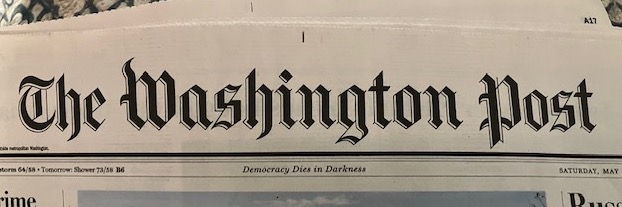
Before boarding, I stopped in an airport convenience store. I was going to buy a copy of the Richmond Times-Dispatch(RTD). Looking around, there were no newspapers for sale in the store. No New York Times, Washington Post, Wall Street Journal, or RTD. I asked an employee about the absence of newspapers. She told me the store stopped carrying newspapers two years ago.

Landing in Atlanta, I stopped at another convenience store. I searched the store—no newspapers, not even the Atlanta Constitution. When I asked an employee, she told me—newspapers stopped arriving at the store in March.

In New Orleans, we hustled out of the airport to catch our ride. I didn’t stop to check for newspapers. But when we returned on Saturday to fly back home, I made a point of checking. At the store where I stopped, they carried two papers—The Wall Street Journal and the New Orleans Times-Picayune. I bought a copy of the Times-Picayune.

Clearly, the digital formatting of newspapers has arrived.

On Thursday, June 20, I read in the RTD, an article written by editor, Chris Coates. The article announces changes to the publication schedule for the paper. On nine holidays, the paper will only be available in a digital format.

In this piece, Coates’ referenced his grandmother, Louann, who was a prolific clipper of newspaper articles. I too was a clipper of articles that I sent to family and friends, but not anymore.

Tired of haggling over subscription prices with the RTD, we switched to the digital format. Like newspapers across America, I guess we newspaper clippers are dying too.

Northwestern University’s Medill School of Journalism has been a leader in studying the death of newspapers across America. The most recent report by the school released in November 2023 stated: “The loss of local newspapers accelerated in 2023 to an average of 2.5 per week, leaving more than 200 counties as “news deserts” and meaning that more than half of all U.S. counties now have limited access to reliable local news and information.”

At this pivotal time in American life, “news deserts” aren’t acceptable. More than ever, we need journalist digging, fact finding, and reporting as a means for holding all of us accountable to save our fragile democracy.

In his article, editor Coates, bragged on four recent stories unearthed by RTD reporters and cited 43 awards the paper earned in an annual contest presented by the Virginia Press Association. Quality reporting and recognition of the RTD’s work by its peers is significant. Also important to the life of the paper are the recent creation of the Reader Advisory Board and the Mobile Newsroom Initiative.

Despite this success, a source of frustration for me and maybe other readers is the inability of the RTD to report its own story on the challenges encountered in running a newspaper. I don’t believe the RTD has adequately reported with journalistic integrity and transparency the stories behind the changes that impacted staff and the paper’s loyal readers.

The RTD is quick to report to readers when changes occur, but readers are left to read between the lines regarding these changes. What’s left of my dinosaur brain tells me the decision not to print on nine holidays is a saving pennies move.

Additionally, I would make the assumption that decisions made over the last several years that impact staff and readers are all grounded in economics. Lee Enterprises the owner of the RTD wants to turn a profit. To turn a profit, newspaper owners gut staff, go whole hog into a digital format, and at every opportunity continue to butcher to the bone— newsprint.

Back on June 2, an op-ed by Glenwood Burley, a member of the Readership Advisory Board, gave readers a rare behind the scenes look at some of the daily decision making and operations of the RTD. I believe your readers would benefit from more insightful writing like this.

Despite what Lee Enterprises might dictate, I believe the RTD owes its remaining readers a more transparent reporting of its decision making when changes are coming to the paper. I don’t think Lee Enterprises would welcome a Freedom of Information Act request about these decisions from a contingency of grumpy old readers and disgruntled former reporters.

Listen, I mostly love the RTD. I cherish the work of reporters, editors, printers, and the early risers who deliver the paper. I don’t want the RTD to die.

But if you are going to continue to tell the stories of our communities, you must improve telling the RTD’s story too.

Photo by Bill Pike