Am I a good soldier?

Scripture 2 Timothy, Chapter 2 verses 1-7:

You then, my child, be strong in the grace that is in Christ Jesus; 2 and what you have heard from me through many witnesses entrust to faithful people who will be able to teach others as well. 3 Share in suffering like a good soldier of Christ Jesus. 4 No one serving in the army gets entangled in everyday affairs; the soldier’s aim is to please the enlisting officer. 5 And in the case of an athlete, no one is crowned without competing according to the rules. 6 It is the farmer who does the work who ought to have the first share of the crops. 7 Think over what I say, for the Lord will give you understanding in all things.

Thanks Judy for your kind words.

I appreciate Laura Candler-White, our church organist, and Daniel Parks, our music director for their participation in this service.

That thanks also includes our acolytes, those of you in this Sanctuary, and anyone watching on-line at home. Additionally, thanks to the Trinity staff, and our Senior Pastor, Brian Siegle, who is running the technology.

I also want to say safe travels to the Hall family. They are making their annual drive to Missouri to be with relatives during Thanksgiving.

I volunteered to be here this evening. Maybe this gives a little break to our pastors Brian, Daniel, and Judy as they head into Advent.

A couple of reminders for you.

I’m not a theologian. I’m no expert on the Bible.

Quite simply, I’m a rapidly aging, grumpy geezer.

And for the next couple of hours, maybe, just maybe I might say something that will resonate with you as we take a look at Timothy, and a few verses of scripture about teachers, soldiers, athletes, and farmers.

But, let’s start with a prayer, let us pray: Father of us all, over the next few minutes touch our hearts. In your name we pray, Amen.

From the 1973 edition of the New Oxford Annotated Bible the Revised Standard Version, here are a few bits of information about Timothy.

Timothy was the son of a Greek father and a Jewish mother who had become Christian.

Timothy’s mother and grandmother raised him as a Christian.

Paul was looking for a helper in his missionary work when he visited Timothy’s hometown, Lystra, in present day Turkey. Clearly, this Christian upbringing helped Paul in the recruitment of Timothy.

In this Second Letter to Timothy, a veteran missionary wants Timothy to understand that endurance is a key quality of a preacher.

Additionally, Timothy is encouraged to rekindle the gift of God within him. The veteran missionary reminds Timothy not to be ashamed of witnessing for the Lord.

There are some indications that Timothy was overawed by his surroundings and did not make his witness boldly.

And finally, Timothy was advised to take his share of suffering as a good soldier of Jesus Christ.

I wonder what Timothy thought about this advice.

I wonder what you, me, we, us think about this advice.

We might not see ourselves as soldiers of Jesus Christ, but we are familiar with the words endurance, rekindle, ashamed, witness, and suffering.

Yes, I’m ashamed to admit it, but I’m not a bold witness for Jesus Christ.

It would be very uncharacteristic of me to walk up to a person or a group of people, and shout out:

Hey, you bunch of heathens, as a Christian, I’m here to tell you that you must quickly rekindle your endurance for following the teachings of Jesus Christ because if you don’t, there’s a whole heap of suffering headed your way.

And yet, I’m drawn to the seven verses in second Timothy chapter two because of these words— teacher, soldier, athlete, and farmer.

Like Timothy, our national holiday of Thanksgiving has become overawed by the commercial rise of Halloween and Christmas. But if you really think about Thanksgiving, farmers are the key. No farmers, no Thanksgiving.

What might we learn from farmers about endurance and suffering as they work through the challenges of a difficult growing season?

At some point over this Thanksgiving weekend, we will probably be drawn to the athletes who play college or professional football.

From this chapter of Timothy, verse five reminds us:
“And in the case of an athlete, no one is crowned without competing according to the rules.”

As fearsome as the football warriors might look on the field, their thinking can become internally fragile. In these frail, weak moments, these athletes can place themselves in unwise situations where they fail to compete by the rules of life or the rules of the game. In those circumstances, there is no crowning.

What might we learn from athletes who fail for not following the rules?

With regard to soldiers, I’m drawn to an intense scene from the movie Saving Private Ryan.

Captain John Miller, played by Tom Hanks, and his soldiers have been given orders to find Private James Frances Ryan. Private Ryan’s three brothers have already been killed in the war.

This mission is to find Private Ryan and send him back home.

After a fierce encounter with a German unit, Captain Miller faces an emotional and out of line pushback from one of his soldiers over this mission to find Private Ryan.

In this pushback, the personalities of his men erupt all around Captain Miller. The language is vile. Weapons are drawn and pointed. Threats are made. Captain Miller’s men plead with him to intervene to stop this unsafe chaos.

Finally, Captain Miller quietly asks one of his men, “What’s the pool up to on me now?”

Captain Miller’s men have been trying to determine his profession prior to joining the Army. The pool amount is up to $300.00.


With that distracting question, the tenseness of this moment is broken. Captain Miller reveals to his men that he was a high school English teacher and baseball coach in a small town in Pennsylvania.

What might we learn from soldiers who struggle to understand the reasoning behind their orders?

For a few minutes, let’s take a brief detour to watch a scene from the movie Mr. Holland’s Opus.

In this scene, two teachers, who are friends have a conversation about a student:
https://www.youtube.com/watch?v=ad5pKiflwew

In this scene, Glenn’s fellow teacher Bill is looking for understanding.

He can’t understand why Glenn can’t teach his star wrestler, Lou Russ, to play a musical instrument.

I’m not sure about you, but for me, in that scene the path to understanding pivots off these words—“then you’re a lousy teacher.”

I wonder if anyone ever said to Jesus—“you’re a lousy teacher.”

At this very moment, when Jesus looks down upon us, I wonder how he might evaluate our current teaching skills. He might ask:

Bill, are you able to teach others about grace?
Bill, do you understand the endurance it takes for people to survive living in difficult environments?
Bill, do you understand their suffering?
Bill, when are you going to enter this game and compete?

Timothy is given a lot to think about in Chapter Two, but the last verse states:
“Think over what I say, for the Lord will give you understanding in all things.”

Isn’t that part of what we are all searching for in life— a bit of understanding?

In David Halberstam’s book October 1964, Mr. Halberstam takes a behind the scenes look at the New Yankees and the St. Louis Cardinals and the season that leads the teams into the World Series.

In the final seventh game of the series, the Cardinals win.

At the end of the game, the reporters want to understand why the Cardinal’s manager, Johnny Keane, left his starting, but worn out pitcher, Bob Gibson, in the game to finish the ninth inning.

Johnny Keane tells the reporters: “ I had a commitment to his heart.”

In the magazine The Week, I recently read about author, Sophie Kinsella. This 54 year old mother of five has terminal cancer.

“Every morning, her husband reads the papers and delivers a cup of tea along with a hopeful story about someone who’s beating the odds on a grim diagnosis. From this routine, Kinsella states, “ I really want to be someone else’s story of hope.”

“ A commitment to his heart and some else’s story of hope,” are powerful human reflections.

However, the question remains for me—am I a good soldier?

Am I a good soldier depends upon my heart.

Is my heart grounded in the teachings of Jesus?

Can my heart offer hope to the people who are lost and struggling to find their way in life?

From my non-theological brain, I sense any chance I have at understanding the pep talk that Timothy has been given lies in these familiar words from John 15 verse 12: “This is my commandment, that you love one another as I have loved you.”

In this very challenging and difficult world to be a good soldier, I must find the capacity to love the people I encounter on my walk through life.

This includes people who don’t look like me, act like me, or think like me.

And this requires me to love 365 days a year. I can’t opt out to love these people only during Thanksgiving and Christmas.

On the afternoon of Saturday, November 16, I was starting my second day in my annual battle with the leaves in our yard.

My wife, the Commander Supreme, came out into the backyard, and said to me, “If you are looking for something else to do, you could trim back the butterfly bush.”

I responded, “I’m not looking for something else to do.”

She laughed and said, “But, I know you are.”

Deep in his heart, Jesus has something for us to do.

He needs us to be graceful, strong soldiers, athletes, and farmers whose hearts can teach a world full of battered and weary people that hope can be found in love.


My clock is ticking. I turn 72 in June.


I’m overdue to be a good soldier.


How about you?

Benediction

As we prepare to head out of here this evening, if you have college students at home—enjoy the laundry.

If your in-laws are visiting your home—pray harder.

Whatever your plans are for tomorrow, I hope you and your family have a good, healthy, and safe Thanksgiving.

And don’t forget the pep talk for Timothy.

Somewhere in your life:

There was a patient teacher who never gave up on you.

The farmer you never met who harvested your food.

The athlete who played by the rules and was crowned.

A soldier who courageously sacrificed to preserve your freedom.

And most importantly, don’t forget Jesus.

He needs our hearts to find the beat just like Lou Russ did.

That beat is a heartbeat, a heartbeat committed to love one another beyond the walls of Trinity.

Now go in peace.

Author’s note: I had the privilege of speaking at the Thanksgiving Eve Service at Trinity United Methodist Church in Richmond, Virginia on the evening of Wednesday, November 27. I’ve included for you a link for the scene we used from the movie, Mr. Holland’s Opus. From the original movie, this scene is called Challenged. It features Bill and Glenn playing chess on Glenn’s porch. The clip is just under five minutes. If the technology fails, I hope you can find it on-line and view it. Happy Thanksgiving, be safe, love, Bill Pike

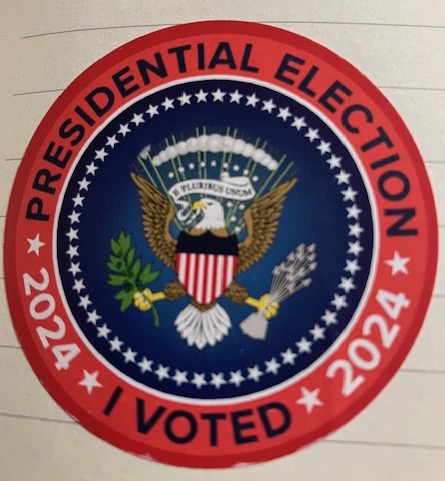
Thanks to the Trinity staff for the design. Thanks to Mike Cross and the staff at the Virginia War Memorial for honoring my request. (Photo by Bill Pike)

Visibility: 0.25 miles

On the afternoon of Monday, November 4, I made sure that Trinity Hall was ready for the precinct volunteers.

At 4:30, they were coming to set up the hall the way it needed to be for election day.

I had six tables and twelve chairs out.

This would be the first presidential voting that had been held at our church since we became the precinct for the Rollingwood neighborhood in western Henrico County, Virginia.

On Tuesday morning, I had to have the building open by five. That gave the precinct volunteers an hour to make sure everything was ready for the voters at six to enter Trinity Hall to cast their votes.

I didn’t sleep well. I kept thinking about what would happen if I overslept.

Just before five, I had the building open.

Since this was my voting precinct, I opened up my office. I checked emails, and shuffled through some papers.

A few minutes before six, I went back down to Trinity Hall. I walked outside and joined the line with other early voters.

It wasn’t long before I was checked in. I was directed to a voting booth.

I carefully marked my ballot. Next, I walked a few steps and inserted my ballot into the machine that recorded my vote.

Then I made the two block drive to our home.

With a temperature of 56 degrees, I decided it was a good morning to go for a run. I always jot down in my running journal the current weather conditions from the Richmond airport.

On most mornings, the visibility is ten miles. Today, the visibility was 0.25 miles. Fog covered the east end of the county.

A gray overcast ceiling hovered just above the tree tops in Rollingwood.

Back on Sunday morning, November 3, I went for a run. I was sluggish. It was like my legs and brain were out of sync. I wanted to turn back.

By body didn’t want to go. I kept trying to nudge it out of this resistance. Some of that reluctance might have been because the last day that I had gone for a run was on October 20.

But on this important Tuesday morning, my body was more cooperative. My route would be to run the 5K course that starts at our church. I ran the course in a reverse sequence.

It was a damp morning. The humidity reading was 97%. A calm wind allowed for a coat of stilled moisture on every surface.

A palette of autumnal colors from the tree leaves temporarily replaced the sun on this gray day.

I wondered how America would be on Wednesday morning. I hoped that we would not be dealing with post-election turmoil.

For a long, long, long, long time America has been struggling.

Without doubt, we are facing multiple challenges within our borders, and troubling challenges outside our borders too.

Regardless of those challenges, and regardless of who becomes our president, it is foolish the amount of money that has been spent on this election.

National Public Radio was one of multiple news outlets that reported these findings from Open Secrets, a group that tracks election spending.

For the 2024, federal election, Open Secrets estimates that nearly $16 billion was spent. Four years ago, the amount was $15 billion.

I’m sorry, but $16 billion spent on an election is wrong.

How can we fail to see this?

But, there is something worse than the $16 billion.

Through the manipulation of fear, misinformation, and complete neglect for the truth, the Grand Old Party’s presidential candidate has eroded the dignity and integrity for the office of president in our country.

Why can’t we see this?

I’m a flawed and imperfect human being.

America is a flawed and imperfect democracy.

Jon Meacham is a Pulitzer Prize winning author and historian. During a lecture at the College of William and Mary in April 2024, Meacham stated: “If democracy were easy, everybody would be doing it.” (W&M Alumni Magazine Fall 2024)

At this stage of my life as a rapidly aging and excessively grumpy old geezer, I think Mr. Meacham is correct—there is nothing easy about a democracy.

And yet, I also believe at this moment, the heart of the shortcomings of our democracy are captured in this quote from Helen Keller: “The only thing worse than being blind is having sight but no vision.”

I wonder if we are capable of regaining our vision to find and live the last six words from President Lincoln’s first inaugural address—“the better angels of our nature.”

With regard to our democracy and America, I pray our divided souls find “the better angels of our nature.”

Photo by Bill Pike

Tweaking accreditation won’t help students in need

RICHMOND TIMES-DISPATCH THURSDAY, NOVEMBER 14, 2024|A9

OPINIONS

LETTERS TO THE EDITOR

Tweaking accreditation won’t help students in need

I recently read in the Richmond Times-Dispatch Del. Mike Cherry’s Oct. 10 op-ed, “Why is school accountability so political?” This piece is about the new accreditation standards for our public schools in Virginia.


Accreditation standards have always been political. Truth be told, accreditation standards will most likely remain political unless we are willing to end our destructive legislative division.


When changes like this are made, I want to know if teachers, testing administrators, parents and students were asked to offer input. After all, they wrestle with accreditation every school year.
But what I really want to know is who is looking at the data that captures what life is like for an unsuccessful student in a nonaccredited school?

How different might that student’s academic performance look if this student had access to quality mental and physical health, non-substandard housing, family stability, proper nutrition, a school environment conducive to learning, and teachers who were respected and supported within the school system and the community.


Sure, every four years in Virginia a new governor and our political parties can continue to burn energy and time to change the accreditation standards to their liking. Unfortunately, tweaking accreditation standards is not going to solve the vicious generational cycles of community neglect.


We are overdue to confront and break those cycles. Failure to analyze and understand the needs of our students and their families in these difficult community environments guarantees less academic achievement.


I believe our Virginia legislators should take a field trip to the Virginia Museum of History & Culture. They should take in the exhibit about Booker T. Washington and Julius Rosenwald. Their unyielding teamwork allowed for the development of 4,978 schools across America. Virginia’s students, parents and teachers need that type of teamwork, not our current political bickering.


Bill Pike. Henrico.

Note from author: I was honored to have this letter published in the Richmond Times-Dispatch today Thursday, November 14, 2024.

(Photo Bill Pike)

Veterans Day 2024: “humility”

I did not serve my country in military service.

Yet, for many years, I have developed a deep respect for our Veterans.

If I notice an older gentleman wearing a hat proclaiming their service in a branch of our military, I make a point of stopping to thank this man for his dedication.

In those brief seconds, the response is a humble smile and thank you.

I also note license plates that indicate a range of links to serving in the military. If I see Bronze Star or Purple Heart, I’m curious about the story behind this recognition.

With a Veteran, there is always a story. Quite often, the Veteran has little desire to share those stories.

My mother’s brother, Sam, was a tail gunner in World II. He was assigned to a bomber, the B-24. I was never allowed to ask Sam anything about his military time. I’ve read enough historical accounts about what those bombing missions were like to understand the reluctance to talk about those perilous flights over enemy territory.

This past year, I had the privilege to make a second visit to Pearl Harbor and the National Memorial Cemetery of the Pacific at the Punchbowl in Honolulu, Hawaii. Both places put into perspective, the horrors of war.

Additionally in May, my wife and I on our visit to New Orleans spent a day exploring and learning at the National World War II Museum. Every square inch of this museum was worthy of our time.

This quote from Private First Class Harry Parley, 116th Infantry Regiment, U. S. 29th Division caught my attention about D-Day and Omaha Beach: “As our boat touched sand and the ramp went down, I became a visitor to hell. I shut everything out and concentrated on following the men in front of me down the ramp and into the water.”

I can’t imagine the hell these young men experienced.

In July, I and three pals from college traveled to Oshkosh, Wisconsin for the Experimental Aircraft Association annual air show and convention.

If you like airplanes, this is where you want to be. If it has wings and an engine, chances are that plane will be at Oshkosh. Annually, the airfields host 600,000 visitors and10,000 airplanes.

Many organizations and private individuals have worked diligently to restore and maintain planes from the World War II era.

One morning at breakfast, my friend Dan Callow and I had the privilege of talking with two of the Veterans who were part of the crew for one of the two B-29 bombers at the show. You might recall that the B-29 was the plane used to drop the atomic bomb on Japan.

I could have stayed for hours and peppered those two Veterans about their experiences flying the B-29. Knowing they had a full day of activities ahead of them, we thanked them for their service, and wished them well.

As respectful and appreciative as I am of our Veterans, I know many of them face challenges in their current day to day living.

For example, “the U.S. Department of Housing and Urban Development(HUD) estimates that 40,056 Veterans are homeless on any given night. Only 7% of the general population can claim veteran status, but nearly 13% of the homeless adult population are veterans.” (National Coalition for Homeless Veterans)

Mental health is another concern for Veterans.

Consider this data from an article appearing in The Conversation on November 7, 2024: “America’s military veterans make up about 6% of the adult population, but account for about 20% of all suicides. That means that each day, about 18 Veterans will die by suicide. In the U.S., the overall rate of suicide has largely increased since the start of the millennium, but Veterans are disproportionately represented among this tragic trend.”

Homelessness and death by suicide lead me to this quote from James Bradley’s book Flyboys.

Veteran Rowdy Dow, who was a gunner in a torpedo bomber, told author Bradley the following: “If we had given in to our fears, we wouldn’t have won that war. There were no replacements out there. Our country was depending on us and we were all ready to die for our country. There was a job to do. We did it.”

I’m not sure about your feelings, but I feel we have an obligation to support and take care of our Veterans. They were willing to die for America. They did their jobs. Why can’t we be better in meeting their housing and mental health needs?

I’m one lucky man.

Because of the sacrifices of the women and men who have served our country, I’ve been able to freely travel to Honolulu, New Orleans, and Oshkosh.

I cherish those trips with family and friends.

But since returning from New Orleans, I periodically go back and look at photos I took while at the National World War II Museum.

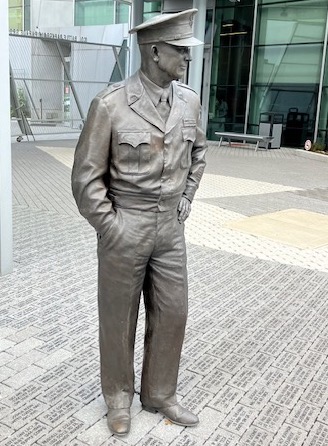
Inscribed on a large cut piece of stone, I keep coming back to this quote from Dwight Eisenhower: “Humility must always be the portion of any man who receives acclaim earned in the blood of his followers and the sacrifices of his friends.”

Statue of General Eisenhower at the National World War II Museum (Photo Bill Pike)

On this Veterans Day, and those in the years ahead, I pray we will never forget the humble humility of the countless sacrifices made by our Veterans to preserve our freedoms.

Too frequently and foolishly, we take these sacrifices and our freedoms for granted.

You, me, we, us can’t disregard humility.

“Humility must always be” an essential “portion” of our character.

Leaders who lack humility are blind to the struggles of real life.

And one last gentle reminder—any day is a good day to stop and thank our Veterans.

The B-29 bomber “Fifi” on the tarmac at Oshkosh Air Show July 2024 (Photo Bill Pike)

No fur, feathers, or fins

At 2227 West Front Street, in Burlington, fur, feathers, and fins were scarce. In our household, when my sister and I were growing up, we had no long term pets.

That absence was a holdover from when our parents were growing up. For my mother, it was surviving a journey from Mississippi to North Carolina after her father deserted his wife and their three children.

My father’s family was a different type of survival. He was one of ten children whose parents miraculously made a living as tenant farmers in Alamance and Guilford counties.

I sense shelter, food, and clothing were the essentials that my grandparents held as a priority for their children, not kittens and puppies.

Yes, I do remember short timers on West Front Street. From the circus at the Greensboro Coliseum, my father purchased me a small turtle.

At some point, I had a chameleon. I kept him in a homemade terrarium in a shoebox. Once I pinched the tip of his tail with the top. My mother told me the tip would grow back. I think the chameleon died before the tip returned.

One spring, a handcrafted cage arrived in the backyard. A few days later, my sister was the proud owner of white rabbit.

Then there was a day when the bunny slipped out of the cage while being fed. In the uncertain chaos that followed, lots of coaxing took place to get the stubborn rabbit back into its home.

Neighbors around us had dogs. I remember Maverick, Brownie, and Penny.

A few times, I was the dog sitter for Brownie when our neighbors were out of town.

As it turns out, my sister and her husband who reside in Snow Camp are the animal lovers. My sister’s childhood love of horses continued. Over the years, she has owned and cared for several. Her knowledge and skills are impressive, and everyone of these beautiful horses has a story.

Chickens are a part of their farm landscape too. I’ve heard the stories about sly black snakes sleuthing for eggs, red tailed hawks skydiving on an unsuspecting hen, and the carnage left from a neighbor’s roaming dog who attacked when no one was at home.

My real introduction to pets came from my wife’s family. I still recall meeting their Cape Cod black lab, Joshua. What I took away from our first meeting was that Josh had more energy than anything powered by an Energizer battery. Josh exuded an exuberant excitement like greeting a long lost friend.

An aging Josh. (Photo courtesy of Ken Cloud)

Also, in this household was a huge black and white cat named Kiwi. During Christmas visits, the bedroom where my wife and I slept had a trundle bed. Unknown to me that trundle bed was a favorite sleeping place for Kiwi. One night, I woke to hear what sounded like human footsteps trudging across the carpet. I looked down to see Kiwi walking toward the bedroom door.

Turns out my father-in-law had a soft heart for all creatures. There might have been one exception to that affection, a beagle named George.

At some point during George’s tenure with the family, he thought it would be a good idea to urinate on my father-in-law’s foot. Not long after that irrigation, George found a new home with the milkman.

When my wife and I started our family, we occasionally had conversations about pets. From my childhood experience, I politely held to no dogs and cats. Goldfish and a few hermit crabs mingled with our three children during their youth. When our children asked about having a cat or dog, my standard line to them was “when you’re 21, out on your own, you can have whatever pet you want.” To this date, none of them have any pets.

Now, I don’t want you to think I’m an anti-pet person. I appreciate the joy pets bring into families. But, I’ve also seen the wear and tear. Veterinarian bills, putting a beloved family friend down when the cherished pet becomes incapacitated, and the hopeless fear when a pet goes missing and never returns.

Over the years, I’ve enjoyed hearing pet stories at the dinner table shared by friends and neighbors.

Our across the street neighbors, Barbara and David tell a good story about a former dog, Dwayne. Dwayne learned how to jump their backyard fence. He also knew how to navigate the city streets to where Barbara’s parents lived.

One day, Dwayne showed up at her parents house with two unopened packs of dinner rolls. Clever Dwayne figured out access to the dumpster at the A&P grocery store on the way.

Another neighbor tells the harrowing story of how a maintenance worker at the University of Richmond saved their cherish dog from drowning in the university’s lake. The dog had become entangled with a drain pipe.

Over the years, I’ve learned that pets are similar to humans. Sometimes, they just need a bit of attention.

Etched in my memory forever is a former neighbor’s yellow lab. On pretty fall afternoons, when I was in the heat of my annual battles with leaves, Zip would wander into our yard with his slobber covered tennis ball.

Zip wanted to play. He’d drop the ball at my feet. With my gloved hand, I’d pick it up and toss the worn ball a few yards away. Even though Zip was aging, he would scurry off and bring the ball back every time.

Despite pets never being a permanent part of my life, they offer something that has become a rarity in our often divided, impatient, and selfish world—loyalty.

That bond, that loyalty between a pet and its owner is “a sight to behold” as Gomer noted when admiring a car on the Andy Griffith Show.

From my no pets experience, I wonder if my take away is this—might our world improve if we could become more loyal to each other, especially on those days when everything goes wrong.

Author’s note: This piece was submitted to the essay contest for O. Henry magazine. I was notified today(11/6/24) that the piece didn’t make the cut. Internally, I knew these ramblings had no chance, but I enjoyed trying.