I am no expert at running.
A long time ago, I subscribed to Runner’s World magazine. I never read the magazine in great detail. What I learned about running came from experiences and the wisdom of friends.
My friend, Bruce Bowen, a former successful Cross Country coach at Hermitage High School put together my training for the Richmond Marathon. It was a good plan. While I barely made it to the finish line, I would have never crossed that finish line without Bruce’s help.
I’m dreading the day when what’s left of my old body conveys to me, “Sorry, Bill, but the working parts of your body have decided that we can’t take you out for a run any more.”
When that day happens, my cherished early morning runs will end, and I expect I will cry.
Over the last few years, I’ve stopped running long distances. I keep enough of a base so that I could sign up and run a 5K, a mere 3.1 miles.
I look for 5Ks that support a good cause.
On the afternoon of Thursday, September 26, my Commander Supreme drove us out to the Hardywood Brewery in Goochland County. The Dominion Energy Charity Classic had a 6 p.m. start time.
With this 5K, individuals could sign up to run/walk for a favorite local nonprofit. I signed up to represent Home Again. I’m proud to say that Home Again finished third in the number of participants who signed up for the 5K. Home Again does good work in helping individuals overcome homelessness.
I rarely go for an afternoon run. I can only think of one other time when I ran in a 5K with a late afternoon start. But here I was in the starting area, awaiting instructions for the beginning of the race.
The Hardywood Brewery is a pretty site for the 5K. My architect friend, Rohn Price, and his team really did a nice job designing the facility and its grounds. The entire place is very user friendly.
I timed my entry into the start area so that I would not be waiting a long time for the beginning of the race. I was ready to go.
I had no concerns about what appeared to be a gently rolling course. No, my concern was the heavy air.
Just as the 5K was about to start, the dew point was 72 and the humidity 85%. That was some heavy, damp air for a run.
Right on time, we moved across the start line. The beginning is always sluggish as walkers and runners are maneuvering finding their space, stride, and pace.
Eventually, the course opens up, and I’m slogging along.
The course is a loop on the main road into the West Creek Business Park. Numerous Richmond based corporations have their headquarters on these pretty parcels of land. Well landscaped and maintained, the route has a natural flow to it.
With officers from the Goochland Sheriff’s department at key points on the route, participants don’t need to worry about a clueless driver intruding.
It doesn’t take long for my old body to respond to the heavy air. Within the first mile, I’m sweating. The further I go, the more I drip.
Some runners adjusted to this smothering air by doing a combination of running and walking. I’m managing my pace and trying not to let this wet blanket of air wear me down.
At the water stop, I do my usual routine: grab a cup, rinse out my dry mouth, and then I take a swallow of the water before tossing the cup into the trash can.
I keep pushing.
I pass the two mile sign.
It seems like I will never reach the three mile sign, but I do.
Seeing that sign, my old sack of bones silently cheers, and my legs push me up the hill toward the finish line.
After crossing the finish line, with hesitancy, I took the medal I was offered. All finishers received one.
I worked my way to a patio where the Commander was sitting at a table enjoying a glass of wine. I grabbed a cup and filled it up with water. She snapped a photo of me, and I sat down for a few minutes.

At the bottom of my bib number was a tear off strip. This strip entitled me to a free beer. So, I gingerly removed the strip and ordered a Farmhouse Pumpkin Ale.
Before leaving, we saw our church friend, Ashley Marshall. She talked about the challenges from the heavy water laden air too.
Then, the Commander and I started our walk back to the car.
There I covered my seat with a towel. Next, I peeled off my wet shirt and put on a dry one.
And, I thought to myself, “thanks old bones for getting me across the finish line.”
But, I also thought, thanks to Dominion Energy for putting together the 5K, and for the staff at Home Again, and all of their work with the homeless.
And I looked at me, and thought how lucky I am, we’re driving home to our house, and I’ve never been homeless.
Part II: More Water
Little did I know that another encounter with water would greet me on Friday morning at Trinity.
At 8:15, on Friday, September 27, I had to meet installers to finish window treatments for the nearly completed renovation project.
As I was walking down the brick sidewalk from the church office, I heard water, lots of water.
I looked to my right, and in the corner of the Bicentennial Garden, water was pouring out of a sprinkler system pipe.
I met the installers, got them into the building.
Then I hustled back to the gushing water. The water was a couple of inches deep in the rock boarder next to the foundation.
I learned a long time ago that water has a mind of its own. At this very moment, the water was gushing into two crawl space wells.
None of the shutoffs at the disconnected pipe were responding. I drenched myself thinking I could reconnect the pipe. I made a decision to shutdown the water from the street connection until I could get to the shutoff valve for the sprinkler system.
It took me a few tries, but I finally was able to shutdown the water. The flow at the dislodged pipe connection stopped.
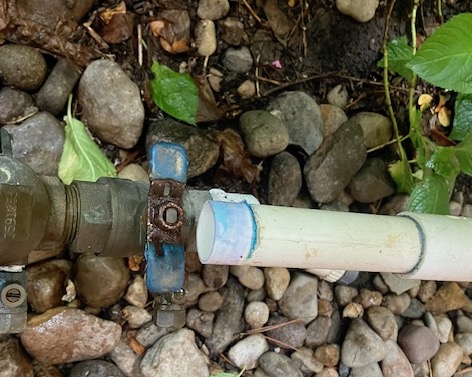
With some help from Chris Howell, a project manager from Century Construction, I was redirected to a new interior water shutoff valve. We put this valve into the off position, and I went back to the street connection and turned the water back on.
The new turnoff valve worked. No water flowed out of the disconnected sprinkler system pipe.
Next, I made preparations to enter the crawl space via the Trinity Hall mechanical room. I needed to locate the shutoff valve for the sprinkler system.
I took our building caretaker, Ronnie Johnson, with me to be my contact person in case the monsters from the crawl space abducted me.
Armed with a flashlight and pliers, I took the step up into the crawl space.
Of course, as I was inside the crawl, Ronnie reminded me that years ago, a raccoon was found in there. That was just the encouragement I needed.
For a while, I could stand with a slight crouch. Gradually, I had to switch to a crawl.
Soon, I came across an area where the water had cut an interior gulley into the orange, red clay. This was beneath the plastic vapor barrier. I kept going, and I had to scrunch lower to crawl under pipes.
With the help of the flashlight, I located the valve. I could also see the water’s entry points. The force of the water had cut another ravine parallel to the foundation wall. I pushed the valve’s lever into the off position.
Then, I headed back to my entry point. By the time I reached Ronnie, I was covered in orange mud and grit.
Out of the crawl space, we walked back to the new shutoff valve, and turned it back to the on position, I could hear the pressure of the water return.
With that on, we rechecked the dislodged pipe in the Bicentennial Garden, and there was good news—no water was flowing. The shutoff valve held.
Not wanting to make another mess, I opted to walk home to change out of the muddy and wet clothes.
I was aggravated at the pipe that had mysteriously come lose. I’m certain the county was going to enjoy this water billing. No telling how many hours the water had gushed unencumbered.
My whining continued as I considered how my plans for today had been derailed by a disconnected sprinkler pipe.
As I restarted my day, I learned that my water encounter was nothing compared to Americans who had been in the direct path of Hurricane Helene.
My family sent me a photo of homes in the mountains of North Carolina. All that could be seen were the rooftops of these homes. Muddy orange water was seen in every direction around them.
No matter where Helene touched, the storm created problems. Unfortunately, the problems created by Helene will take a long, long time to correct.
In times like this, I ask myself how can America be better prepared to work through these natural disasters? No matter how accurate our weather forecasting, it is the aftermath of the storm that makes life very, very difficult.
We invest billions and billions in the space program, and just as ridiculous we spend billions, billions, and billions trying to elect people into office who truly aren’t qualified to hold office.
And consequently, we continue to struggle improving the basics of our infrastructure when natural disasters smack us.
Years ago, when a hurricane impacted our Richmond neighborhood, I stumbled upon this Bible verse from 1 Kings 18:44: “At the seventh time he said, ‘Look, a little cloud no bigger than a person’s hand is rising out of the sea.’ Then he said, ‘Go and say to Ahab, “Harness your chariot and go down before the rain stops you.”’
Way out in the ocean, Helene started as a little cloud. All the right atmospheric conditions conspired to build a catastrophic storm. Its winds, storm surge, and buckets of rain stopped the daily routines of people from every walk of life.
Now, some are dead, some missing, some traumatized from the experience, and some no matter the support given will never recover from this hurricane.
My heavy air slog on Thursday evening, and my soaking on Friday morning from the disconnected sprinkler pipe are nothing in comparison to the hurricane experiences from Helene.
In the days ahead of us, we must nudge our hearts to be a part of this long term recovery.
We can’t let our fellow Americans down.
In his book, October 1964, David Halberstam references former Negro League baseball star, Buck O’Neil. Halberstam writes about O’Neil’s code of life: “He believed that there was almost nothing in life that could not be solved by hard work.” (October 64 pages 147-148)
Our fellow Americans need the hard work of our hearts.
We need to be like that “little cloud rising out of the sea.”
Our collective hard work must rise together to make a difference in the lives of every person in every state that was impacted by Helene.
They need us.
Now.

 might be baloney
very engaging pieces. I enjoyed reading them.
LikeLike
Doug, appreciate the follow-up, and comment.
LikeLike