In our Richmond, Virginia yard we have three gardenia shrubs.
Two of those shrubs are tied to the yard where I grew up in Burlington, North Carolina.
The other one, a different gardenia variety came from the faculty and staff at Lakeside Elementary School when our father died.
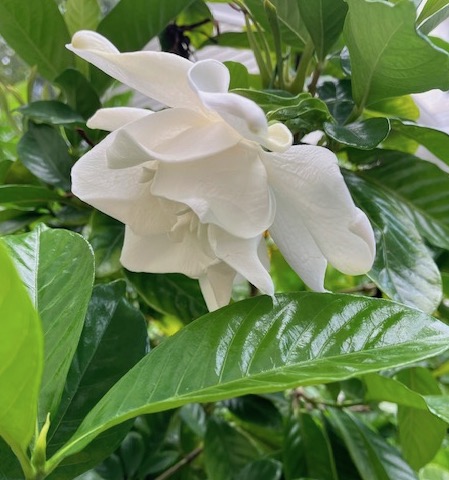
An August bloomer (Photo Bill Pike)
For my sister and me, the last days of August have never left us.
On August 31, 1992, our mother said goodbye after a brief skirmish with that bum cancer.
Ten years later on September 1, 2002, we lost our father. It was just barely past midnight when his heart said I’m done.
Maybe angels conspired with the timing.
Somewhere in the world at this very moment, a child will start a new day without a mother or father.
I have no concept of what their life must be like.
Also at this very moment, there is a child that is plotting how to survive another day with a parent who is irresponsible in providing care.
Again, I have no concept of what this life must be like with an irresponsible parent.
At some point, my mother’s father deserted his wife and their three children. I don’t know how, but their mother figured out the path to survival. She raised three smart, responsible, resilient, kindhearted children with very little support.
Life for our father was a different type of survival. His parents Izetta and Charlie had ten children. Izetta and Charlie raised a good crew as well. Everyone of them graduated from high school. This was a rigid requirement.
My wife and I still enjoy puttering around in our yard. I hope we can putter in our yard for as long as we remain vertical.
As you know, summer along the east coast of America can be brutal.
Temperatures in the nineties, some days over one hundred, combined with excessively high humidity and dew points creates a hellish misery.
Often that misery is locked in place for days and sometimes weeks without a break and barely a drop of rain.
During these dry spells, we keep our shrubs and flowers in our borders watered. I don’t waste much water on our lawn.
Usually when the hot spell breaks, we’ll have some good rain. And for me, there is something magical about those rain drops from heaven.
My biology professor at Greensboro College, Kemper Callahan, would be disappointed in my lack of understanding the “secret life of plants.” Something miraculous happens from those soaking raindrops.
A shrub like a gardenia has already bloomed in the late spring. Now, the shrub is full with new shoots of green leaves.
Yet, twice this August, two of our gardenia shrubs have sprouted new flower blossoms.
When I discover those blossoms, I automatically think of my parents. They loved their flower beds and bountiful backyard garden. They had green thumbs, a love for the earth, and an appreciation for every bloom no matter if it was from a okra stalk or a gardenia shrub.
There was a lot that I failed to absorb from my parents. I regret my stubborn impenetrable head everyday of my life.
I’m certain there were many times they wanted to wring my neck like a chicken on a cool spring morning. But, they restrained themselves. Somehow, they continued to love me despite my countless faults.
It was that love that bound them together, and pushed them to sacrifice for my sister and me.
And as long as the good Lord keeps me vertical, I will love and cherish those August days when a gardenia surprises me with a bloom.
That will be my reminder of how lucky I was to be raised and loved by Louise and Bill.
I’m sure the editors at the Upper Room spend lots of time figuring out the cover for the magazine. The magazine prints six times during the course of a year.
That’s not as stressful as figuring out the cover every week for a news magazine, but I know the editors work diligently to find the right piece of art.
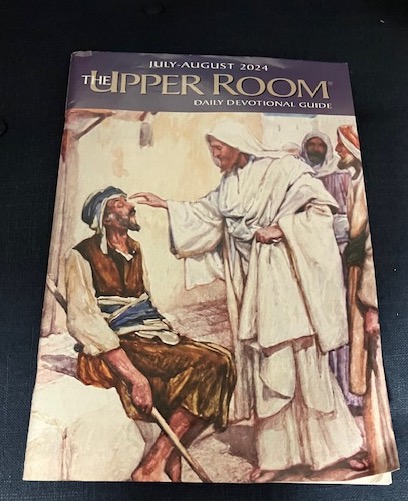
The July/August 2024 edition has found me staring into that cover quite a bit. British artist, Arthur A. Dixon, depicts Jesus healing a blind man.
On page two of the magazine, the editors offer an interpretation of the cover. The interpreter attempts to give the reader a few things to ponder about the work of the artist.
The interpreter, Nancy Cason, references the movement in the scene. Jesus’s fingertips gently moving toward the closed eyes of the blind man. She uses the words—“loving, compassionate, and gentle healer who is just and merciful,” to describe Jesus.
When I view this beautiful painting, the impatient, whiner, grumbler that I am, forms this question—“Hey Jesus, where is your loving, compassionate, just and merciful, gentle healing today?”
Jesus, in case you haven’t noticed, we are a hurting world. Where is your touch, your instantaneous touch that in a blink changes a life for the good?
Perhaps, this verse from John Chapter 6 was written for me: “Jesus answered them, ‘Do not complain among yourselves.’
I’m among the complainers. I want to advocate for those who need the instantaneous touch of Jesus.
Usually when I take the time to ride the exercise bike in our basement, I will listen to a recent broadcast from the National Public Radio Show Fresh Air. I respect the interview format of this program because I always learn something from the moderator and the guest.
On the morning of August 5, I listened to host Terry Gross interview Dr. Theodore Swartz, a neurosurgeon. Dr. Swartz has written a new book: “Gray Matters: A Biography Of Brain Surgery.”
The interview was fascinating. Yes, I was a bit squeamish at times, but fascinating.
This was especially true in terms of how the medical science for helping people with brain injuries and illnesses has changed. The surgical techniques and procedures have continued to evolve and change for the good.
I learned how sensitive the brain is. Despite its tough skull, in a blink, our skulls can be damaged in ways that no one might anticipate.
A neurosurgeon must be in good mental and physical shape when performing surgery. Surgeries can last six to eight hours— with no restroom breaks or stops for refreshments. And most critical, the neurosurgeon is required to have steady hands at all times.
And perhaps like Jesus, “neurosurgeons have a unique window into the human condition.”
It is our human condition that makes my sleep restless some nights.
I imagine that Jesus and neurosurgeons have restless or almost sleepless nights too.
Can weary and fragile human beings continue to endure unbearable and relentless trauma? Especially in world that appears at times to have lost its compassion and ability to think in reasonable and rational ways.
And I keep coming back to the cover of the Upper Room. I see the right hand of Jesus reaching to touch the closed eyes of the blindman, and in a blink he is healed.
In his own remarkable way, Dr. Swartz has the capacity to heal. His surgical skills are similar to the touch of Jesus. While not always immediate, Dr. Swartz’s touch can save and improve the quality of lives.
For my old brain, I’m always going to wrestle with the blink found in the instant touch of Jesus.
And unseen, unknown to me is that somewhere today, in the most desperate of situations, the instant touch of Jesus will arrive in a blink.
Why is that?
How does Jesus choose when to appear and save?
I wonder if anyone has the metrics on unexplainable medical miracles?
In the same way, I believe that the healing touch of Jesus can be working through other people like Dr. Swartz.
In the magazine The Week, I recently read about Lewis H. Lapham. Mr. Lapham was a columnist and editor. From 1971 to 2006, Mr. Lapham’s leadership was dedicated to Harper’s magazine. Mr. Lapham recently passed away, and this article was a recapping of his career and life.
I was drawn to this quote from Mr. Lapham: “The hope of social or political change stems from language that induces a change of heart. That’s the power of words, and that’s a different power than the power of the internet.”
Jesus had no internet.
No his power came from his words, his compassion, his movement, his ability to teach, and from his heart.
Changing hearts in this world today doesn’t happen in a blink.
But, we can’t give up on the hope in our hearts.
With the right words, that hope can cause a person to blink, and change for the good.
Upper Room cover from July/August 2024 (Photo Bill Pike)
On May 8, my wife and I flew into New Orleans. My last visit to the city was when I was 5. I turn 71 in June.
We live in Richmond, Virginia. Our cities share some similarities.
Rivers are central to our landscapes. You have the Mississippi, we have the James.
Statues from the Civil War created some interesting dynamics in our cities when decisions were made to remove them.
Sections of Richmond and New Orleans have been revitalized with restaurants, shops and craft breweries.
Collegiate life at Tulane, Loyola, Virginia Commonwealth University and the University of Richmond adds to the diversity of our communities.
You have the New Orleans Jazz & Heritage Festival; we have the Richmond Folk Festival. Beautiful homes are found in your Garden District and the Fan in Richmond.
Clearly, I could drone on, but each city also has challenges.
Neither city has immunity from issues surrounding affordable housing, the homeless, safety, equity, public education and infrastructure upkeep.
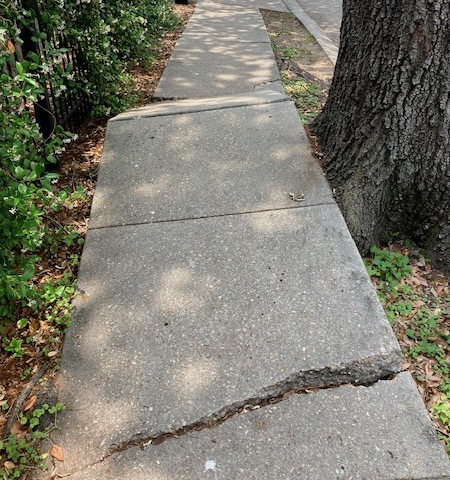
Aside from one day of streetcar use, we walked everywhere. I can’t believe that one of us didn’t roll an ankle on multiple imperfections found on sidewalks.
Sidewalk impacted by tree roots in a pretty New Orleans neighborhood (Photo Bill Pike)
My old heart hurt when we came upon a homeless person zonked out on the hard concrete at the entrance to a dilapidated building.
Despite these concerns, we also encountered genuine hospitality.
A streetcar driver ensured that we departed at the correct stop for Audubon Park.
We spent an entire day at the National WWII Museum. Every staff member was courteous, helpful and patient.
No matter where our appetites took us, diverse and knowledgeable waitstaffs gave us graceful guidance.
Reluctantly when our trip was over, we flew back home.
Since returning, pitching New Orleans has been my mantra.
Thanks, and I hope we can return someday.
BILL PIKE Richmond, Virginia
Author’s note: In May 2024, we traveled to New Orleans. This letter was published in the Times-Picayune on June 19, 2024.
On Monday, July 29, I felt like a summer cold was encroaching.
Knowing that I was supposed to travel on Thursday, on the morning of Tuesday, July 30. I took a COVID test.
Wait time for the test kit didn’t matter. I was positive immediately. Just what I expected to happen.
I spent the next few minutes trying to remember everyone that I had spent time with on Monday. I compiled a list and sent an email to Kim Tingler at the Trinity church office. Graciously, Kim forwarded the email for me. I said a silent prayer asking that none of these people get the COVID.
I’m sure it didn’t help that from July 23 thru July 28, I boarded four different jets in four different airports traveling to and from the Experimental Airline Association’s annual airshow in Oshkosh, Wisconsin. Over a half-million people from all over the world attend the show every year.
But this bout of COVID, I’m going to blame on American Airlines and the night I spent in the Philadelphia airport.
Tuesday, I was miserable, and that pushed into Wednesday a bit. Nasal congestion, a raspy voice, a few chills, but no sustained fever.
By Friday, I was feeling better, and I volunteered to open Trinity on Saturday morning so that construction workers could keep hacking away at our renovation project.
They worked from 6 a.m. until 2:30 p.m. A little before 3, I drove to the building to make sure that all of the exterior doors were locked.
Wearing my mask, I saw that someone had scribbled on a piece of cardboard that one of the slats in a Bible rack in the Sanctuary had come lose. So, I tracked it down . Sure enough, the slat was just dangling there.
Internally, the harsh words were rising. It is beyond me how someone can properly place his or her foot on that exposed slat and exert enough force to make four pneumatically installed nails fail. I curse every time this happens.
But, I’ll tell you what aggravates me even more, we never use those Bibles during Sunday morning worship. In my thirty-two years of membership, I can remember a handful of times when a minister says, “please take out your pew Bible, and follow me in the scripture reading.”
Technology changed all of that. Now the scripture reading appears on two TV monitors at the front of the Sanctuary.
I grabbed the tools I needed to make the repair. To do this, I have to be flat on my back. I search for the right angle to be able to position myself to use a hammer to tap the slat back in place.
Sometimes the nails and slat play nicely, and other times they are uncooperative. Today, it is 50/50. One end complies. The other end sticks it to me.
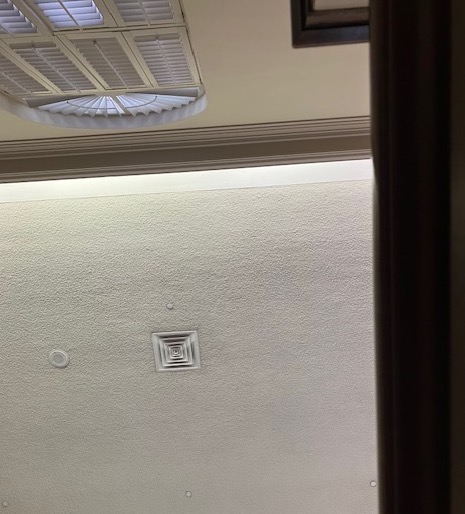
Flat on my back, I stare up at the ceiling as I shift strategies to combat the non-compliant end.
From the floor of the Sanctuary staring at the ceiling. (Photo Bill Pike)
I start thinking about other quirks of managing this building that aggravate me.
Un-flushed toilets and urinals are the worst. This is especially true if they have sat for several days. The aroma is like a port-a-john that was left on a construction site for a month. What I want to know is if you flush at home, why can’t you flush at God’s house?
Next would be our two church vans. A few times they resemble a frat house after a weekend kegger. The floor of a van is not a trash can.
And yet, I keep coming back to fix pew racks, flush restroom equipment, and cleanup two weary vans.
Why?
Maybe its God’s way of getting back at me for all the times I have let him down during my lifetime.
Or maybe, it is because of the Trinity people. Despite my grumpy, grouchy, crabby, shirty, picky personality that surfaces more frequently now, it is the hearts of Trinity that make me hang around too.
In your hearts are stories. Stories that need to be told. I only wish we could peel those stories out of you before you croak. Reading about your hobbies, talents, and skills in your obituary is frustrating.
You see those stories allow people to make connections. Connections provide an opportunity for a relationship to develop. A congregation can’t develop a relationship with “ashes to ashes, dust to dust, now you will no longer he with us.”
If a church is going to continue to attempt to live, it must be capable of telling stories.
Stories make us think. But stories also push us to ponder deeper, to dream, to wonder, and ask.
There are more stories in this building than broken slats, un-flushed toilets, and trashed vans.
I love the ancient Cokesbury Worship Hymnal. Confession, yes, I took one from Trinity.
I keep it on a shelf compartment below my desktop at home.
On page 286 is the classic “Tell Me The Stories of Jesus” written by William H. Parker and Frederic A. Challinor. The words are straightforward, and even for a guy like me who can’t sing a lick, this is a singable hymn.
But more importantly, the writer wants to be told the stories of Jesus.
And yet for my old brain, I think some days, Jesus is thinking—“Hey enough of me, this world of ours is making me weary, I need to hear your stories. I need some hope. I need some light. I need to laugh. I need some different angles to see the world. I’m running out of Kleenex up here.”
Yes, I will blame my latest confrontation with my dear friend COVID on my unscheduled overnight stay in the Philadelphia airport.
But, if we fail to share our stories with each other before we croak, we have no one to blame, but ourselves. We never know how sharing a life story might make a difference in the life of another person.
My wife’s nephew, Brad, and his family live in London, England. Brad grew up in Los Angeles. He still follows the ups and downs of the Los Angeles Dodgers.
A couple of years ago, Brad told me about the Eric Nusbaum book Stealing Home. The book is about the move of the Brooklyn Dodgers to Los Angeles and the “lives caught in between.”
I love this quote from page 202: “The fact that big-league baseball hadn’t already reached the West Coast was a character flaw, a result of baseball, almost by its very nature, being resistant to change and obsessed with its own past.”
I’m an imperfect human being, I have character flaws, God knows my poor choice of words in his house. On paper, Trinity is still a good sized church.
However, if we continue to be obsessed with our past, and resist change, we’re dead.
Stories can move us out of the past.
Stories can form the steps for change.
And stories can come from an unwanted, overnight stop in the Philadelphia airport with COVID as a post-script.
How many other people in our congregation have had a similar travel experience and a confrontation with COVID?
Sharing those stories establishes a link, a connection, and the opportunity to relate to a person that I might not have known ten minutes ago.
Jesus was a storyteller.
It is time for you, me, we, us to share and tell our stories.
You, me, we, us can’t continue to hold our stories for the obituaries published in a newspaper.
Perhaps, this verse from Psalm 119 verse 130 will nudge us: “The unfolding of your words gives light; it imparts understanding to the simple.”
Author’s note: I confess, I’m an imperfect caretaker of God’s house. If my whining wounded you, I apologize.
Our excursions started early on Friday, February 2. My first photo on my phone, captured a rainy morning at 7:49. We were in the tour van driven by our guide, Kevin.
Kevin would prove to be an excellent guide. He knew Kauai from a variety of angles and experiences. His approach was balanced. Kevin could spout history, local color, and he was accomplished in the timing of how to navigate the local traffic.
Additionally, we always knew where we were headed, he gave us essential background, and it might seem absurd, but he knew our age group, and the need for restrooms too.
Personally, I wasn’t concerned about these early raindrops. The weather would improve. It wasn’t like we were walking around in drenching downpours.
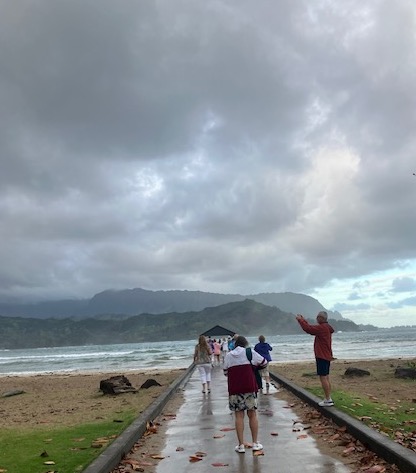
Our first stop for the day was the famous Hanalei Pier. The pier is part of a public beach on Hanalei Bay. The pier was made famous in the 1957 movie South Pacific. Even on a rainy morning, the beach, the pier, the narrow neighborhood streets, and the pretty houses made things brighter.
Walk out to the pier (Photo Bill Pike)
Oh, how I wished I had a fishing rod with me. The pier seemed to be the perfect place to cast a line.
During a quick drive through the neighborhood, Kevin gave us a snapshot of the how the local real estate market was faring. This included pauses at homes where some famous names lived.
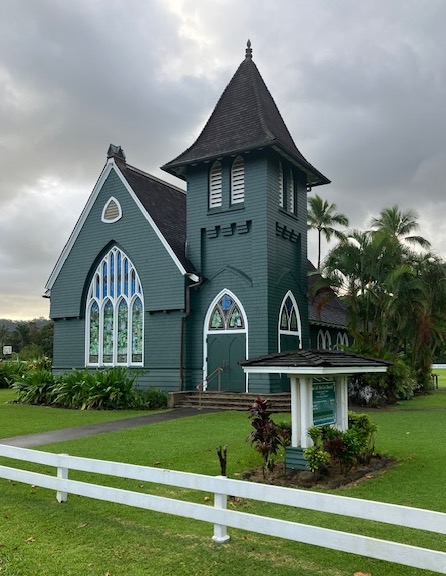
On the way out of the neighborhood, Kevin stopped the van so we could stare at the beautiful Wai oli Hui ia Church. Church of the Singing Waters has quite a history.
The stunning church (Photo Bill Pike)
It dates back to 1837 when missionaries and the initial congregants started building the church. Since 1956, the church has been aligned with the United Church of Christ. I had an immediate affection for this pretty house of worship and its grounds.
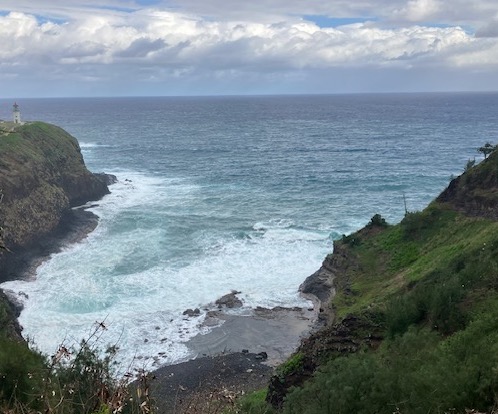
Kevin navigated the local traffic without a hitch. We saw pretty beaches, sandy coves, and an occasional waterfall. The scenery was stunning, especially the coves. Their shapes seemed perfectly carved by nature.
One of the pretty coves (Photo Bill Pike)
Soon, we arrived at Kilauea Point National Wildlife Refuge. The point is famous for its beautiful shoreline, but a variety of Pacific waterfowl frequent this area too.
From there, we drove to Wailua River State Park with its Fern Grotto. Once we checked in for the boat ride up the river, Kevin had lunch ready for us.
After lunch, we hustled and found our seats on the boat. Since 1946, the Smith family, yes Smith, has been providing boat tours of Wailua River. Either side of the river is lush in greenery, and occasionally a singular house will appear.
The boat comes to a dock where we depart onto a pretty trail for a short walk to the Fern Grotto. At the viewing area for the grotto, there is a deck where members of the Smith family with ukuleles and guitars sing and tell stories about local legends.
The Fern Grotto is very pretty. The uniqueness of the grotto comes from the ferns which actually are growing in an upside down position from inside the grotto.
Fern grotto (Photo Bill Pike)
The ride on the boat is effortless. It is a good way to take in another diverse Hawaiian landscape. Back at our starting point, Kevin wants us to make one more stop out on the Wailua Heritage Trail.
So, we make the short drive to Opaekaa Falls. Opaekaa means “rolling shrimp.” These were a freshwater shrimp that were once plentiful in the waters of the falls.
Falls in the distance (Photo Bill Pike)
With us loaded back into the van, Kevin is wrapping up his comment as he drives us toward our ship. Despite our early morning raindrops, the sun has been out with us sporting blue skies with wispy cotton ball clouds.
For a short period of time, we regrouped at the ship, and then Dan, Butch, and I decided we are going to catch a ride to the Kauai Beer Company. Located on Rice Street in Lihue, it is a short drive with our friendly Uber driver.
Established in 2013, Kauai Beer Company is in an ideal location in town. It has ample indoor and outdoor seating. We attempted to sit outside on a patio, but the wind had kicked up, and we came back inside to order our beers.
Dan had an IPA(India Pale Ale), and Butch and I ordered their schwarzbier which is a German styled black lager. We enjoyed our well-made beers. A couple of other plusses for this craft brewery is they offer a full menu, and if beer isn’t your thing, other drinks are also available.
Our beers (Photo Bill Pike)
Before we knew, our beer glasses were empty. Time to head back to the ship. We needed to start organizing our suitcases and other travel bags—we head back to reality tomorrow.
Back at the room, I started figuring out my suitcase and departure plans.
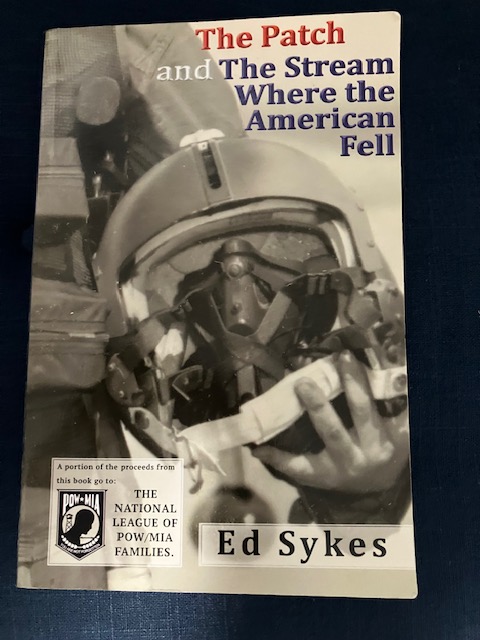
Before dinner, I made arrangements to meet Ed and Mary Sykes in the ship’s lobby. It took a few minutes for us to recognize and each other and meet, but we did. I enjoyed meeting Ed, and I purchased a copy of his book The Patch and The Stream Where The American Fell.
The book is about Ed becoming an Air Force jet fighter pilot and his combat missions in the Vietnam War. But, the book is more than that.
Ed’s roommate was shot down in a mission. He did not survive. American rescue teams were not able to recover his body. The book is about Ed’s efforts to recover his roommate’s remains from a stream bed. This is a fascinating, heart tugging story full of twists and turns, red tape, funding challenges, and pure out luck.
Book cover (Photo Bill Pike)
After dinner at the Jefferson’s Bistro, we attended a British Trivia event. Dan’s wife, Judy, knows a lot about British history and royalty. To our surprise, the trivia questions were about British rock and roll bands. When the contest was over, we had won by answering correctly 18 out of the 20 questions.
After the British Trivia, we were off to bed. We had to be up early for breakfast and an organized load out by the cruise line’s experts to get us to the airport in Honolulu.
At 3:46 on the morning of Thursday, May 23, my cell phone rang.
I keep my cell phone on the small table beside my side of our bed. That’s so I can take security calls related to our church, or from one of our children who might have an unexpected challenge.
On May 23, the caller was my friend, Clint Smith. Clint and his wife, Madelyn, had experienced a couple of tough days. Madelyn had fallen. While the injuries from the fall were not life threatening, she ended up in the intensive care unit of a local hospital.
I was fearful when Clint called that something had gone wrong with Madelyn.
Fortunately, that wasn’t the case. Clint was calling about his HVAC system. It seemed to be running nonstop, not cooling properly, and Clint could hear water running.
Clint wanted me to ride out to their home and check the system. Just so you know, I have no expertise in assessing HVAC systems anytime of the day.
I’ve known Clint a long tome. When I first took the property manager job at Trinity, Clint was the assistant property manager. He helped me to transition into this role. I have lots of respect for Clint’s wisdom.
I told him I would be there soon.
I dressed, grabbed a flashlight, typed the address into my phone, and headed toward Clint and Madelyn’s home.
While I had been there many times before, it was dark. Once in their neighborhood, I ignored the directions coming from my phone. I ended up turning one street too soon.
Clint had told me the front door would be unlocked. I parked. I walked up the steps to the front porch, and the front door was locked.
I decided to give Clint a quick call and that’s when I fully understood I’d come to the wrong house. I rapidly moved off that property.
Back in my car, I made the short drive to the correct house. The front door was open, and I found Clint inside.
He gave me some background about his HVAC system. His multiple calls to the company that services his HVAC system were met with no response. So, armed with my flashlight, I started to poke around.
Meanwhile, Madelyn in her ICU room was not asleep. She had her phone on. Her phone is linked to the security system for their home. On the phone’s screen, Madelyn had noted this unrecognizable person.
Madelyn alerted their across the street neighbor about the stranger, and the neighbor called Henrico Police.
Clint and I were oblivious to what Madelyn and the neighbor were orchestrating.
I continued to look for problems with the HVAC system. I was inside and outside.
Neither on the inside nor outside could I hear or see any problems with water running like described by Clint.
After sharing this with Clint, I went back outside to make sure that I had closed the gate properly to the backyard.
That’s when I noticed something unusual.
If I flashed the light from my flashlight into the backyard, another beam of light appeared.
I did this a couple of times, and each time, a flash of light came back toward the light cast by my flashlight.
Puzzled, I walked toward the light, and that’s when I encountered a Henrico County police officer.
I quickly gave the officer an account of what was going on.
By that time, his partner had arrived at the front of the house.
I walked my new friend into the house to meet Clint.
Thankfully, Clint confirmed to the officer what was taking place, and the officer conveyed Madelyn’s involvement.
At that point, I think we all were silently chuckling inside.
We thanked the officers for their patience and cooperation.
I said goodbye to Clint, and the officers walked toward their cars.
On my ride home, I deduced that I was not a good burglar prospect.
First, what kind of burglar would go out to work in the light of a full moon? Second, a burglar would not go to the wrong house.
And, the more I thought about this whole excursion, I realized how lucky I had been. To begin with, going to the wrong house could have been a disaster. If I had awakened that homeowner, physical harm might have come to me.
With the police officers, I was lucky too. Neither of them was brandishing their firearms. Perhaps from their experiences, these officers knew the chances that a real burglar was in this neighborhood were slim.
And despite my luck on this early May morning, somewhere in America at 3:46 a.m. things had gone horribly wrong for a burglar. This person might have been caught by police, attacked by a security dog, wounded by a bullet, physically assaulted, or shot dead.
For those burglars who are unsuccessful, I wonder what caused them to pursue such a risky path? What went wrong in their lives that nudged them to become a thief? What were they lacking in their day to day living?
In David Halberstam’s book, The Teammates, he uncovers the differences in the home environments where Ted Williams was raised compared to Ted’s teammate, Bobby Doerr.
Bobby Doerr’s parents provided stability, care, and love for their son. On visits to the Doerr home, Ted constantly commented to Bobby “You just don’t know how lucky you are. You’ve got the greatest parents. Your dad is always watching out for you.”
That support was lacking in the Williams’ home. And even though Ted found success in baseball, I wonder if his sometimes gruff, cantankerous personality, and deep mood swings could have been softened with more stability in his home?
Despite his flaws, I think Ted Williams understood loyalty.
He was loyal to his teammates. Regardless of the dysfunctional home, Ted supported his mother financially, and he attempted to help his brother who made multiple bad choices.
Perhaps, that is why my friend, Clint, reached out to me at 3:46 a.m. on Thursday, May 23—loyalty.
Any loyalty that is in my old, soft heart came from my parents. They were loyal to each other, my sister and me, their siblings, friends, and the good Lord.
Their loyalty and love provided an irrefutable stability.
That stability kept me from the path of a burglar.
I was lucky.
I need to remember— not everyone I encounter had the luck of that loyal love and stability. And, it would be a good idea for me to keep these simple words from Galatians Chapter 6, verse 2 on call in my ancient noggin’: “bear one another’s burdens.”
Moon setting over the Smiths’ neighborhood at 4:27 a.m. (Photo Bill Pike)
Here is this week’s letter to the editor of the Oshkosh Northwestern. See our letters policy below for details about how to share your views.
‘Impressive’ people made EAA AirVenture a captivating experience
On the afternoon of July 23, my friends and I arrived in Oshkosh for the EAA air show. For almost a year, we had been planning our trip.
Back home in Maryland, North Carolina and Virginia, friends who had made previous trips to the show kept using the word “overwhelmed.” They told us to be prepared to be “overwhelmed” by the show, and we were.
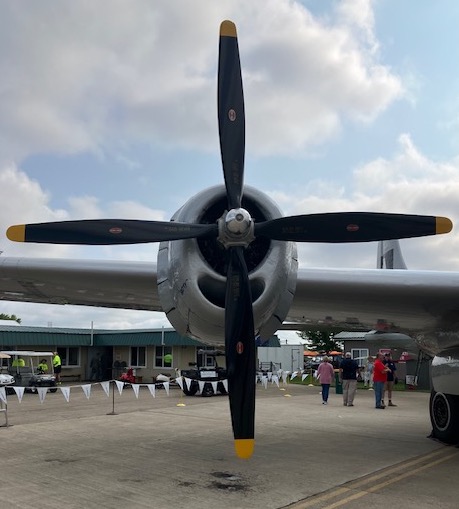
No matter if we attended an informative seminar, toured a history changing B-29, gawked at the agility and power of supersonic fighter jets, felt the passion from the owner of a homebuilt airplane, or reflected about what the Wright Brothers sparked with their first flight — we were captivated.
One of the four propellers from the historic B-29 Superfortress “Fifi” (Photo Bill Pike)
Whether we opt to return for another Oshkosh air show isn’t important.
No, the important piece is this — there is no air show without people.
From the people who graciously checked us in at the Gruenhagen Conference Center, ticket takers, bus drivers, food service workers, vendors, volunteers and all the people who handle the logistics behind the scenes, we were impressed.
These people were well-trained, effective communicators, and most importantly driven to give their best no matter how many people were in the serving line or packed into a bus.
Additionally, we loved the emphasis on aviation education for our youth and women. They are the key to the future.
Rest up, Oshkosh.
July 2025 is a blink away.
And those guests want to be overwhelmed, too.
Bill Pike
Richmond, Virginia
Author’s note: From July 23-27 three college friends: Steve Boone, Dan Callow, Steve Hodge, and I traveled to Oshkosh, Wisconsin for the EAA Airshow. On the way back, I was stranded overnight in the Philadelphia Airport. Luckily, I had my laptop with me and composed the letter. Thanks to the editors at the Oshkosh Northwestern for publishing the letter on Sunday, August 4, 2024.
On Thursday, February 1, 2024, I was anxious to get off the ship. Because of wind and choppy seas, we had spent all day Wednesday ship locked , unable to take tenders to Kona.
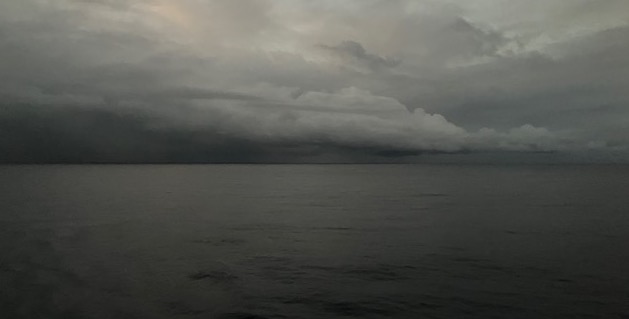
When I first went out on our balcony this morning, I again was skeptical of the weather. The cloudy, dark horizon didn’t look promising. Yet, the big ship kept slowly churning to its docking position.
Stormy skies out in the Pacific (Photo Bill Pike)
I continued my stay on the balcony, and gradually land came into view.
(Photo Bill Pike)
We kept inching closer toward the dock.
My eyes were locked on the clouds, and the gray, black water.
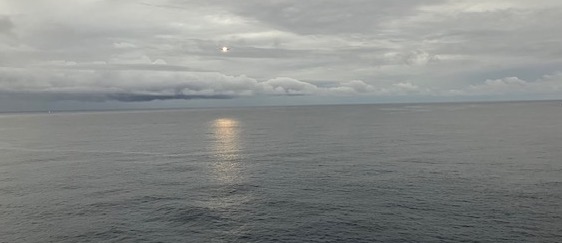
At some point, my old eyes picked up a speck of light in the thickness of the clouds. The light was powerful enough to be reflected on the surface of the ocean.
(Photo Bill Pike)
I kept watching. The glow on the water grew, and then it would dim.
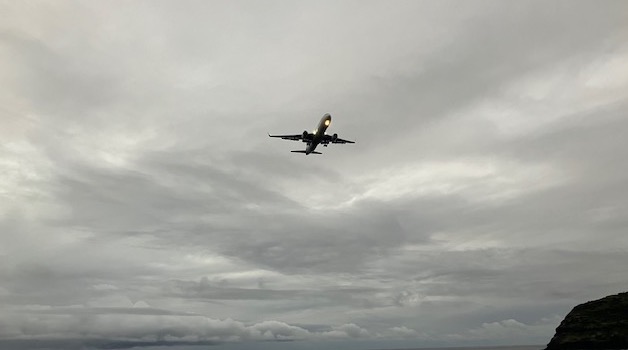
Then my eyes started to focus against the backdrop of the clouds, and a dark object moving toward the ship. Before I knew it, a huge jet was lumbering in over the ship on its final approach into the local airport.
Jet with the bright light (Photo Bill Pike)
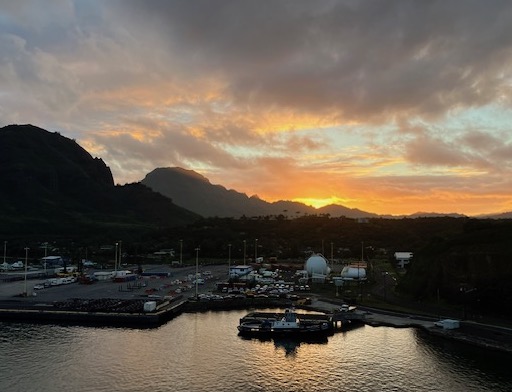
More land began to appear, some boats were moored in a small harbor, and the next thing I knew we were readying ourselves for breakfast and a 9 a.m. departure to the Waimea Canyon.
We did a good job of getting to the bus on time. Our tour guide for today was an older gentleman known as Uncle Willy. Word on the street was Uncle Willy was a real Hawaiian, and that he had a role in the movie South Pacific.
As a tour guide, Uncle Willy was a two for one—he could yak with the best them, and he loved to sing.
On the ride toward Waimea Canyon, he talked a lot about all things local.
Let me tell you about the road to Waimea Canyon— this road was not designed for large, full-size tour busses. I still don’t know how the driver made some of those hairpin turns. Somehow, the driver got us safely to the parking lot. As I exited the bus, I complimented him on his good driving. He thanked me and said it was his first day. I hope he was teasing me.
Several summers ago, our family had the privilege of visiting the north rim of the Grand Canyon. That canyon from many vistas was simply stunning.
I can say the same for Waimea Canyon. While on different scale related to size, Waimea Canyon is stunning too. What makes the canyon so appealing is its location. As a tourist, I didn’t expect to find a canyon with such a rich beauty out in the middle of the Pacific Ocean.
No matter where my eyes scan, the natural hues of green and orange that merge seamlessly with perfectly cast shadows could hold my attention for days. Weave into that backdrop the gentle collision at the top of the canyon where the blue skyline and puffy cumulus clouds of white and gray hover, and you have the opportunity to create hundreds of astonishing postcards.
Waimea Canyon (Photo Bill Pike)
Whether it was his first day or not, again the bus driver did a nice job driving us back down the canyon’s access road. In every stretch of that road the potential exist for lots to go wrong, but luckily nothing did.
Fortunately, nothing went wrong going to or leaving the canyon area. The wrong waited to make its appearance at our lunch stop.
Coming out of the canyon, we stopped in the town of Waimea for lunch. The challenge here is that it appeared that every other tour bus near Waimea Canyon had opted to stop here too.
Waimea is a pretty town with shops, scattered empty buildings, a grocery store, and a handful of small restaurants. I’m not sure any of the restaurants were truly prepared to deal with tourists in a hurry.
I don’t recall the amount of time we were given to purchase lunch and make it back to the bus on time.
Unfortunately, some of our fellow tourists did not make it back on time. When the finally arrived and started to board the bus, some passengers who had been waiting patiently booed them. One of those tardy passengers, a lady, snapped back at the boos with “Hey, I’m on vacation!”
With everyone finally back on board, we slowly moved out of the parking area.
Sensing this tension, perhaps Uncle Willy was reminded of this line from William Congreve’s 1697 play The Mourning Bride: “music has charms to soothe a savage breast.”
Thus, on the ride back to the ship, Uncle Willy sang a number of songs, and he did his best to drag us into singing along. But his attempts, for the most part failed.
Once back at the ship, I seem to recall that we caught a shuttle to Hilo Hattie, the store of Hawaii since 1963. This is simply the “tourist trap” store for tourist.
After Hilo Hattie, we relaxed on the deck of the ship, and snapped some photos of the sun saying goodnight.
I will never forget Waimea Canyon.
But the remarkable beauty of the canyon is tainted by the lunch stop fiasco.
Seems to me that the thinkers for the cruise line need to rethink the lunch stop plan.
That plan did not work.
And that failure was complicated by the “Hey, I’m on vacation” attitude.
And no sing along with Uncle Willy can soothe that self-centered selfishness.
Sun setting from the back of the ship (Photo Bill Pike)






 might be baloney