No matter where we travel, my built in early rising alarm clock will not let me sleep in. On Tuesday, January 30, the ship is heading into the port of Hilo on the island of Hawaii.
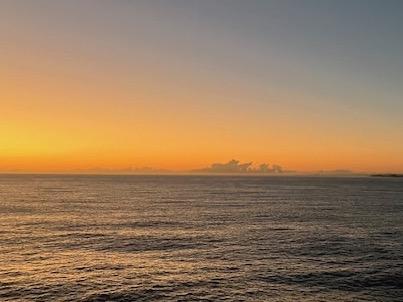
From our balcony, the horizon is beginning to turn assorted shades of orange. Orange sherbet comes to mind, fresh papaya, or the hues of Piedmont red clay back home. Toss in some clouds hanging in the distant background, and my appreciation for the dawning of a new day deepens.
Today, the schedule is different for us. Our morning is quiet. We are on are own. For the afternoon, we have a date to travel to Volcanoes National Park.
After breakfast, Butch, Dan, Betsy, and I decide to go into Hilo. It took us a few minutes to figure out the transportation options, but we opt to ride with a local nonprofit that is linked to the Hilo Farmers Market.
Our driver is polite and patient with our questions. Soon she is dropping us off at the farmers market, and giving us instructions on how she will come back to pick us up.
The farmers market is a mixture of local fruits and vegetables. One vendor has some nice looking oranges so, I bought a couple.
The market offers more than produce, and Butch finds a local vendor who makes and sells t-shirts. Butch was intrigued by the design and material and bought one.
Dan had scurried off to the local CVS, yes a CVS, to pick up a prescription refill. The marvels of technology allowed this to happen.
We walked and explored, went into some shops, and waited for Dan’s return.
As we shuffled around, I was approached by a very polite homeless person. Perhaps, he sensed I was a tourist.
Waiting for Dan and our ride to return, I noted Hilo was in people motion— pedestrians and vehicles moved around us. Dan and our driver’s timing couldn’t have been better as she picked us up and drove us back to the ship.
Once back at the ship, we decided to explore some more. We walked over to the Big Island Coffee Roasters. Neither Betsy nor I are coffee drinkers, but our traveling companions are. I find coffee roasters to be bold gamblers much like craft beer brewers.
The story of Big Island Coffee Roasters dates back to 2010, and the purchase of a “run-down coffee farm in a rugged region of Hawaii.” That gamble paid off, as Big Island Coffee Roasters has won many awards for their coffees, with devoted purchasers from all 50 states and 13 countries.
Our coffee drinkers enjoyed this stop.
The morning had slipped by quickly. We had a 1 p.m. departure time to board the buses to Volcanoes National Park, home to two active volcanoes—Kīlauea and Mauna.
Our tour guide for the afternoon, Leroy, shares his story on his connection to Hawaii. He has a voice like a late night jazz disc jockey.
Throughout the afternoon, his gentle, smooth voice spews out the required history and personal stories about the park and his life in Hawaii.
Before heading out to the park, we make an unexpected stop at Big Island Candies. If you have a sweet tooth, this is a dangerous place. Lots of people were making multiple purchases of the yummy items.
Once back on the bus, Leroy refocused us on our afternoon goal—Volcanoes National Park.
From the time the bus entered the grounds of the park, we knew we were in a unique environment. One of the best parts about this visit was the ample time we were given to take in its remarkable landscape.
As our bearings came into play, we immediately noted this sign: Why are these buildings closed?
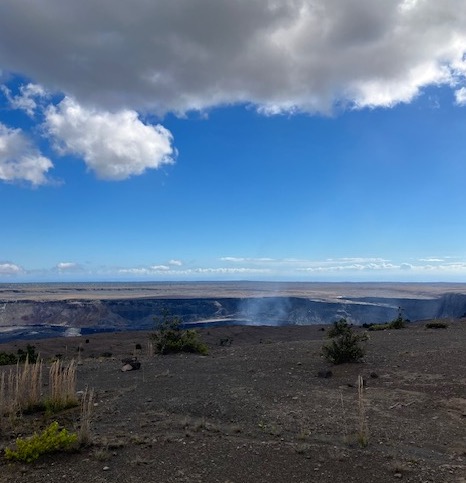
Standing at Uekahuna, we learned in 2018, the summit of the Kilauea volcano had a significant eruption. That eruption damaged the buildings.
As we walked and explored, the views made us stop and pause.
Sometimes within a few yards, or in the distance we would see steam vapor being released from openings in the earth’s surface called steam vents.
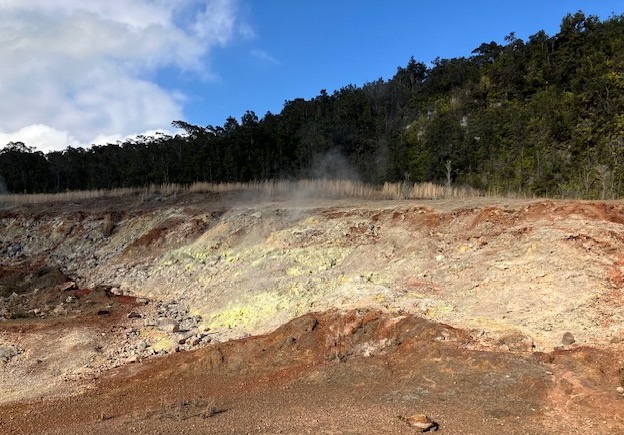
Also, we walked over to explore the Sulphur Banks. A couple of times our noses would pick up the unpleasant aroma of the sulfur fumes emitting from the earth. In some spaces, the mineral deposits from these chemical interactions were quite colorful.
The park’s visitor center has lots of good information, excellent staff, and a nice store.
Also within the grounds of the park is the beautiful Volcano House, a very nice hotel on the rim of the volcano. This historic hotel sits 4,000 feet above sea level, and its unique environment allowed it to be named as a UNESCO World Heritage Site. It is worth your time to take a stroll through the lobby to see some of the views from the backside of the hotel.
With our departure time upon us, we started the walk back to the bus. Leroy was ready for us. He chatted us up all the way pack to the port.
In our visit to Hilo today, we learned quite a bit. Skimming one of the local brochures, I was reminded as to how vulnerable these islands can be. For example, the Shinmachi Tsunami Memorial was erected to remember those who perished in tsunamis that have in the past devastated parts of the island.
The 2018 when the Kilauea volcano erupted lava covered almost 14 square miles of the “lower east rift zone.” If the volcanoes decide to have a bad day, you don’t want to be in the path of their anger.
Yes, the island’s environment can be impacted in many ways, but the complexities of the chaos going on below the earth’s surface might be the biggest concern.
Maybe, the same can be said for my rapidly aging body. I don’t always know what might be churning deep inside of me either.
And yet, despite the island’s unsettled substructure, there is a precarious beauty here carved out over time like nothing I’ve ever seen back home.
No matter how harsh conditions have been or might be here in the future, I will always remember the singular stubbornness of a wildflower in a field of weary, weathered grass.

That wildflower is a story, a lesson in resilience.
And, no matter how they are challenged, that resilience is not unlike the people of Hawaii, who continue to persevere while preserving their land’s unique environments.

 might be baloney