On Wednesday, May 8, my wife and I flew from Richmond to Atlanta with our final destination New Orleans.
Before boarding, I stopped in an airport convenience store. I was going to buy a copy of the Richmond Times-Dispatch(RTD). Looking around, there were no newspapers for sale in the store. No New York Times, Washington Post, Wall Street Journal, or RTD. I asked an employee about the absence of newspapers. She told me the store stopped carrying newspapers two years ago.
Landing in Atlanta, I stopped at another convenience store. I searched the store—no newspapers, not even the Atlanta Constitution. When I asked an employee, she told me—newspapers stopped arriving at the store in March.
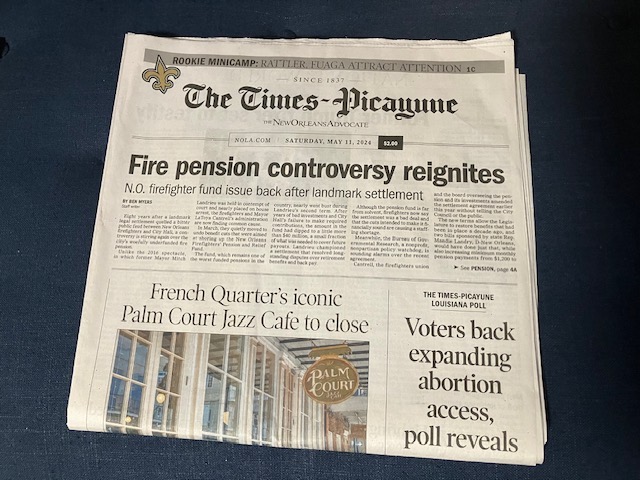
In New Orleans, we hustled out of the airport to catch our ride. I didn’t stop to check for newspapers. But when we returned on Saturday to fly back home, I made a point of checking. At the store where I stopped, they carried two papers—The Wall Street Journal and the New Orleans Times-Picayune. I bought a copy of the Times-Picayune.
Clearly, the digital formatting of newspapers has arrived.
On Thursday, June 20, I read in the RTD, an article written by editor, Chris Coates. The article announces changes to the publication schedule for the paper. On nine holidays, the paper will only be available in a digital format.
In this piece, Coates’ referenced his grandmother, Louann, who was a prolific clipper of newspaper articles. I too was a clipper of articles that I sent to family and friends, but not anymore.
Tired of haggling over subscription prices with the RTD, we switched to the digital format. Like newspapers across America, I guess we newspaper clippers are dying too.
Northwestern University’s Medill School of Journalism has been a leader in studying the death of newspapers across America. The most recent report by the school released in November 2023 stated: “The loss of local newspapers accelerated in 2023 to an average of 2.5 per week, leaving more than 200 counties as “news deserts” and meaning that more than half of all U.S. counties now have limited access to reliable local news and information.”
At this pivotal time in American life, “news deserts” aren’t acceptable. More than ever, we need journalist digging, fact finding, and reporting as a means for holding all of us accountable to save our fragile democracy.
In his article, editor Coates, bragged on four recent stories unearthed by RTD reporters and cited 43 awards the paper earned in an annual contest presented by the Virginia Press Association. Quality reporting and recognition of the RTD’s work by its peers is significant. Also important to the life of the paper are the recent creation of the Reader Advisory Board and the Mobile Newsroom Initiative.
Despite this success, a source of frustration for me and maybe other readers is the inability of the RTD to report its own story on the challenges encountered in running a newspaper. I don’t believe the RTD has adequately reported with journalistic integrity and transparency the stories behind the changes that impacted staff and the paper’s loyal readers.
The RTD is quick to report to readers when changes occur, but readers are left to read between the lines regarding these changes. What’s left of my dinosaur brain tells me the decision not to print on nine holidays is a saving pennies move.
Additionally, I would make the assumption that decisions made over the last several years that impact staff and readers are all grounded in economics. Lee Enterprises the owner of the RTD wants to turn a profit. To turn a profit, newspaper owners gut staff, go whole hog into a digital format, and at every opportunity continue to butcher to the bone— newsprint.
Back on June 2, an op-ed by Glenwood Burley, a member of the Readership Advisory Board, gave readers a rare behind the scenes look at some of the daily decision making and operations of the RTD. I believe your readers would benefit from more insightful writing like this.
Despite what Lee Enterprises might dictate, I believe the RTD owes its remaining readers a more transparent reporting of its decision making when changes are coming to the paper. I don’t think Lee Enterprises would welcome a Freedom of Information Act request about these decisions from a contingency of grumpy old readers and disgruntled former reporters.
Listen, I mostly love the RTD. I cherish the work of reporters, editors, printers, and the early risers who deliver the paper. I don’t want the RTD to die.
But if you are going to continue to tell the stories of our communities, you must improve telling the RTD’s story too.

 might be baloney