Memorial Day: sacrifice

I never met my father’s oldest brother, Boyd Pike. But, I think of Boyd every Memorial Day.

Boyd was a Fireman Third Class aboard the USS Sims, a United States Navy destroyer. In early May 1942, my grandparents received the notification from the Navy that no parents want—Boyd was missing in action.

In the Coral Sea, the Sims had been escorting an oiler, the Neosho, when both ships were attacked by Japanese fighter planes. Unfortunately, the Sims could not withstand the fierce attack. The ship sunk. Thirteen survived. Boyd was not one of them.

A year later, the family received official notification from the Navy declaring Boyd dead. Boyd’s parents and nine siblings are now deceased. Yet, the nieces and nephews in the family make a point of not forgetting Boyd’s sacrifice.

In an United States military cemetery in the Philippines, there is a grave marker for Boyd. In the cemetery, at the family’s home church, Mt. Pleasant United Methodist in Guilford County, North Carolina, a gravestone honors Boyd.

I don’t expect in my life time to make an excursion to the Coral Sea or the cemetery in the Philippines to honor Boyd. Yet, I hold in deep respect Boyd and the United States military personnel who gave their lives to preserve our freedoms.

In January 2024, with friends from college, my wife and I had the privilege of making our second trip to Hawaii. During this visit, we made a point of taking our friends to the Pearl Harbor National Memorial and to the National Memorial Cemetery of the Pacific.

Each memorial is distinct in their offerings to the public. At Pearl Harbor, the displays capture what took place on the morning of the attack. But for me, the most moving part of Pearl Harbor is the boat ride to the USS Arizona Memorial.

Before boarding the boat, an atmosphere of quiet reverence hushes all visitors. That restraint is maintained throughout the visit. At the Arizona’s memorial, the stillness is broken by the American flag flapping in the breeze, and the solemn voice of a docent carefully recanting what the crew of the Arizona experienced on the fateful morning.
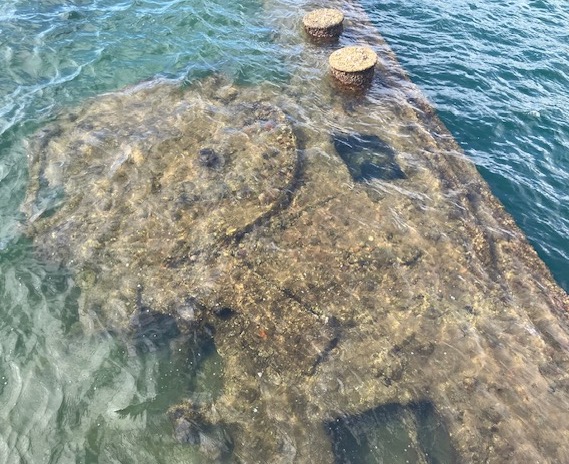
A section of the rusting Arizona (Photo Bill Pike)

At the National Memorial Cemetery of the Pacific, a quiet reverence is also present. Here, the setting is in the crater of an extinct volcano. The cemetery is nicknamed the “punchbowl.”

The meticulously maintained grounds frame out the grand stairs with their majestic panels. These panels form eight courts. Inscribed on the panels are the 18,095 names of the missing from the battles in the Pacific during World War II.

Looking down the grand stairs (Photo Bill Pike)

At the top of the stairs, visitors will find another area of displays capturing the battles in the Pacific. Rendered in mosaic tiles, I found the Coral Sea with the posted days that the attacks took place in May 1942.
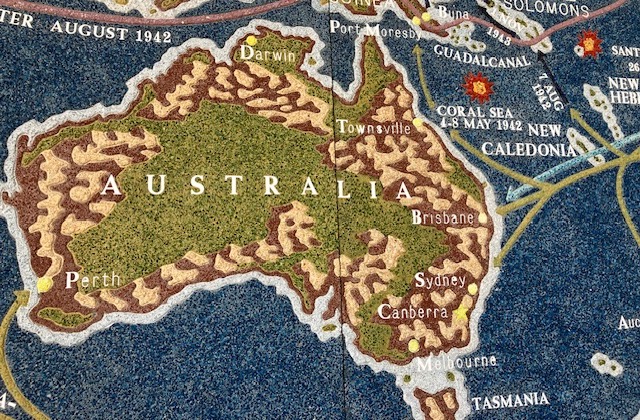
Tile mosaic note the Coral Sea (Photo Bill Pike)

The walk to the area of the overlook is worth it. At this point, visitors look down over Honolulu with the blue Pacific Ocean forming a sun sparkled backdrop.

When my wife and I returned from our Hawaiian trip, we started to work on our plans for a visit to New Orleans. My main purpose for making this journey was to visit The National World War II Museum.

On Thursday, May 9, we spent our entire day at this museum. The museum’s location in New Orleans is tied to the Higgins boats. These landing craft were built in the city. They were used to transport our troops to the beaches of Normandy on D-Day.

A Higgins boat (Photo Bill Pike)

The museum is massive. Curators missed no details in capturing World War II from its beginning until the final victory. To take in the museum in a day, we had to hustle.

Yet, our quick, but focused pace allowed us to appreciate the hearts and souls, and sacrifices of all Americans during the war. Their determination is well documented.

No question that films, short videos, and photographic displays add much to the telling of the World War II story. However, my wife and I were touched by multiple recorded interviews with our military personnel who gave firsthand accounts about their experiences during the war.

I wonder what my Uncle Boyd’s story would have been if he had survived?

As an imperfect American, one thing is very clear to me— we can’t allow ourselves to forget the stories from World War II.

At various points around the museum are quotes from famous leaders. Inscribed in stone, I’ve been thinking quite a bit about this quote from George C. Marshall: “The soldier’s heart, the soldier’s spirit, the soldier’s soul are everything.”

This Memorial Day, and those in my future, I hope I never fail to understand that my existence is forever linked to the heart, spirit, and soul of those soldiers and their sacrifice.
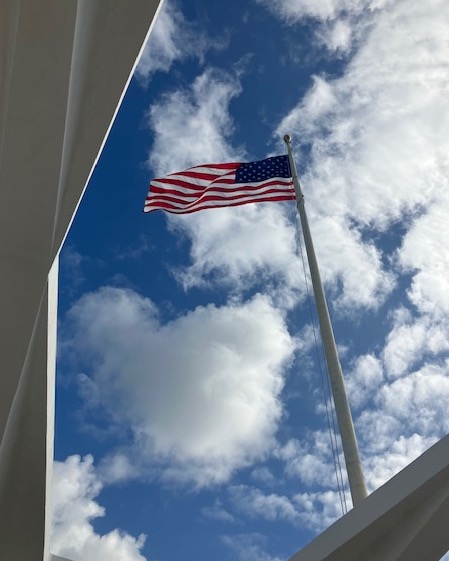
American flag at the Arizona Memorial (Photo Bill Pike)

Letter To The Editor: school names

Author’s note: On Monday, May 13, 2024, this letter was sent to the editors of the Washington Post. On Thursday, May 16, I was notified by an editor that the letter was under consideration for publication. I had to answer a few questions, and then review an edited copy of the letter. On Friday, May 17, I received a final draft of the letter to review and approve. That final draft was published in the Saturday, May 18 edition of the Washington Post. The final edited version appears after the original letter I sent.

As a retired Virginia public schools’ educator, I was disappointed to read that the school board for Shenandoah County Public Schools has voted to reinstate Confederates’ names to two of its schools.

This is another example of how the fear of losing touch with the past pushed this school board to reverse a logical decision made by a previous Shenandoah County school board in 2020.

But of course, fear can prevent a school board from thinking logically. Only one member of the school board, Kyle Gutshall, thought logically and voted against reinstating the Confederates’ names.

I wonder how many of the conservative influencers in the county who orchestrated this change actually have students in the school system?

The school board stated the cost to install new signage will be covered by private donations. Will these same private donors step forward when the school system has a budget crisis with a dead HVAC system in a school?

School systems in Virginia are struggling to find and retain skilled teachers. After this decision, why would any prospective teacher consider applying to Shenandoah County Public Schools?

I’m sure the teachers in the Shenandoah system are deeply appreciative of the extra level of pressure that has been placed upon them with this regressive decision.

Since this school board is so intent to preserve the past, perhaps they would benefit from a group reading of Isabel Wilkerson’s The Warmth Of Other Suns. Yet, I’m uncertain the harsh truths documented in this book could even jolt their insensitive stubbornness.

I appreciate this quote from American writer, E. B. White: ‘The only sense that is common in the long run, is the sense of change and we all instinctively avoid it.”

Public school systems that instinctively avoid needed changes will continue to find difficult challenges in the future.

One of the most difficult of those challenges will be dealing with the morale of every student, parent, and teacher who put their trust in the school board to make a reasonable decision for the good of all, not just those who fear losing the past.

The edited letter as it appeared in the Washington Post on May 18, 2024.

As a retired Virginia public schools educator, I was disappointed to read that the school board for Shenandoah County has voted to reinstate Confederate names to two of its schools. The decision itself is foolish, reversing a logical decision made by a previous school board. And it made me wonder how many of the conservative influencers in the county who orchestrated this change actually have students in the school system?


The school board stated the cost to install new signage bearing the schools’ reinstated names will be covered by private donations. Will these same private donors step forward when the school system has a budget crisis, or a dead HVAC system in a school leaves students learning in freezing or sweltering conditions?

School systems in Virginia are struggling to find and retain skilled teachers. After this decision, why would any prospective teacher consider applying to Shenandoah County Public Schools if this is what the school board prioritizes? And how must teachers in the Shenandoah system feel about the extra level of pressure that has been placed upon them with this regressive decision?


E. B. White once wrote: ‘The only sense that is common in the long run, is the sense of change and we all instinctively avoid it.” Public school systems that instinctively avoid needed changes will continue to find difficult challenges in the future.

Among the challenges the Shenandoah County School Board has created for itself is how to earn back the trust of every student, parent and teacher who looks to the school board to make reasonable decisions for the good of all, not just those who fear losing one version of the past.


William Avery Pike, Jr., Richmond

More Methodist Musings

Historic Vote

As a lifelong member of the United Methodist Church, I’m relieved with the news from Charlotte, North Carolina.

On May 1, multiple news outlets reported that members attending the General Conference of the United Methodist Church “by a 692-51 vote, passed several rules without debate, including overturning both its ban on gay clergy and the penalties for holding same-sex marriages.”

From my perspective, it’s about time for the church to initiate this change.

This emotional issue has resulted in many Methodist churches in America leaving the denomination through a disaffiliation process. Methodists aren’t the only mainline denomination to be walloped with challenges related to human sexuality.

For many years, data has a revealed a steady decline in church attendance across America. While it is true that the pandemic added to the woes of churches, churches were struggling before COVID-19 hit. Declining attendance, shrinking budgets, and deteriorating facilities are among the challenges experienced by churches that resulted in closures.

In Virginia, I had the privilege of attending three annual conferences. At each annual conference a handful of churches were closed because of challenges related to attendance and finances.

Even if the reorganization plan gives relief to the church’s stance on human sexuality, challenges related to attendance, finance, and facilities are not going away.

With a decline in church attendance and religion in America, the release of a January 2024 report from the Pew Research Center has an interesting finding.

The Pew report found that the “religious ‘Nones’ are now the largest religiously unaffiliated cohort in America at 28%. The ‘Nones’ are larger than Catholics 23% and evangelical Protestants 24%.”

I wonder how many of the ‘Nones’ are from the LGBTQ community, or individuals who didn’t grow up in the church, or who had an unpleasant church experience? Also, I wonder if the Methodist church or any other mainline denomination can find ways to bring the ‘Nones’ back to church?

For the last twelve years, I’ve had the privilege of working at the Methodist church where my family and I are members. With this work, and in my previous career in public education, I’ve come to realize that churches like schools are interesting places as they both center upon working with people.

I find church leaders and their congregations to be good people who care deeply about their church. However, these good people are often reluctant or incapable of making needed changes. This inability to change has hurt churches more than they realize.

Whether related to human sexuality, declining attendance, drops in revenue, and deteriorating facilities, I don’t think we’ve seen the end of church closings. And there is part of me that wonders if churches would benefit from undergoing an accreditation process. Schools, fire/police departments, non-profits, and some professions are familiar with this practice.

I’m curious to learn if the challenges that churches are experiencing could have been avoided or corrected with a rigorous “self-study.” This diligent internal examination would require churches to carefully assess their programming, personnel, finances, facilities, outreach, and communication.
Even if an accreditation process was available to church leaders and their congregations, I’m not certain they would pursue taking a hard look at themselves. It is easier to develop a strategic plan that collects dust rather than asking difficult internal questions about your operations.

However, if churches have any desire to slow their downward spiral, leaders and their congregations must work quickly to assess their fiscal, mental, physical, and spiritual health status.

Our current church times are in sharp contrast to the boom of the 50s and 60s. Then the mentality was if we build a church—they will come.

Within easy driving distance to our church are five other Methodist churches. Today, any of those congregations could be nervously thinking— ok, we’ve built this church, but do we have capacity to sustain it?

In her book, Factory Man, author, Beth Macy, wrote about John Bassett III, and the challenges he faced in America’s furniture industry. I love this advice from Mr. Bassett— “be willing to change and improve repeatedly.”

If the United Methodist Church has any hope
of being around for fifty more years, church leaders and congregations must “be willing to change and improve repeatedly.”

Failure to change beyond the Charlotte vote guarantees two things: the ‘Nones’ will continue to grow, and more Methodist churches will close.

Yes, I’m encouraged by the Charlotte vote.

But now, the real work must start.

An impatient world will be watching to see if Methodists can truly become more inclusive.
I hope we can.

Post Conference Reflections

I am a lifelong Methodist.

But, I did not attend the General Conference of the United Methodist Church that was held in Charlotte, North Carolina from April 23 – May 3, 2024.

Nor did I carefully follow any pre-Conference wrangling, or any daily news reports about what was taking place at the conference.

Personally, I wasn’t optimistic that we Methodist could agree to settle our differences found in the Book of Discipline related to ordaining gay clergy and clergy having permission to perform same-sex marriages.

On May 1, multiple news outlets reported that members attending the General Conference of the United Methodist Church “by a 692-51 vote, passed several rules without debate, including overturning both its ban on gay clergy and the penalties for holding same-sex marriages.”

From my perspective, it’s about time for the church to initiate this change. And, I can’t believe that making this change took over fifty years.

Now, the tough work must begin.

No one can deny that the COVID-19 pandemic walloped churches. But the truth is that churches were in trouble prior to the pandemic. Attendance was down, financial giving slipping, and facilities were feeling the impact of neglect. Add to this to the struggle to understand a changing world related to LGBTQ communities, and churches were in trouble.

For Methodist, even with this historic vote, we have lots of work to do to attempt to slow the multiple challenges that church leaders and congregations face. Personally, I don’t sense we are done with churches closing.

In her book, Factory Man, author, Beth Macy, wrote about John Bassett III, and the challenges he faced in America’s furniture industry. I love this advice from Mr. Bassett— “be willing to change and improve repeatedly.”

If the United Methodist Church has any hopeof being around for fifty more years, church leaders and congregations must “be willing to change and improve repeatedly.”

I’m not sure if Methodist leaders and their congregations realize how much the church has been hurt by the paralyzing inability to change.

In David Halberstam’s book The Teammates, he writes about a 1997 decision made by the management of the Boston Red Sox to let go a long time coach and team legend, Johnny Pesky. This wasn’t a popular decision in Boston.

Five years later, the Red Sox were sold. One of the first things the new owner did was to bring back Johnny Pesky.


Halberstam wrote the following when he reflected about the general manager of the team who had dismissed Johnny Pesky: “It was almost as if his strategy was designed to separate himself from the team’s rich history and lore, as if the past was more of a burden than an enhancement, and that in order to build for the future, he had to destroy the past.”

As the Methodist church looks to its future, it must not bury its past. Rather the church must understand its past to learn how to shape the future.

We Methodist are at a critical point. If we continue to mire ourselves in “that’s the way we have always done it mentality,” we’ll miss an opportunity to connect with people who are searching for a community.

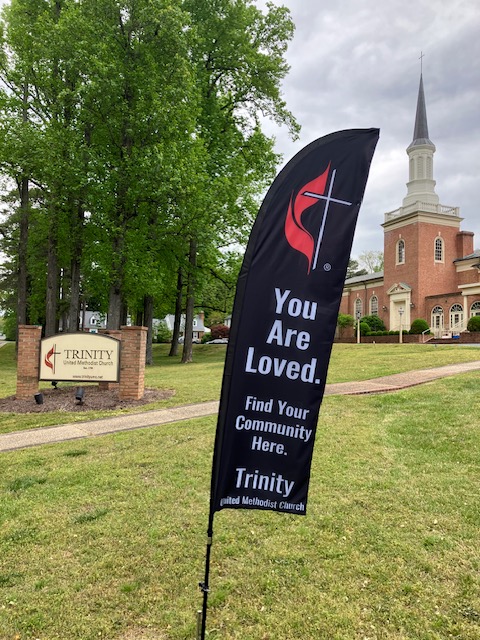
I’m not a big believer in banners that adorn the front lawns of many churches. I think a banner is a blur to a driver zipping by a church.

Yet, out on the lawn of Trinity, is a banner that reads: You Are Loved. Find Your Community Here.

Methodist— you, me, we, us are overdue to love all in our community.

The third verse of Psalm 23 states: “He restores my soul.”

Isn’t this an opportunity through love to “restore our souls”?

Isn’t this an opportunity that we can’t afford to miss?

(Photo by Bill Pike)

Hawaii Day Eight: Haleakala Crater

I don’t believe either of us had trouble sleeping on our first night on the ship.

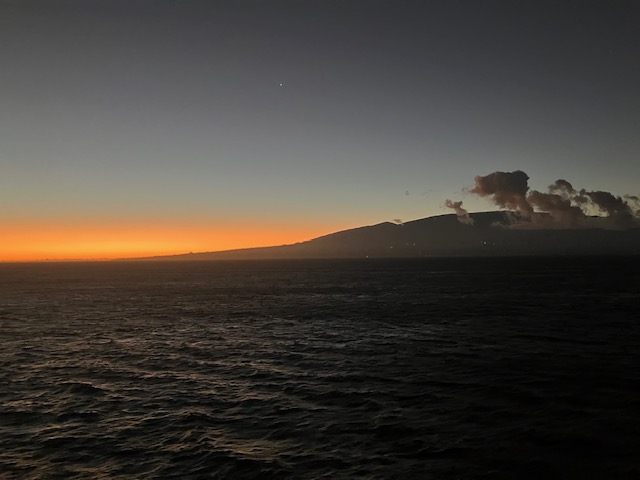
Early riser that I am, I found my way around the tiny cabin without stumping a toe or noisily clunking into something. I was working my way toward the sliding door where our small balcony was starting to show the first signs of light over the Pacific.

This first light was the color of the flesh of a fully ripe summer cantaloupe. A few clouds were near the brightening light, and hills were etched out like an artist had used pen and ink to trace their smooth edges.

(Photo Bill Pike)

The time on the phone noted 6:30 a.m. By 8:30, we were to boarding for an excursion to the Haleakala Crater.

I continued to watch the movement of the ship as we came into this commercial port for docking.

In the cabin next door were our friends the Sherrills, and at some point our early morning curiosity had connected us on our respective balconies for a good morning and comments about the sights.

Soon, we were ready to find our way to breakfast. Without any wrong turns, we found a big dining hall. The room was loaded with multiple food options and tourists just like us trying to figure what to eat and where to sit. We managed, and this was followed by hustling back to the room to make sure we were ready for our excursion departure.

We cleared the security check, and proceeded to the waiting area for our bus and driver. Following instructions from Norwegian personnel, we were soon in a line and boarding the bus.

Our tour guide was named Dino. He was an all in one package—the driver and the guy with the knowledge about our trip. During the course of the week, we found that all of the guides had a story about how they had arrived on Hawaii. Dino was soft spoken and low key, but he was knowledgeable about the area as he drove us toward the crater.

Agriculture was an early topic, and we learned how the sugar cane economy is gone. Pineapples are still around, but we saw groves of avocado and citrus trees.

The landscape began a gradual transition as we started the climb toward Haleakala National Park.

Dino shared with us that real early risers can make a reservation through the National Park Service to see what must be spectacular views of the sunrise.

One thing Dino cautioned us about was the change in temperature that we would experience. He was correct. For the area we were in, one source recorded the high temperature for January 28 as 52 degrees and the low was 39 degrees.

We made an initial stop at the park’s headquarters and visitor center. The elevation here was 7,000 feet, and as soon as I stepped off the bus, I could feel the change in temperature with a bit of wind in the bright sunshine.

All around us were pretty views and interesting plant life. We noted the Haleakala silverswords.

(Photo Bill Pike)

We re-boarded the bus, and drove toward the visitor’s center for Haleakala Crater.

The elevation at our next stop was 9,000 feet. The difference here was the wind. It was intense.

We had all dressed in layers, but the wind was a cutting wind. The layers weren’t much help. But the cold air and biting wind didn’t matter, the remarkable scenery captured us.

I don’t know that I ever viewed such a landscape. It rolled and dipped, rose and fell. Rock and hills of all shapes and contortions were all around us. The puffy tops of clouds formed a layer covering a valley beyond the hilltops.

(Photo Bill Pike)

The tough terrain was painted in varying shades of gray, onyx, rust, coffee, faded khaki, and those tones were cast in every direction.

(Photo Bill Pike)

We countered the wind with the exterior design of the visitors center, and marveled more at the madness found in nature’s sculptured topography.

And at the agreed upon time, Dino rounded us up. With everyone present, we started making our way back down via a winding road.

Dino continued his obligatory chatter as he retraced his turns to bring us safely back to the ship.

Before re-entering the ship, we had to again clear security. We had no hiccups, and our group agreed on meeting at the Cadillac Diner for lunch. The temptation was their milkshakes. While we patiently persevered the less than adequate service, the milkshakes were a hit.

Napping, more exploring the ship took up the remainder of the afternoon.

It is amazing to me that geologist have figured out how a volcano formed out in the middle of the Pacific Ocean.

The eruption of hotspots in the Pacific Plate is the pivotal first step. Over time, these volcanoes are moved away from the hotspot to the Aleutian Trench. At that point, the plate sinks into our planet, Earth.

I’m not smart enough to fully understand these important discoveries, but I sense that if we continue to be careless and reckless with our planet, we will eventually destroy it, and all of Earth’s unique beauty.

If we are clever enough to build this massive ship to tote people out into the middle of an ocean to see these beautiful and fragile Hawaiian Islands, then we need to be even smarter and more determined than ever to protect them.

How is your lilium longiflorum?


 A plot of land about the size of a postcard on the north side of our church’s grounds has become a home for the unwanted, the castaways. 

Growing in this plot are towering Loblolly pines, delicate dogwoods, a couple of magnolias, a Bradford pear, one crepe myrtle, and a random assortment of other plantings.


 It is my rapidly aging, sympathetic heart that has let this plot become a home for the unwanted, the castaways.

 Over the years, clumps of flowers and singular shrubs have found a home in this landscape.
These relocations occur when gardeners in the neighborhood change their landscape plan.

They dig up the flowers or shrubs that no longer fit. Often, I happen to be in the wrong place at the wrong time to claim the unwanted.


 Once I transport the plants to church, I work to find these outcasts a good spot in the tract. A part of the planting includes a good soaking from a deep bucket of water.

 At Easter, the altar in the Sanctuary of our church is adorned with real, live potted lilium longiflorum, better known as the Easter Lily. 


 After the Easter services, the lilies are offered to the congregation. Most are taken, but a few always remain.

My conscience will not allow me to even think about tossing an Easter lily. Last year, I started transplanting the lilies that no one claimed.

Trinity member, Dianne Moore, encouraged me to give this a try.


Weeks after Easter, I began my work. I’m not sure how many I planted, but in the end, I had one lily that looked frail and puny. I was certain this lily was dead.

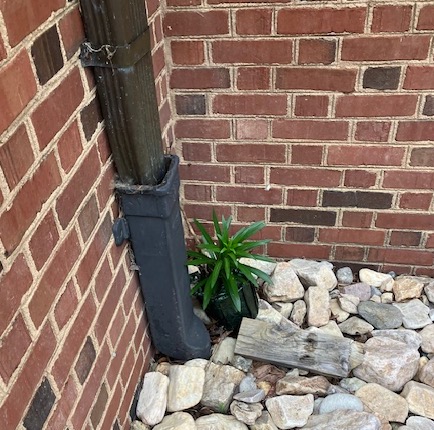
 For some reason, I left the dried up flower in its pot, and I tucked it away in an outside corner of our building.


The lily was out of my sight lines, somewhat concealed by a downspout and two electrical transformer boxes.

Through the summer, fall, and into the winter, I completely forgot about the lily.


And, I don’t know why, but this year, a few days after Easter, something nudged me to look into the corner.
 
When I did, my eyes stared in disbelief. The discarded and forgotten lily was peering out by the downspout where it had been placed. 


 Several inches high, with healthy green leaves sprouting from its stem, the lily looked just like a lily should.

  On the morning of April 11, Dianne was at church for a United Women In Faith meeting. When there was a break, I asked Dianne to walk outside with me.


I led her to the lily’s spot and showed her the green miracle. This viewing also included my admission that I had been completely negligent in providing any care.

Perhaps, you are familiar with the scripture from Matthew Chapter 6 verses 28-29: 
“And why do you worry about clothing? Consider the lilies of the field, how they grow; they neither toil nor spin, 29 yet I tell you, even Solomon in all his glory was not clothed like one of these.”


I guess I shouldn’t have worried about whether the scrawny lily was going to survive.

Seems to me that the uncared-for Lily wasn’t worried about surviving. The lily was better in trusting God than I am when worry consumes my life.


After sharing the lily’s story with Dianne, I transplanted it along with a couple of other shrubs that had straggled into my life.

Maybe, the real question for me is how do I respond to the people who straggle into my life who appear to be discarded, tossed aside, and forgotten?


Do I pay attention to their needs, their struggles, or do I toss them into a corner?

The forgotten lily (Photo Bill Pike)