An unseasonably warm temperature greeted me on the morning of Saturday, December 2. The remnants of an early fog had left a coating of moisture on the church’s old pick up truck.
With a wheel barrow and shovel in the back bed, I drove the short distance to the Sons and Daughters of Ham Cemetery. This is an historic African-American cemetery located at 7001 Chandler Drive in Henrico County. Established on an acre of land, the cemetery is scrunched between Bandy Field, the University of Richmond, and a quiet Henrico neighborhood.
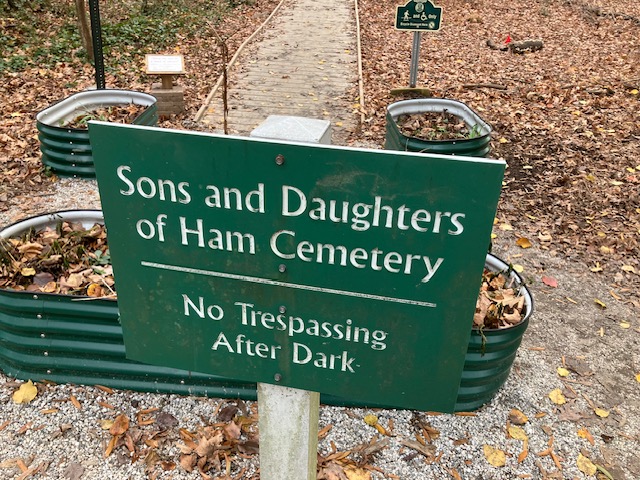
This morning, about twenty volunteers had assembled to work on an erosion project.
In the past, I and other members from Trinity United Methodist Church had volunteered for cleanup days at two other African-American cemeteries—Evergreen and Woodland. Evergreen and Woodland are sprawling properties with many grave markers very visible.
The Sons and Daughters of Ham Cemetery doesn’t sprawl. Grave markers are hard to spot to the untrained eye, and that’s where the skills of archaeologist, Tim Roberts, become valuable.
At the entry path off Chandler Drive, Brooke Davis from the cemetery’s board and Tim circled up the volunteers.
Tim has been responsible for conducting quite a bit of research about the cemetery. In getting to know the property, Tim has focused on the obvious above ground finds, but also those undisturbed items buried in the soil.
Through his work, and with the advance of technology, Tim has discovered previously unmarked graves. Additionally, he has given us a snapshot of how the property was originally plotted out with buildings, paths, and roads. His gentle probing into the earth has helped to confirm that we still have much to learn about this historic cemetery.
But this morning, our goal was to construct wattles. Down from the contours of Bandy Field, the cemetery has a steep incline. When heavy rains pound this slope, rainwater pushes anything in its way down the hillside. Through the board’s leadership, a grant was secured to construct the wattles.
With Tim and Brooke leading, we took the short walk to the construction site. A diagram showed us the points down the hill where the wattles would be built.
A wattle is a type of barrier that helps to slow erosion created by water runoff. Those rectangular bales of straw you’ve seen outlining a construction site are a type of wattle.
For our purposes, volunteers will be accessing adjoining University of Richmond property to locate fallen trunks and large limbs from trees. These pieces will form the foundation of the wattles.
For two hours, a team of us scoured the woods. We carried logs and tree limbs to a drop zone where another team worked on placing our finds.
As the wood debris was placed to form the foundational barrier, another team was using the shovels and wheelbarrows to dump a mixture of soil on top of the wooden wattles.

At some point in the future, when the soil layer reaches an appropriate depth, another crew will carefully plant shrubs. These planting will enhance the aesthetics of the grounds, but more importantly, the plants will help to keep the wattles in place and curtail future erosion.
By noon, we could start to see our progress.
Since 2017, lots of progress has been made in uncovering the cemetery. This transformation is linked to Richmonder, Marianne Rollings, who has become the steady spirit for the recovery and restoration of the cemetery.
All kinds of skirmishes have taken place on its grounds, and Mrs. Rollings knows every square inch of that history. It is a history that deserves to be preserved and maintained for our present time and into the future.
No matter the location, properly maintaining these African-American cemeteries is always a work in progress. From late spring into early fall, keeping ahead of the weeds is a challenge. The weeds love covering up history.
I hope we find the commitment and determination to keep the weeds under control. And while money is essential in sustaining the cemeteries, the real key is having enough volunteers.
Just as the foundation of the wattles depends upon the strength of those intertwined connections, maybe the current leaders of the African-American cemeteries throughout Richmond can find the way to collectively “wattle” their community resources and volunteers.
How might working together create a more sustainable supply of resources and volunteers for the cemeteries?
I enjoyed every minute on Saturday morning at the Sons and Daughters of Ham Cemetery.
But, I tell you what I enjoyed the most was the diversity and demographics of the people who showed up to help.
Who knows, maybe constructing a wattle can help me understand the layers of the barriers that often set us apart.

 might be baloney